

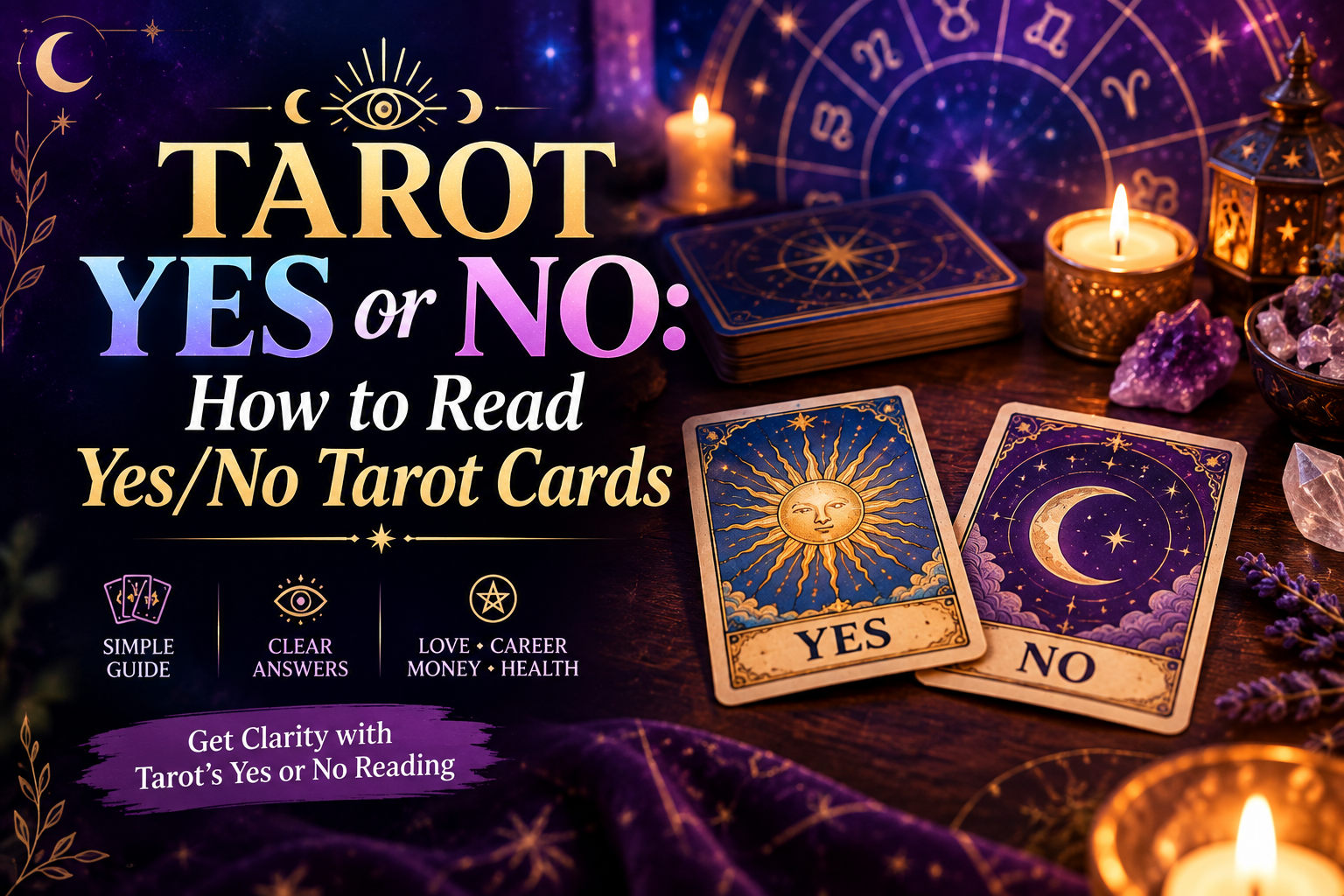
Sometimes you don’t want a complicated Tarot spread.
You have one question in your mind:
Will this relationship work?
Should I take this opportunity?
Is it the right time to make this decision?
That’s where a Tarot yes or no reading can feel appealing. Instead of interpreting a large spread, you can draw one or a few cards and explore whether the situation appears favourable, unfavourable, or conditional.
However, Tarot isn’t a guaranteed prediction machine. A card can reflect the current circumstances, patterns, possibilities, and choices surrounding a question. Biddy Tarot also notes that Yes/No readings can become limiting when they reduce a complex situation to a single word.
So, the goal isn’t simply to ask:
“Is the answer yes or no?”
A better approach is:
“What does this card show me about the situation, and what should I understand before I decide?”
In this guide, you’ll learn how Tarot yes or no readings work, how to ask clearer questions, which cards often lean toward yes or no, how to use one-card and three-card methods, and how to avoid common mistakes.
What Is a Tarot Yes or No Reading?
A Tarot yes or no reading is a simple reading method designed around a question with two possible directions.
For example:
- Should I accept this opportunity?
- Is this relationship moving in a healthy direction?
- Should I contact this person?
- Is now a good time to start something new?
- Should I continue pursuing this goal?
Instead of using a large spread, you can draw one card and interpret its overall energy in relation to your question.
However, there isn’t one universal rule saying that every Tarot card is permanently “yes” or “no.”
The same card can communicate something different depending on the question.
For instance, Six of Swords might suggest moving forward in one situation, while in another reading it could indicate leaving something behind.
That’s why context matters.
Biddy Tarot describes several approaches, including upright/reversed cards, personal Yes/No/Maybe categories, favourable/unfavourable language, conditional “Yes, if…” answers, and interpreting the card directly within the question.
Can Tarot Really Give a Yes or No Answer?
It can be used for Yes/No-style reflection, but it’s better not to treat the result as an unchangeable prediction.
Your circumstances can change.
Your decisions can change.
Other people’s decisions can change.
Therefore, a Tarot card drawn today doesn’t have to represent a fixed future.
Instead, think of the answer as a current direction or reflection point.
For example:
“Is this a good time to have an honest conversation?”
A card may suggest openness, hesitation, conflict, patience, or preparation.
That information can be more useful than simply hearing “yes.”
In fact, Biddy Tarot argues that the deeper value of Tarot often comes from exploring the influences and actions underneath a Yes/No question.
How to Ask a Good Tarot Yes or No Question
The quality of the question matters.
A vague question can produce a vague interpretation.
Compare these:
Less useful
“Will I be happy?”
That’s extremely broad.
Clearer
“Is this relationship likely to support my emotional wellbeing over the next three months?”
The second question gives the reading a clearer subject and timeframe.
Current Yes/No Tarot guides also commonly recommend specific questions and defined timeframes because they reduce ambiguity.
Use These 5 Rules
1. Ask about one thing
Don’t combine multiple questions.
Instead of:
“Will my ex come back and will we get married and will everything be okay?”
Separate them.
2. Make the question specific
Instead of:
“Will things work out?”
Try:
“Is this relationship moving toward greater stability?”
3. Add a timeframe when useful
For example:
“Is this likely to improve within the next three months?”
4. Avoid leading questions
Instead of:
“Does my partner secretly love me?”
Try:
“What should I understand about the emotional direction of this relationship?”
5. Ask something you can actually reflect on
A good Tarot question should help you understand your situation rather than simply encourage endless reassurance-seeking.
One-Card Tarot Yes or No Reading
The simplest method is the one-card reading.
Step 1: Clear your question
Write your question down or say it quietly.
For example:
“Should I have this conversation this week?”
Step 2: Shuffle your deck
Focus on the question while shuffling.
There’s no need to keep shuffling indefinitely.
Step 3: Draw one card
Place the card face-up.
Step 4: Look at the card before searching for its meaning
Notice:
- Your first emotional reaction
- The imagery
- The main symbols
- The mood
- Whether the card feels open or blocked
- What immediately stands out
Step 5: Decide the direction
You can interpret the card as:
Yes
No
Maybe
or:
Favourable
Unfavourable
Conditional
The final approach is often more flexible than forcing every card into a strict yes/no category.
Tarot Yes or No: Yes, No and Maybe
One useful approach is to create three categories.
Yes Cards
These cards may suggest openness, movement, growth, harmony, or favourable conditions.
Examples can include:
- The Sun
- The World
- The Star
- Ace of Wands
- Ace of Cups
- Two of Cups
- Six of Wands
However, don’t automatically interpret every appearance as a guaranteed “yes.”
The question still matters.
No Cards
Some cards can suggest blockage, endings, conflict, delays, or circumstances that aren’t currently supportive.
Examples may include:
- Ten of Swords
- Five of Pentacles
- Eight of Swords
- The Tower
- Three of Swords
Again, these are interpretive tendencies, not universal rules.
The Tower, for example, could represent disruption in one question but necessary change in another.
Maybe Cards
Some cards naturally encourage a more conditional interpretation.
Examples include:
- Seven of Cups
- Two of Swords
- The Hanged Man
- Wheel of Fortune
- Moon
These cards can suggest uncertainty, delay, hidden information, competing possibilities, or circumstances that are still changing.
In such situations, “not yet” or “it depends” may be more useful than forcing a yes/no answer.
The “Yes, If…” Tarot Method
This is one of the most useful ways to make a Tarot yes or no reading more practical.
Instead of saying:
“Yes.”
Ask:
“Yes, if what?”
For example, suppose you ask:
“Will I succeed with this new project?”
You draw Seven of Pentacles.
Rather than declaring:
“Yes, you will succeed.”
you might reflect:
“This looks more favourable if you’re willing to be patient, continue investing effort, and allow the results to develop over time.”
Now the reading gives you something actionable.
You can also ask:
“What could make this outcome less favourable?”
That turns the reading into a conversation with yourself rather than a fixed prediction.
Biddy Tarot specifically discusses conditional “Yes, if…” and “No, if…” interpretations as a way to preserve the flexibility of Tarot.
How to Read Tarot Cards for Yes or No
Don’t look only at a memorised keyword.
Read the card in layers.
Layer 1: Basic meaning
What does the card traditionally represent?
Layer 2: Question
How does that meaning relate to what you actually asked?
Layer 3: Direction
Does the situation appear to be moving toward the desired outcome, away from it, or nowhere yet?
Layer 4: Condition
What needs to happen for the situation to develop?
Layer 5: Your response
What can you personally do with the insight?
This method creates a much richer reading than simply memorising:
Sun = Yes
Tower = No
Tarot Yes or No With Reversed Cards
If you read reversals, you can incorporate them into your Yes/No method.
One simple system is:
Upright = Yes
Reversed = No
This is easy for beginners, and Biddy Tarot describes it as one possible technique.
However, it isn’t a universal Tarot rule.
Another approach is to interpret the reversal according to the card itself.
For example, a reversed card might suggest:
- Delay
- Internal resistance
- Blocked energy
- Misunderstanding
- Something developing privately
- A need to reconsider the situation
Therefore, don’t assume that every reversed card automatically means “no.”
Choose your method before the reading and apply it consistently.
A 3-Card Tarot Yes or No Spread
If one card doesn’t give you enough context, try three cards.
Card 1 – Current Energy
What is happening around the situation right now?
Card 2 – What Supports the Outcome
What is helping the situation move forward?
Card 3 – What Could Block the Outcome
What challenge or condition should you understand?
This spread is especially useful because it doesn’t force the cards to produce three separate yes/no answers.
Instead, you receive context.
5 Tarot Cards Often Associated With “Yes”
These cards can often feel encouraging in Yes/No readings, although their interpretation depends on the question.
The Sun
Often associated with clarity, vitality, optimism and openness.
For a question about moving forward, it may suggest favourable circumstances.
The Star
Often associated with hope, renewal and faith.
It can encourage patience and continued trust in the process.
The World
Can represent completion, achievement and reaching an important stage.
Ace of Cups
Often connected with emotional openness, new feelings and fresh emotional beginnings.
Two of Cups
Often associated with mutual connection, partnership and emotional exchange.
These interpretations should be treated as starting points rather than fixed answers.
5 Tarot Cards That May Suggest “No” or “Not Yet”
Some cards can point toward resistance, delay or circumstances that require reconsideration.
Eight of Swords
May suggest feeling restricted or trapped by your current perspective.
Three of Swords
Can point toward emotional pain, difficult truths or disappointment.
Five of Pentacles
May indicate hardship, insecurity or feeling unsupported.
Ten of Swords
Can represent an ending, exhaustion or the completion of a difficult cycle.
The Tower
May indicate sudden disruption or the breakdown of an unstable situation.
However, “No” isn’t always the only possible interpretation.
For example, The Tower could mean “not in the way you currently expect” rather than simply “never.”
What If the Tarot Gives a Confusing Answer?
Don’t immediately pull another card.
This is one of the biggest mistakes beginners make.
You receive a card you don’t understand.
So you pull another.
That card creates another question.
You pull another.
Eventually, you have five cards saying five different things.
Instead, pause.
Ask yourself:
What part of this card am I finding difficult to accept or understand?
Then return to the original question.
You may discover that the card wasn’t actually confusing.
Your expectations were.
Biddy Tarot also advises discipline around repeated draws rather than continuing to pull cards simply because you dislike the first answer.
Should You Keep Pulling Clarifier Cards?
Usually, don’t pull clarifiers immediately.
First interpret the original card.
If you still genuinely need more context, use a structured second position.
For example:
Card 1: What is the current direction?
Card 2: What condition affects this?
This is better than repeatedly asking:
“But is it really yes?”
Repeatedly pulling cards can turn a reflective practice into reassurance-seeking.
Tarot Yes or No for Love Questions
Love is one of the most common areas where people use Yes/No Tarot.
You might ask:
- Will this relationship become more serious?
- Should I contact my ex?
- Is this connection worth pursuing?
- Is there potential for reconciliation?
- Should I give this relationship more time?
- Is this relationship emotionally healthy for me?
Instead of asking only:
“Does my ex want me back?”
consider:
“What should I understand about the possibility of reconnecting with my ex?”
The second question gives you room to explore the situation rather than trying to access another person’s private thoughts.
If you’re dealing with relationship uncertainty, you can also explore our guide to Tarot for Relationship Clarity.
Tarot Yes or No for Career Questions
You can use the same approach for work-related decisions.
For example:
“Is this a favourable time to apply for this position?”
A card suggesting movement and opportunity may encourage action.
A card suggesting delay may encourage preparation.
A card suggesting confusion may tell you that you need more information before deciding.
The useful part isn’t simply the word “yes.”
It’s understanding:
What should I consider before I act?
Tarot Yes or No for Big Life Decisions
Tarot can also be used as a reflective tool when you’re considering major changes.
For example:
- Moving to another city
- Starting a new project
- Ending a pattern
- Beginning a relationship
- Having an important conversation
- Changing your routine
However, Tarot shouldn’t replace professional advice for medical, legal, financial, or other high-stakes decisions.
Instead, use it to explore your own thoughts, concerns and priorities.
7 Common Tarot Yes or No Mistakes
1. Asking the same question repeatedly
This usually creates more confusion rather than clarity.
2. Changing the question after seeing the card
Don’t rewrite the question simply to get a more desirable answer.
3. Treating Tarot as absolute prediction
A reading reflects an interpretation of the present situation, not an unchangeable future.
4. Ignoring the actual card meaning
Don’t memorise a list of “yes cards” and stop there.
5. Pulling too many cards
More cards don’t automatically mean more clarity.
6. Asking two questions at once
For example:
“Will my ex come back and will we get married?”
Those are two separate questions.
7. Using Tarot instead of real-world communication
If your question concerns another person’s behaviour, direct communication and observable actions are still important.
Better Questions to Ask Tarot
Instead of:
“Will they text me?”
Try:
“What should I understand about the communication between us?”
Instead of:
“Will we get married?”
Try:
“What is influencing the long-term potential of this relationship?”
Instead of:
“Will I get the job?”
Try:
“What should I focus on to improve my chances with this opportunity?”
Instead of:
“Will my ex come back?”
Try:
“What do I need to understand before considering reconciliation?”
This approach keeps Tarot focused on reflection and action.
Tarot Yes or No vs a Full Tarot Reading
A Yes/No reading has one major advantage:
It’s simple.
You can answer a narrowly framed question with one card.
However, a full Tarot reading provides more context.
| Tarot Yes/No | Full Tarot Reading |
|---|---|
| Quick | More detailed |
| Usually 1–3 cards | Can use larger spreads |
| Focuses on direction | Explores the bigger picture |
| Easy for beginners | Requires more interpretation |
| Good for simple questions | Better for complicated situations |
| Can feel very direct | Allows more nuance |
If your question contains several emotional or practical layers, a larger spread may provide more useful reflection.
A Simple 5-Minute Tarot Yes or No Practice
Want to improve your reading skills?
Try this exercise.
Minute 1 – Write one question
Make it specific.
Minute 2 – Shuffle
Focus on the question without trying to predict the answer.
Minute 3 – Draw one card
Look at the imagery before checking a guidebook.
Minute 4 – Write your interpretation
Record:
- Yes / No / Maybe
- Why?
- What condition?
- What action could I take?
Minute 5 – Journal
Write one sentence:
“What is this card helping me notice?”
This practice can help you develop a more intuitive relationship with your deck.
If you want to strengthen your Tarot intuition further, see our guide on how to develop intuition with Tarot.
Final Thought
A Tarot yes or no reading doesn’t have to be about receiving a perfect prediction.
Sometimes the most useful card isn’t the one that gives you the answer you hoped for.
It is the one that makes you stop and look at the situation differently.
Ask one clear question.
Draw intentionally.
Read the card in context.
Then consider what the insight means for your own choices.
If the answer feels uncertain, don’t automatically pull another card. Sometimes “maybe,” “not yet,” or “yes, if…” contains more useful information than a simple yes or no.
Tarot becomes more meaningful when you use it not only to ask “What will happen?”, but also:
“What do I need to understand, and what can I do next?”
FAQs
1. What is a Tarot yes or no reading?
A Tarot yes or no reading is a simple method where Tarot cards are used to explore a question with a yes, no, maybe, or conditional direction.
2. What Tarot card means yes?
Cards such as The Sun, The World, The Star, Two of Cups and some Aces can often be interpreted positively. However, there is no universal list where every card always means yes.
3. What Tarot card means no?
Cards such as Ten of Swords, Three of Swords, Five of Pentacles and The Tower may suggest difficulty, endings or resistance depending on the question. Context matters.
4. Can one Tarot card answer a yes or no question?
Yes. A one-card reading is one of the simplest methods. However, the card can provide more useful information when you interpret its meaning and circumstances rather than treating it as a mechanical yes/no button.
5. Should I use reversed Tarot cards for yes or no?
You can. One method treats upright cards as yes and reversed cards as no. However, this is a reading technique rather than a universal Tarot rule.
6. Can I ask Tarot the same question twice?
It’s better not to repeatedly ask the same question simply because you dislike the first answer. If you revisit it later, consider whether the circumstances or timeframe have genuinely changed.
7. Is Tarot yes or no accurate?
Tarot isn’t a guaranteed prediction system. A Yes/No reading can be used as a reflective practice for exploring the current situation, patterns and choices.