

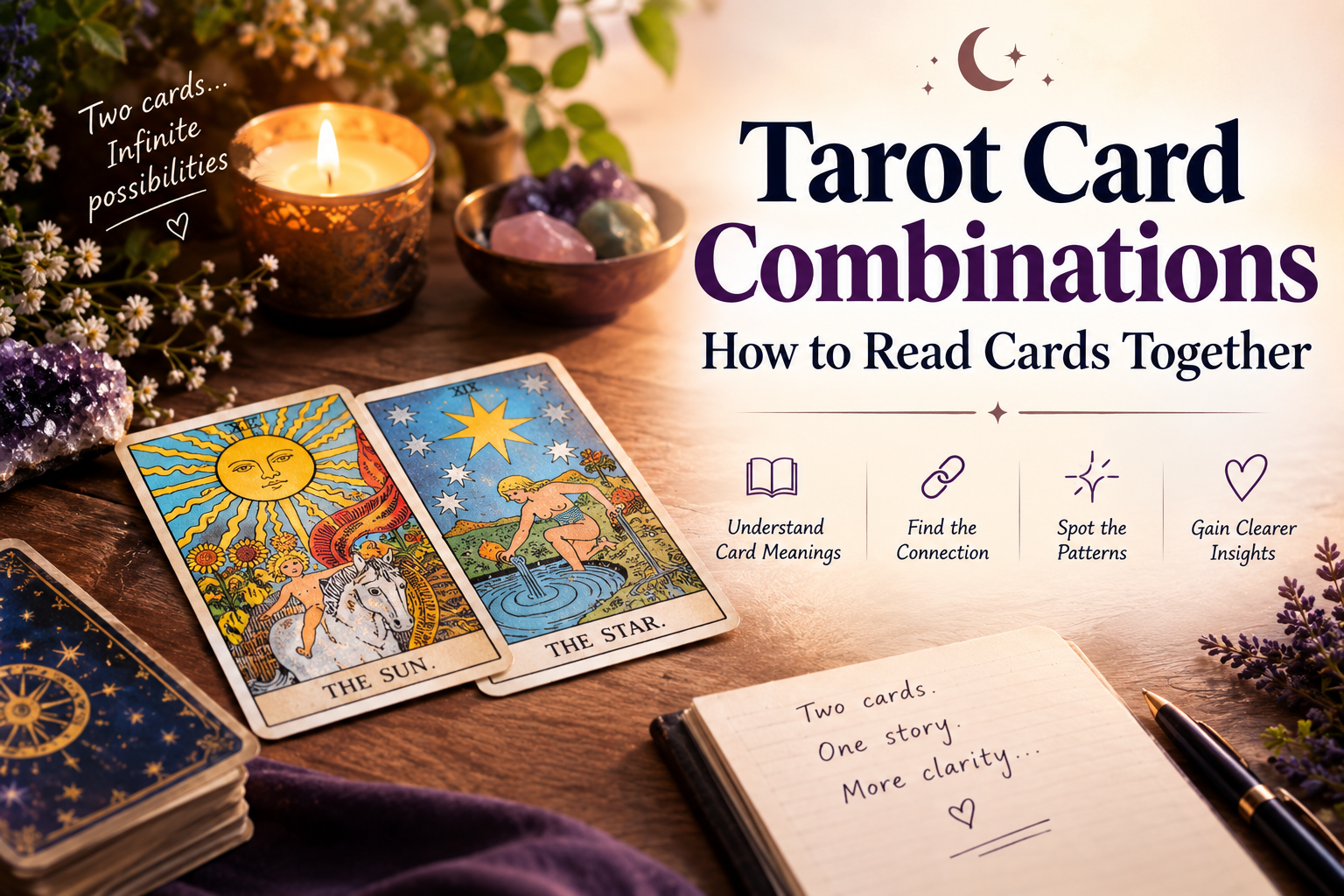
Knowing the meaning of individual Tarot cards is only the beginning.
Eventually, you will pull two or more cards and realise that the real message isn’t contained in one card alone.
Perhaps you draw The Lovers + The Devil.
Or The Hermit + The Star.
Maybe you receive Two of Cups + Eight of Cups.
Instead of reading each card separately and stopping there, you can ask:
“What story are these cards telling together?”
That’s where Tarot card combinations become especially useful.
A card can take on a different emphasis when it appears beside another card. Biddy Tarot explains that card combinations can be explored through keywords, numerology, symbolism, elements, interactions between figures, and the flow from one card to another.
You don’t need to memorise hundreds or thousands of Tarot pairs.
In fact, learning a few simple techniques can help you interpret combinations more naturally and confidently.
What Are Tarot Card Combinations?
Tarot card combinations are two or more cards interpreted together rather than as completely separate meanings.
For example:
Two of Cups + Eight of Cups
Individually:
- Two of Cups → connection, partnership, emotional exchange
- Eight of Cups → leaving, emotional distance, moving on
Together, the cards could suggest a story about a relationship that once had emotional connection but is now going through a period of separation or departure.
The exact interpretation depends on:
- The question
- The spread position
- The surrounding cards
- Upright or reversed cards
- The imagery
- Your intuitive response
- The situation being explored
Therefore, there isn’t necessarily one fixed meaning for every pair.
Labyrinthos similarly describes Tarot reading as putting the meanings together into a larger story rather than treating every card as isolated.
Why Should You Learn Tarot Card Combinations?
Reading individual cards can feel relatively straightforward.
Reading combinations is where Tarot starts becoming more conversational.
For example:
The Hermit
might suggest solitude or introspection.
The Star
might suggest hope, healing or renewal.
Together, the cards may suggest that stepping back and spending time alone could create space for renewed hope or emotional clarity.
The second card doesn’t simply repeat the first.
It changes the story.
That’s why learning combinations can help you:
- Read two-card spreads
- Understand larger Tarot spreads
- Avoid memorising endless meanings
- Develop your intuition
- Notice repeating themes
- Connect cards into a narrative
- Give more contextual readings
Do You Need to Memorise Every Tarot Card Combination?
No.
This is one of the biggest misconceptions beginners have.
A standard 78-card Tarot deck can produce thousands of possible two-card combinations.
Trying to memorise every possible pair would make Tarot unnecessarily difficult.
Biddy Tarot specifically points out that there are more than 3,000 possible two-card combinations and recommends learning techniques for interpreting them instead of memorising them individually.
Think of Tarot like learning a language.
You don’t memorise every possible sentence.
You learn words, grammar and context.
Then you create meaning.
Tarot works similarly.
The 7 Best Ways to Read Tarot Card Combinations
1. Combine the Keywords
The easiest method is to start with one or two keywords for each card.
For example:
High Priestess
→ intuition, mystery, inner knowledge
Eight of Pentacles
→ practice, skill, dedication
Put them together:
Intuitive skill developed through practice.
That’s already a meaningful interpretation.
Biddy Tarot recommends keywords and phrases as one of the simplest approaches to combining cards.
Another example
Ace of Wands
→ new idea, inspiration, beginning
Three of Pentacles
→ teamwork, skill, collaboration
Together:
A new idea developing through collaboration.
You don’t need a complicated system.
Start simple.
2. Look for a Story Between the Cards
Instead of asking:
“What does Card 1 mean?”
and then:
“What does Card 2 mean?”
ask:
“What is happening between these two cards?”
Imagine:
The Fool + The Chariot
The Fool can represent a new beginning.
The Chariot can represent determination, direction and forward movement.
Together, you could read the pair as:
Starting a new journey and then taking deliberate control of its direction.
Now the cards feel like a sentence.
This storytelling approach is also discussed by Biddy Tarot, which suggests looking at the story, directionality and flow between cards.
3. Pay Attention to the Numbers
Numbers can add another layer to your interpretation.
For example:
Two of Cups + Two of Wands
Both cards contain the number Two.
That repeated number may make themes such as:
- Partnership
- Choices
- Duality
- Balance
- Planning
- Two different possibilities
more noticeable.
Biddy Tarot’s combination guide also recommends looking at numerology and repeated numbers when cards appear together.
You don’t need to become an expert in numerology immediately.
Simply notice repetition.
Ask:
“Is the same number appearing more than once?”
4. Look at the Tarot Suits
The four Minor Arcana suits can provide another layer.
| Suit | Common themes |
|---|---|
| Cups | Emotions, relationships, feelings |
| Wands | Passion, creativity, action |
| Swords | Thoughts, communication, conflict |
| Pentacles | Work, money, practical matters |
Now imagine you receive:
Queen of Cups + King of Swords
You have:
Cups → emotions
and
Swords → thoughts and communication
One possible theme becomes:
Balancing emotional understanding with rational communication.
Biddy Tarot similarly suggests combining the elemental associations of the suits when interpreting Minor Arcana combinations.
5. Notice Repeating Elements
The suits can also be associated with elements:
- Cups → Water
- Wands → Fire
- Swords → Air
- Pentacles → Earth
When two cards share the same suit, that theme may become stronger.
For example:
Three of Cups + Queen of Cups
Both are Cups.
The reading may therefore place stronger emphasis on:
- Feelings
- Emotional connection
- Relationships
- Social connection
- Compassion
By contrast, two different suits can create an interesting tension.
For example:
Ace of Swords + Ace of Cups
You have:
Swords → thought
Cups → emotion
The combination may invite reflection on the relationship between head and heart.
6. Look at the People in the Cards
This technique is especially useful in relationship readings.
Suppose your cards contain two people.
Look at their body language.
Are they:
- Facing each other?
- Looking away?
- Moving toward each other?
- Moving apart?
- Sitting together?
- Standing separately?
Visual direction can add another layer to the reading.
Biddy Tarot specifically discusses observing how figures interact, where they are looking, and how their direction can contribute to the combined interpretation.
For example:
Two of Cups + Eight of Cups
If you visually experience one card as connection and the next as departure, the sequence itself can create a story:
Connection → emotional withdrawal → movement away.
The cards don’t need a memorised combination meaning.
You’re reading the relationship between the images.
7. Read the Flow From Left to Right
The order of the cards matters.
Imagine:
Eight of Cups → Two of Cups
This could suggest moving away from one emotional chapter and toward another connection.
Now reverse them:
Two of Cups → Eight of Cups
The story changes.
Now you could read it as:
A relationship or emotional connection leading toward withdrawal or departure.
Biddy Tarot also highlights the importance of flow and sequence when reading combinations.
So when you pull multiple cards, don’t immediately rearrange them.
Look at the order they appeared in.
Tarot Card Combinations Examples
Let’s put these techniques into practice.
The Lovers + The Devil
The Lovers can relate to relationships, choices, values and alignment.
The Devil can relate to attachment, temptation, desire or unhealthy patterns.
Together, the pair may suggest:
A powerful connection where desire, attachment or difficult choices need closer examination.
This doesn’t automatically mean a “bad relationship.”
Context matters.
Labyrinthos similarly describes this pairing as potentially involving love, desire, choices and the tension between connection and attachment.
The High Priestess + Justice
The High Priestess is commonly associated with intuition and inner knowledge.
Justice relates to truth, fairness and accountability.
Together:
Use intuition alongside clear facts and honest judgment.
This can be especially interesting when someone is trying to make an emotionally complicated decision.
Labyrinthos interprets this combination around balancing intuition with logic, fairness and clarity.
The Tower + The Chariot
The Tower can represent sudden disruption or major change.
The Chariot can represent determination, direction and taking control.
Together:
A major disruption may require deliberate action and a strong sense of direction.
Labyrinthos similarly interprets this combination through themes of upheaval followed by determination and taking charge.
Death + The Emperor
Death is often associated with transformation and endings.
The Emperor can represent structure, authority and stability.
Together:
A major transformation may require rebuilding structure or taking greater responsibility.
The combination doesn’t necessarily mean something negative.
Sometimes an ending creates space for a stronger structure.
The Star + The Hermit
The Hermit can represent introspection and stepping back.
The Star can represent hope, renewal and healing.
Together:
Solitude and reflection may create space for renewed hope.
This is a good example of why combinations can produce a richer message than simply reading two individual keywords.
How to Read Tarot Card Combinations in Love Readings
Relationship readings are where card combinations become particularly interesting.
Instead of asking only:
“What does this card mean for love?”
look at the interaction.
For example:
Two of Cups + Six of Pentacles
Possible theme:
Mutual emotional exchange + balanced giving and receiving.
Five of Cups + Eight of Cups
Possible theme:
Emotional disappointment + moving away from what is no longer fulfilling.
Lovers + Justice
Possible theme:
Relationship choice + honesty, accountability and values.
Devil + Two of Cups
Possible theme:
Strong attraction + a need to examine attachment or relationship patterns.
These are interpretive examples, not guaranteed predictions.
The question and surrounding cards always matter.
How to Read Three Tarot Cards Together
Once you’re comfortable with two cards, move to three.
A simple structure is:
Card 1 — Situation
What is happening?
Card 2 — Challenge
What is complicating the situation?
Card 3 — Direction
What should I understand about the way forward?
For example:
The Hermit → Two of Swords → The Star
You could read the sequence as:
Reflection → uncertainty → renewed clarity or hope.
Notice how the cards form a story.
You aren’t reading three isolated dictionary definitions.
You’re connecting them.
A Simple 3-Card Relationship Combination
Try this spread:
Card 1 — My energy
How am I approaching the relationship?
Card 2 — Relationship dynamic
What pattern is currently present?
Card 3 — What I need to understand
What perspective could help me move forward?
This keeps the reading reflective rather than attempting to claim certainty about another person’s private thoughts.
If you’re specifically exploring relationship confusion, you can also read Tarot for Relationship Clarity.
What If Two Tarot Cards Seem to Contradict Each Other?
Don’t panic.
Contradiction can actually create useful information.
Imagine:
The Sun + The Moon
The Sun can represent clarity and openness.
The Moon can represent uncertainty, intuition and things that aren’t fully visible.
Instead of choosing one card and ignoring the other, ask:
“Where is the tension?”
Perhaps the situation has both:
- Something becoming clear
- Something remaining uncertain
That’s much more realistic than forcing the cards to agree.
A Tarot reading doesn’t always have to give one simple message.
Sometimes the tension is the message.
How to Read Difficult Tarot Combinations
Don’t automatically assume that a difficult-looking card means something terrible.
For example:
Death + The Star
Death can represent an ending or transformation.
The Star can represent hope and renewal.
Together, you might interpret the pair as:
An ending creating space for healing and a new direction.
Likewise:
Tower + Sun
could suggest:
A sudden revelation bringing clarity.
The meaning depends on the relationship between the cards.
That’s why learning combinations can help you move beyond simplistic “positive card” and “negative card” interpretations.
Tarot Card Combinations and Reversed Cards
If you use reversed Tarot cards, combinations can become even more nuanced.
For example:
Nine of Cups + Queen of Swords reversed
The first card may suggest satisfaction or emotional fulfilment.
The reversed Queen of Swords may introduce themes such as distorted communication, defensiveness or unclear judgment.
Instead of automatically labelling the pair “good” or “bad,” ask:
“How does the reversal change the flow of the reading?”
You can also compare:
Both upright
versus:
One upright + one reversed
versus:
Both reversed
Biddy Tarot discusses these combinations as another layer readers can explore after becoming comfortable with basic pairings.
The Biggest Mistake: Reading Every Card Separately
Imagine you pull:
The Fool + The Chariot + The World
A beginner might write:
- Fool = new beginning
- Chariot = determination
- World = completion
Then stop.
But there’s a story here:
A new beginning → determined movement → completion of a journey.
That’s much more powerful.
Your job isn’t simply to know what each card means.
Your job is to understand how the cards speak to each other.
A 5-Step Method for Any Tarot Card Combination
Whenever you’re stuck, use this process.
Step 1 — Identify the main keyword
Give each card one simple word.
Step 2 — Find the connection
Ask what the two keywords have in common.
Step 3 — Look for contrast
Are the cards showing opposite energies?
Step 4 — Observe the imagery
Look at people, direction, colours, symbols and movement.
Step 5 — Create one sentence
Turn the pair into a simple story.
For example:
High Priestess + Eight of Pentacles
Keywords:
Intuition + practice
Combined sentence:
Developing intuitive skills through consistent practice.
That’s your Tarot combination interpretation.
10 Questions to Ask When You Pull Two Tarot Cards
If you don’t know how to combine your cards, ask:
- What does each card represent?
- What theme do both cards share?
- Do the cards support each other?
- Do they contradict each other?
- Is one card explaining the other?
- Are the numbers repeated?
- Are the suits connected?
- Are the figures facing each other?
- Is there a movement from one card to the next?
- What single sentence describes both cards together?
These questions can turn a confusing pair into a readable story.
Practice Exercise: Learn Tarot Combinations in 10 Minutes
You don’t need a complicated spread.
Take your Tarot deck and draw two cards.
Write down:
Card 1:
One keyword.
Card 2:
One keyword.
Then ask:
“What happens when these two ideas meet?”
Write one sentence.
For example:
Hermit → reflection
Star → hope
Combined:
Reflection creates space for renewed hope.
Draw another pair.
Repeat.
After ten minutes, review your interpretations.
You’ll start noticing how your understanding of the cards becomes more flexible.
Biddy Tarot also recommends practising with random two-card pairs and using different techniques to build confidence in combination reading.
Tarot Card Combinations vs Individual Card Meanings
| Individual cards | Card combinations |
|---|---|
| Focus on one card | Connect multiple cards |
| Easier for beginners | Requires more interpretation |
| Uses basic keywords | Uses context and relationships |
| Can feel fixed | More flexible |
| Good for learning foundations | Good for telling a story |
| Limited context | Richer overall message |
You need both skills.
Learn individual cards first.
Then learn how they interact.
Can Tarot Card Combinations Predict the Future?
Tarot combinations shouldn’t be treated as guaranteed predictions.
They can be used as a reflective framework for exploring:
- Current patterns
- Emotional themes
- Possible directions
- Personal choices
- Relationship dynamics
- Areas requiring attention
A combination may suggest a particular theme, but your actions and circumstances still matter.
For that reason, a useful Tarot reading should leave you with clarity and reflection, not the belief that your future is permanently fixed.
Final Thought
Learning Tarot card combinations is one of the best ways to move from memorising Tarot meanings to actually reading Tarot.
You don’t need to know the official meaning of every possible pair.
Start with the basics:
Keywords.
Numbers.
Suits.
Symbols.
Body language.
Contrast.
Flow.
Then turn those observations into a story.
When two cards appear together, don’t immediately ask:
“What does this combination mean?”
Instead, ask:
“What are these two cards saying to each other?”
That small change can make your readings feel more natural, intuitive and personal.
And remember: Tarot is most useful when it helps you reflect on your situation and choices rather than replacing your own judgment.
FAQs
1. What are Tarot card combinations?
Tarot card combinations are two or more Tarot cards interpreted together rather than individually. The cards can create a combined theme, story, contrast or progression.
2. How do I read two Tarot cards together?
Start with one or two keywords for each card. Then look for shared themes, contrasts, numbers, suits, imagery, direction and the flow from the first card to the second.
3. Do I need to memorise Tarot combinations?
No. There are thousands of possible two-card combinations. Learning interpretation techniques is more practical than memorising every possible pair.
4. Can the order of Tarot cards change the meaning?
Yes. Reading cards from left to right can create a sense of progression or movement. Reversing the order can change the story you perceive.
5. What if two Tarot cards contradict each other?
Look at the contradiction instead of choosing one card. The tension between the cards may reveal an important part of the situation.
6. How many cards should I use for a combination reading?
Beginners can start with two cards. Once comfortable, try three cards and gradually experiment with larger spreads.
7. Can Tarot combinations be used for love readings?
Yes. You can use combinations to explore themes such as emotional connection, communication, attraction, boundaries, choices and relationship patterns.
8. What is the most important skill when reading Tarot combinations?
Context. The question, spread position, surrounding cards, imagery and your own interpretation all influence how a combination can be understood.

One thought on “How to Read Tarot Card Combinations: A Beginner’s Guide”