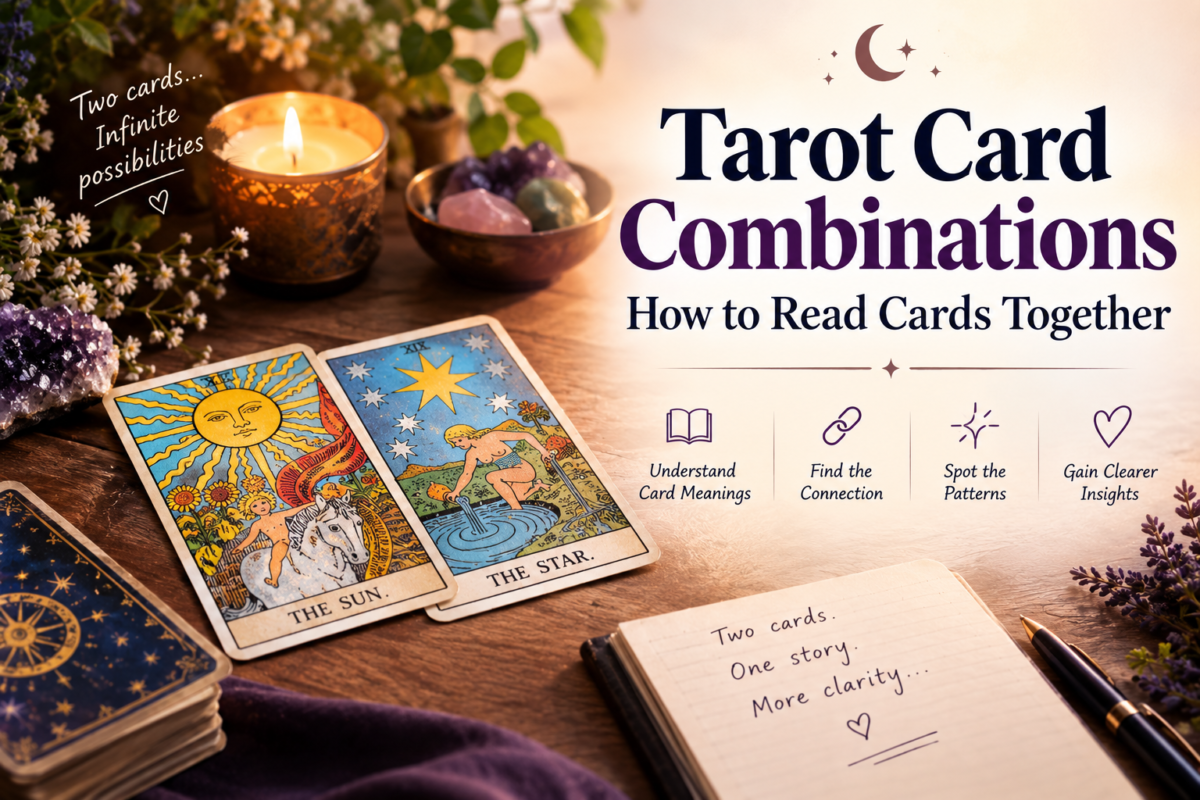


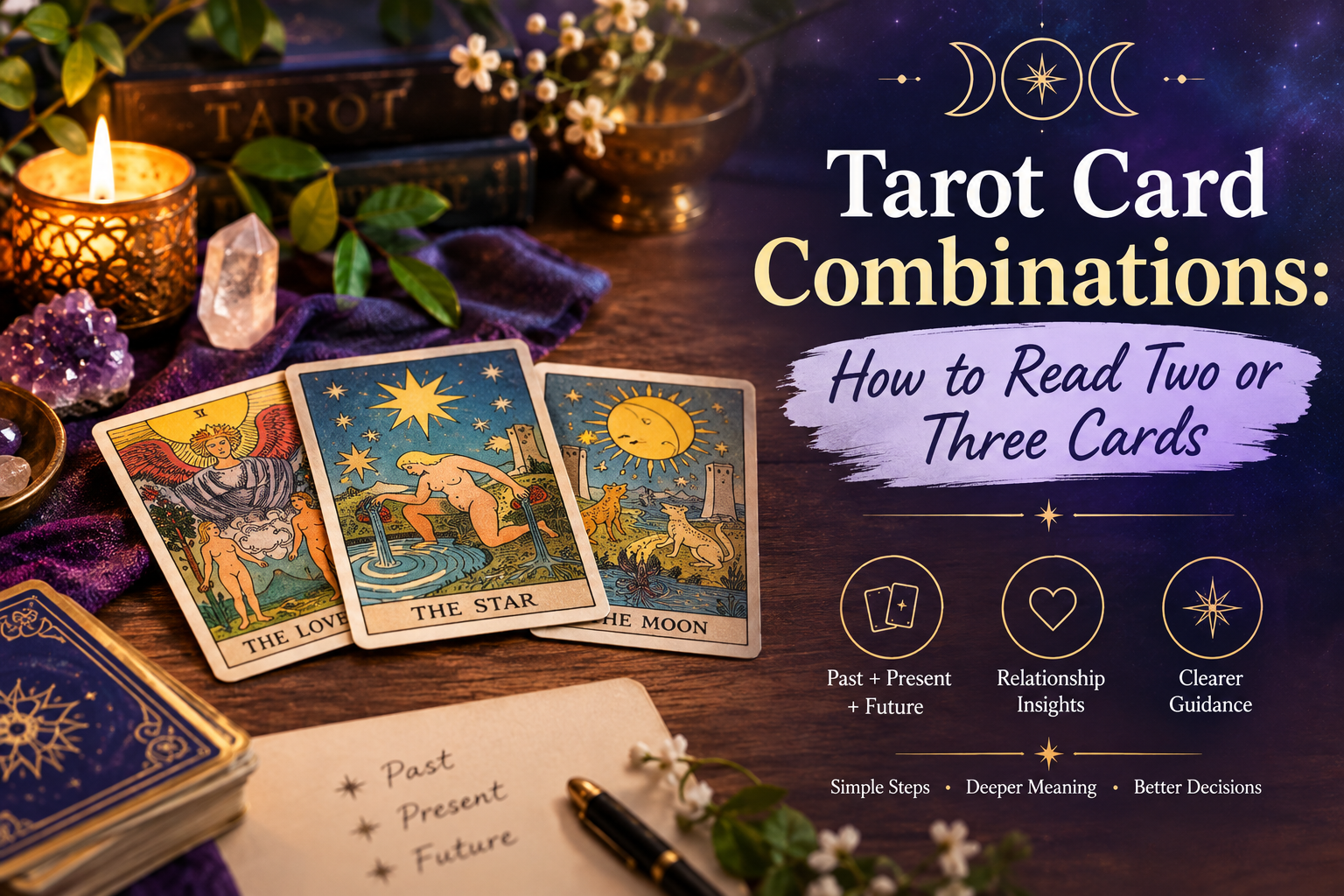
Tarot card combinations help you understand how two or three Tarot cards work together to tell a connected story. A single card may represent a feeling, challenge, opportunity, or decision. However, when you read multiple cards together, you can explore how these themes influence one another.
Imagine drawing The Lovers and The Devil in a relationship reading. The Lovers can represent connection and choices, while The Devil can highlight attachment or unhealthy patterns. Together, they may invite you to examine whether attraction supports a healthy relationship or makes it harder to recognize a problem.
You do not need to memorize thousands of possible combinations. Instead, learn a simple method that helps you connect card meanings, notice patterns, and interpret the message in the context of your question.
In this guide, you will learn how to read two-card Tarot combinations, interpret three-card spreads, understand common card pairings, and practise combining cards with confidence.
What Are Tarot Card Combinations?
Tarot card combinations are two or more cards interpreted together rather than as separate, unrelated meanings.
For example, consider the following cards:
- The Hermit: Reflection, solitude, and inner wisdom.
- The Star: Hope, healing, and renewal.
Separately, these cards have their own meanings. Together, they might suggest that taking time for reflection can help you regain hope or find emotional clarity.
The exact interpretation depends on your question, the spread positions, the surrounding cards, and the imagery you notice. Therefore, a combination does not always have one fixed meaning.
How to Read Two Tarot Cards Together
The easiest way to understand Tarot card combinations is to treat the cards like words in a sentence. Each card contributes an idea, while the connection between them creates the overall message.
Follow these five steps whenever you draw two cards.
Step 1: Identify Each Card’s Main Meaning
Start with one or two keywords for each card. Avoid looking up every possible interpretation because too many details can make your reading confusing.
For example:
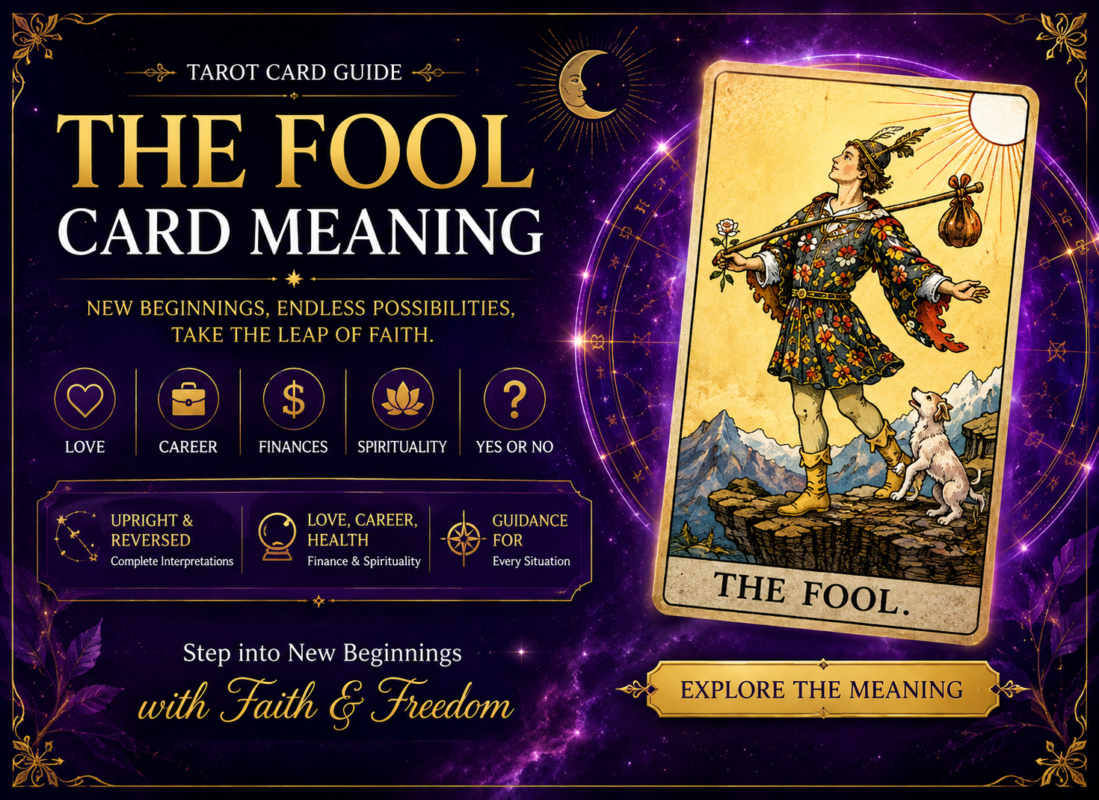
- The Fool: New beginnings, curiosity, and taking a risk.
- The Chariot: Direction, determination, and control.
You now have two ideas to work with: beginning and direction.
Step 2: Find the Relationship Between the Cards
Ask yourself how the two meanings interact. Does one card support the other, create a challenge, or suggest what might happen next?
The Fool and The Chariot could suggest starting a new journey and then taking deliberate control of its direction.
Try describing the relationship with a simple phrase, such as “leads to,” “challenges,” “supports,” or “requires.”
Step 3: Look for Similarities and Contrasts
Some Tarot combinations reinforce the same theme. Others show tension between two different energies.
For example, the Queen of Cups and King of Swords bring together emotional understanding and rational thinking. Their combination may encourage you to balance compassion with clear judgment.
Meanwhile, The Sun and The Moon can represent clarity alongside uncertainty. Instead of choosing one card and ignoring the other, explore what both ideas reveal about the situation.
Step 4: Study the Numbers, Suits, and Images
The cards’ visual details can add another layer of meaning. Notice repeated numbers, similar colours, figures facing each other, or images that suggest movement.
The Minor Arcana suits also provide useful themes:
| Suit | Common themes |
|---|---|
| Cups | Feelings, relationships, and emotional connection |
| Wands | Passion, creativity, and action |
| Swords | Thoughts, communication, and conflict |
| Pentacles | Work, money, resources, and practical matters |
For example, two Cups cards may emphasize emotional matters. A combination of Cups and Swords, however, may invite you to consider how feelings and thoughts influence one another.
Step 5: Turn the Cards Into One Sentence
Finally, combine your observations into a single, natural interpretation.
Consider the High Priestess and Eight of Pentacles:
- High Priestess: Intuition and inner knowledge.
- Eight of Pentacles: Practice, skill, and dedication.
Combined message: Develop your intuitive skills through consistent practice.
This approach keeps your interpretation focused. You do not need a memorized definition for every possible pair.
10 Tarot Card Combinations and Their Possible Meanings
These examples show how two cards can create a shared theme. Use them as starting points rather than universal predictions.
1. The Lovers + The Devil
The Lovers can symbolize connection, choices, and personal values. The Devil can highlight attachment, temptation, or patterns that feel difficult to change.
Together, these cards may encourage you to examine a powerful attraction. Are both people making healthy choices, or is fear, dependency, or unhealthy attachment influencing the connection?
Key theme: Attraction, choices, and relationship patterns.
2. The Hermit + The Star
The Hermit represents reflection and stepping back. The Star often symbolizes hope, healing, and renewal.
Together, these cards may suggest that quiet reflection can help you recover your sense of direction.
Key theme: Finding hope through reflection.
3. The Tower + The Chariot
The Tower can represent disruption or the breakdown of an unstable situation. The Chariot symbolizes determination and purposeful movement.
This combination may suggest responding to unexpected change with focus and practical action.
Key theme: Regaining direction after disruption.
4. Death + The Star
The Death card usually represents endings, transformation, or transition rather than literal death. The Star brings themes of hope and renewal.
Together, they may suggest that accepting an ending can create room for healing and a different future.
Key theme: Transformation followed by renewal.
5. Two of Cups + Eight of Cups
The Two of Cups often represents connection and emotional exchange. The Eight of Cups can suggest leaving, searching for something more fulfilling, or stepping away from an unsatisfying situation.
Together, these cards may explore a relationship in which emotional connection exists alongside a need for distance or change.
Key theme: Connection, emotional needs, and difficult choices.
6. The Sun + The Moon
The Sun represents clarity, openness, and optimism. The Moon can point toward uncertainty, intuition, or information that remains unclear.
Together, they may suggest that some aspects of a situation are becoming easier to understand while others still require patience.
Key theme: Balancing clarity with uncertainty.
7. Ace of Wands + Three of Pentacles
The Ace of Wands can symbolize inspiration and a fresh idea. The Three of Pentacles emphasizes skill, teamwork, and collaboration.
Together, the cards may encourage you to turn an exciting idea into a practical project with help from others.
Key theme: Turning inspiration into collaborative action.
8. Queen of Cups + King of Swords
The Queen of Cups brings emotional awareness and compassion. The King of Swords emphasizes logic, communication, and clear judgment.
Together, they may suggest balancing your feelings with an honest assessment of the facts.
Key theme: Emotional intelligence and rational thinking.
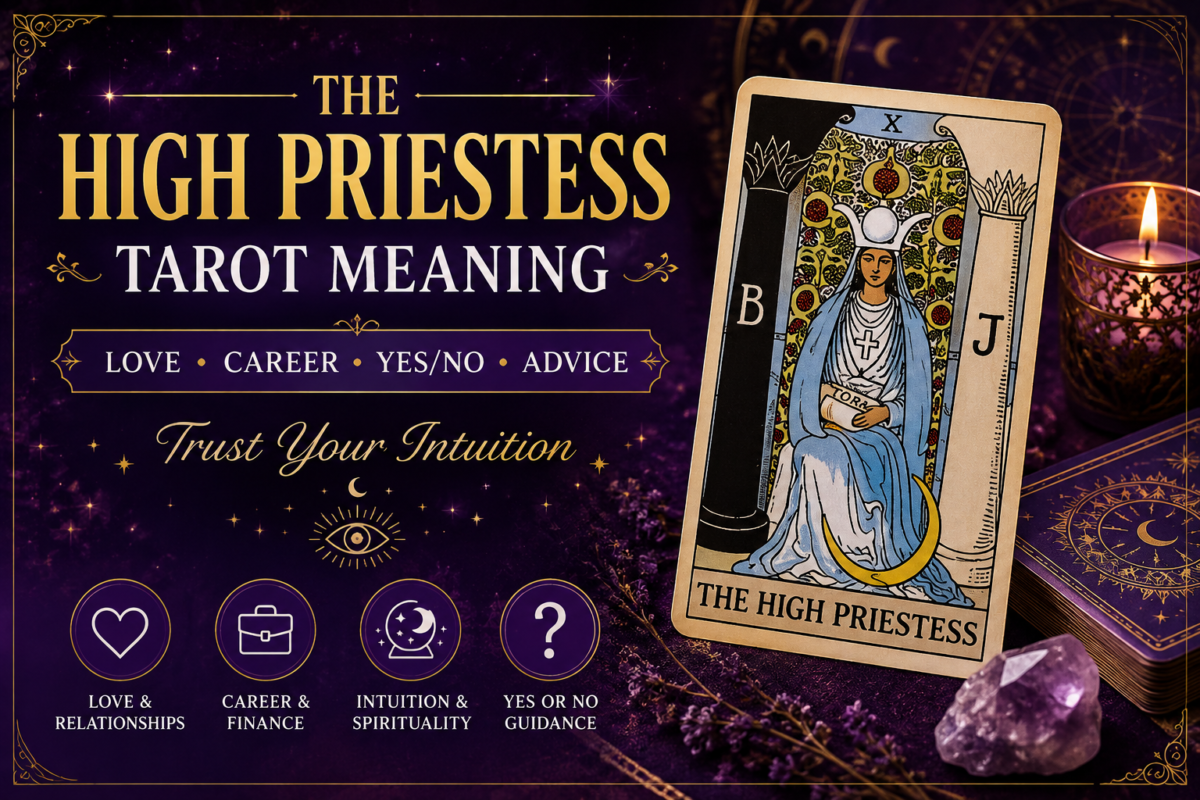
9. The High Priestess + Justice
The High Priestess is associated with intuition and inner knowledge. Justice emphasizes fairness, truth, and accountability.
Together, the cards may encourage you to listen to your instincts while examining the evidence and considering everyone’s responsibilities.
Key theme: Intuition guided by fairness and facts.
10. The Fool + The World
The Fool represents a fresh beginning, while The World can symbolize completion and reaching an important milestone.
Depending on the question and spread, this pairing may suggest moving from one completed chapter into a new phase of life.
Key theme: Completion and a fresh start.
How to Read Three Tarot Cards Together
Three-card Tarot spreads give you more context without requiring a complicated layout. The most important step is deciding what each position represents before interpreting the cards.
A simple spread uses three positions:
- Card 1 — Situation: What is happening now?
- Card 2 — Challenge: What issue or influence needs attention?
- Card 3 — Direction: What perspective or next step could help?
For example, imagine drawing The Hermit, Two of Swords, and The Star.
The Hermit suggests reflection. The Two of Swords can represent indecision or difficulty choosing. The Star brings hope and renewal.
Read together, the sequence might suggest that taking time to reflect can help you understand a difficult choice and find a more hopeful direction.
Notice how the cards form a story instead of three separate answers.
Three-Card Tarot Spread for Love
If you want to explore a relationship, try this layout:
- My feelings: What should I understand about my own emotional response?
- The relationship dynamic: What pattern deserves attention?
- My next step: What can I do to approach the situation thoughtfully?
This spread keeps the focus on reflection, communication, and your own choices. It does not claim to reveal another person’s private thoughts with certainty.
Three-Card Tarot Spread for Career
For a work-related question, assign these positions:
- Current situation: What is happening with my career or project?
- Challenge or opportunity: What should I consider?
- Practical next step: What action could help me move forward?
You can use the same structure for studying, personal goals, or other decisions. Just make sure each card has a clear role.
What If Two Tarot Cards Seem to Contradict Each Other?
Contradictory cards do not automatically mean your reading is wrong. In fact, the contrast may be the most useful part of the combination.
Consider The Sun and The Moon. One card may suggest openness, while the other highlights uncertainty. Together, they might reflect a situation in which you understand some facts but still lack important information.
Rather than forcing the cards to agree, ask yourself:
- What is clear about this situation?
- What remains uncertain?
- Am I overlooking a different perspective?
- What information would help me make a better decision?
This method allows you to explore complexity instead of reducing every reading to a simple positive or negative answer.
Common Mistakes When Reading Tarot Combinations
Even experienced readers can fall into habits that make interpretations less helpful. Watch out for these common mistakes.
Memorizing every pairing: You do not need to learn a separate definition for every possible combination. Focus on individual card meanings and the relationships between them.
Ignoring the question: The same pair can have different implications in a love reading and a career reading. Always return to the question that prompted the draw.
Treating difficult cards as guaranteed bad news: Cards such as Death and The Tower can represent change, transition, or disruption. They do not automatically predict disaster.
Ignoring card order: When the spread uses a sequence, consider how the first card leads into the next. Reversing the order can change the story you see.
Pulling too many clarifiers: Repeatedly drawing cards until you receive the answer you want can make your reading harder to interpret. Pause and work with the original cards first.
A Simple Practice Exercise for Tarot Card Combinations
You can practise this method in about ten minutes.
- Draw two cards from your deck.
- Write down one or two keywords for each card.
- Identify one similarity or contrast between them.
- Look for a repeated symbol, number, suit, or visual connection.
- Write one sentence that combines their meanings.
For example, draw the Eight of Pentacles and The Star.
The Eight of Pentacles represents practice and dedication. The Star represents hope and renewal.
Your combined interpretation might be: “Consistent effort can help turn hope into meaningful progress.”
Repeat the exercise with a new pair. Over time, you will become more comfortable building interpretations without depending entirely on guidebooks.
Tarot Card Combinations vs. Individual Card Meanings
| Individual card reading | Combination reading |
|---|---|
| Focuses on one card’s symbolism | Connects two or more cards |
| Helps build foundational knowledge | Adds context and relationships |
| Often starts with keywords | Uses keywords, imagery, and sequence |
| Explores one main theme | Explores how themes interact |
| Useful for learning a deck | Useful for interpreting larger spreads |
Both skills matter. Learn the individual cards first, then practise connecting their meanings.
If you want to explore simple yes-or-no readings, read Yes or No Tarot Cards: Complete 78-Card List. You can also learn the basics in Tarot Yes or No: How to Read Yes/No Tarot Cards or improve the wording of your questions with How to Ask Yes or No Questions in Tarot.
For another perspective on interpreting pairs, explore Biddy Tarot’s guide to reading Tarot card combinations.
Frequently Asked Questions
1. What are Tarot card combinations?
Tarot card combinations are two or more cards interpreted together. Their shared meaning can emerge from the individual symbols, the question, the spread positions, and the way the cards relate to one another.
2. How do I read two Tarot cards together?
Identify the main meaning of each card, look for similarities or contrasts, examine the imagery, and combine your observations into one sentence. Then interpret that sentence in the context of your question.
3. Do I need to memorize Tarot card combinations?
No. Learning a repeatable interpretation method is more practical than memorizing thousands of possible pairs. Start with keywords, suits, numbers, symbols, and the flow between cards.
4. How do I interpret three Tarot cards?
Assign each card a position before drawing. For example, use situation, challenge, and direction. Interpret each card in its position, then connect the three meanings into one coherent story.
5. Can Tarot combinations predict the future?
Tarot combinations can be used to explore themes, possibilities, and personal choices, but they do not guarantee future events. Treat the interpretation as a reflective tool rather than a fixed prediction.
6. What should I do if the cards seem confusing?
Return to your original question and identify the simplest meaning of each card. Look for a shared theme or contrast. If the message remains unclear, take a break instead of repeatedly drawing more cards.
Final Thoughts
Learning Tarot card combinations can help you move beyond memorizing individual meanings and begin reading the cards as a connected story.
Start with two cards. Identify their keywords, notice their similarities or contrasts, and ask how one changes the meaning of the other. Once you feel comfortable, introduce a three-card spread with clear positions.
Remember that context matters more than a memorized definition. Use the question, imagery, card order, and your own observations to develop a thoughtful interpretation.
Most importantly, let Tarot support reflection rather than replace your judgment. A useful reading should help you explore your options and understand your situation more clearly.