

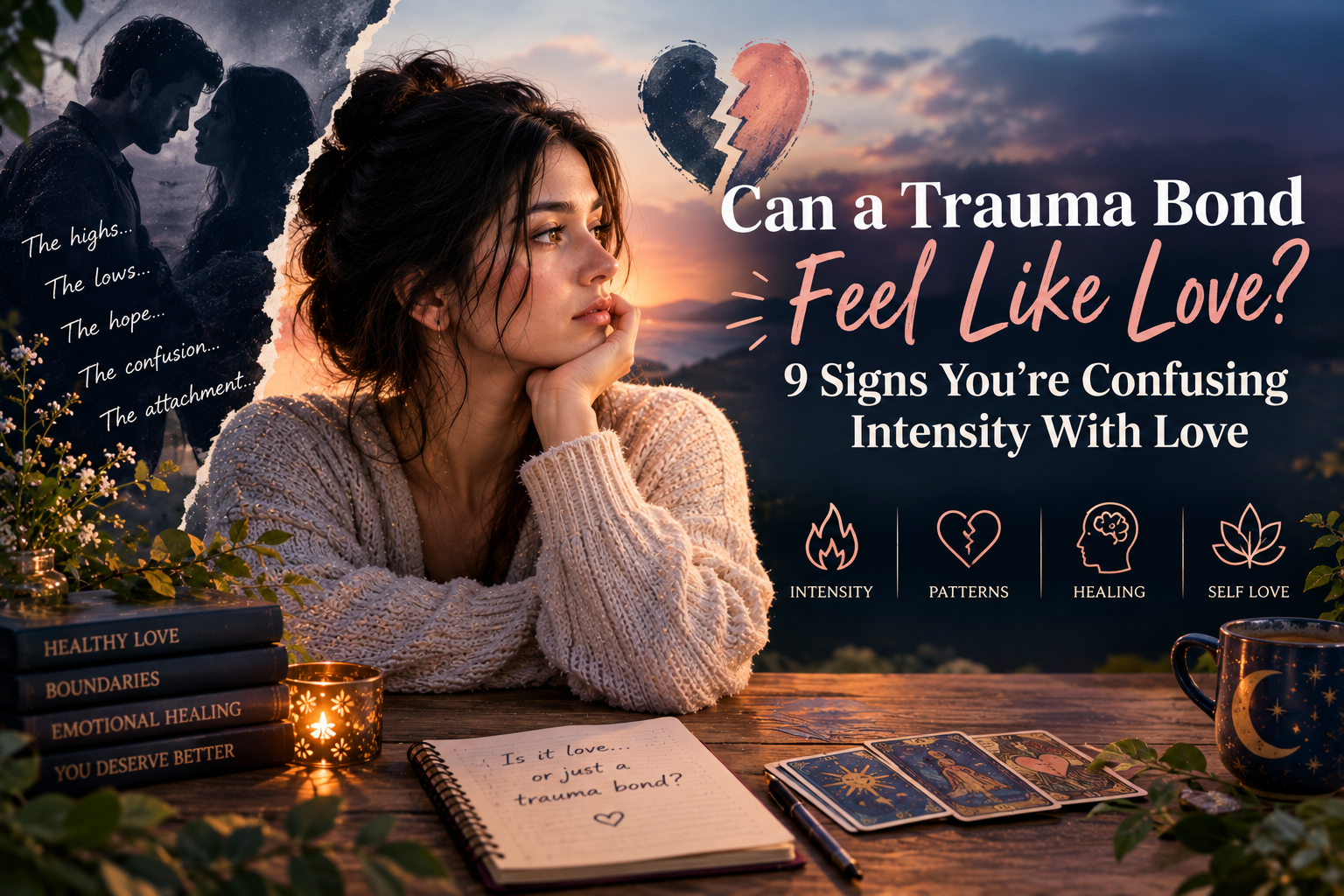
Have you ever felt intensely attached to someone even though the relationship repeatedly hurt you?
Perhaps the connection feels impossible to explain. After an argument, you may desperately want their attention. When they become affectionate again, the relief can feel incredibly powerful.
That emotional intensity can make you wonder:
“Is this really love, or am I experiencing a trauma bond?”
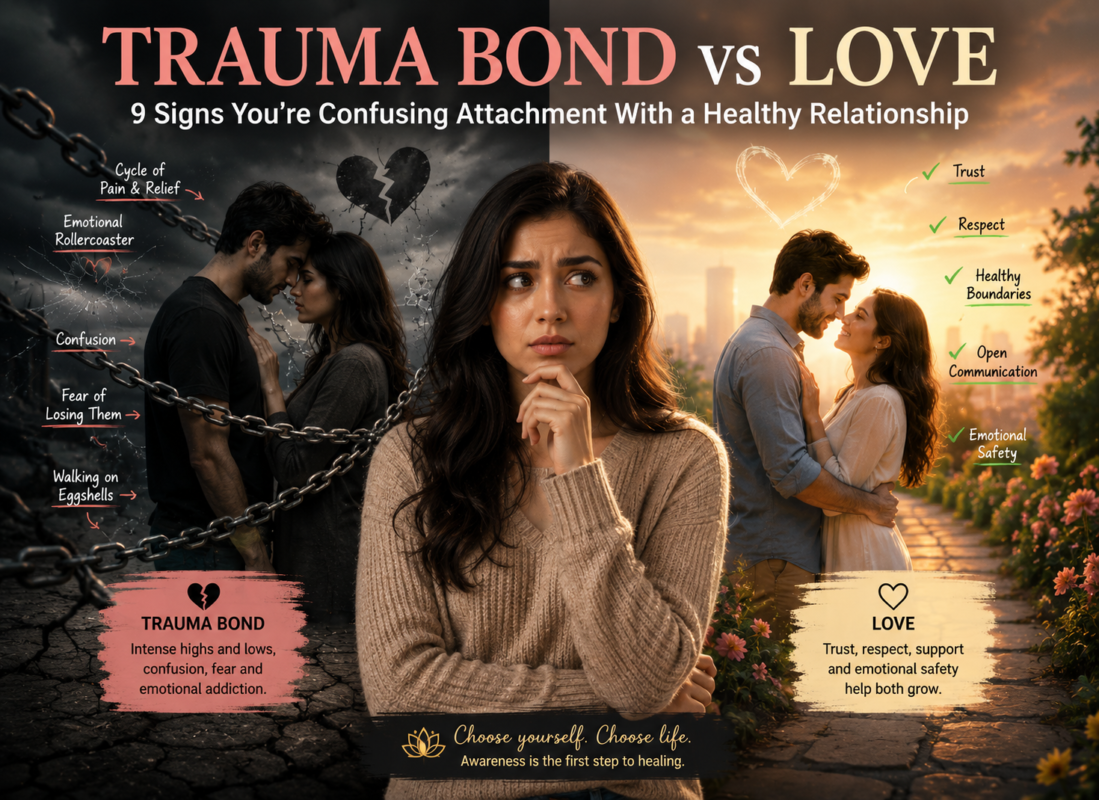
A trauma bond can feel like love, but the two are not the same thing. Trauma bonding refers to a strong emotional attachment that can develop within a harmful or abusive relationship, particularly when affection, kindness or reconciliation repeatedly follows mistreatment. This cycle can make the positive moments feel especially powerful.
Understanding the difference does not mean your feelings are fake. Your attachment can be completely real while the relationship pattern remains unhealthy.
Let’s look at why trauma bonds can feel like love and the signs that may help you understand what you’re experiencing.
What Is a Trauma Bond?
A trauma bond is a powerful emotional attachment that develops between someone and a person who repeatedly harms, manipulates or abuses them.
The relationship often contains a repeating pattern:
Hurt → distance → apology or affection → relief → hope → hurt again
The periods of kindness can create a strong sense of relief after painful experiences. Over time, that contrast may make affection feel even more valuable.
Cleveland Clinic describes trauma bonding as an unhealthy attachment that can develop through cycles of abuse followed by periods of kindness, affection or reconciliation.
It is also important to understand what trauma bonding doesn’t mean.
Simply having arguments, relationship problems or strong chemistry does not automatically mean you have a trauma bond. The term is most appropriately used when there is a pattern involving harm, manipulation, abuse, dependency or a significant power imbalance.
Can a Trauma Bond Feel Like Love?
Yes. A trauma bond can feel emotionally similar to love, especially when the relationship alternates between pain and intense affection.
The feelings themselves may include:
- Strong attachment
- Missing the person constantly
- Wanting their approval
- Feeling emotionally dependent
- Intense chemistry
- Fear of losing them
- Hope that things will improve
- Relief when they become affectionate again
However, healthy love generally allows room for safety, respect, consistency, boundaries and emotional security.
A trauma bond can instead make you feel as though you have to survive the relationship to experience its good moments.
That difference matters.
Why Does a Trauma Bond Feel Like Love?
One reason is intermittent reinforcement.
Imagine that someone is distant, critical or hurtful toward you. Later, they suddenly become affectionate, apologetic or loving.
That change can create enormous emotional relief.
You may start thinking:
“This is the person I fell in love with.”
The positive moment can become something you desperately want to experience again. Consequently, you may focus heavily on the good periods while minimizing the painful ones.
Cleveland Clinic explains that temporary affection after harmful behavior can create a powerful sense of relief and reinforce emotional attachment.
This can create a confusing emotional loop:
Pain → hope → affection → relief → attachment → pain
The intensity of that cycle can sometimes be mistaken for passion or deep love.
9 Signs You May Be Confusing a Trauma Bond With Love
Not every sign below means you have a trauma bond. Instead, look at the overall pattern of the relationship.
1. The Relationship Feels More Intense Than Peaceful
Healthy relationships can certainly have passionate moments.
Still, constant emotional highs and lows may deserve closer attention.
One day, everything feels perfect. The next, you are anxious, confused or devastated.
The relationship may seem exciting because you never know what is coming next.
Ask yourself:
“Do I feel emotionally safe, or am I constantly waiting for the next change?”
Intensity alone does not prove love.
2. You Feel More Attached After They Hurt You
This can feel particularly confusing.
Instead of becoming emotionally distant after being hurt, you may find yourself wanting the person even more.
Their apology may suddenly make you feel extremely close again.
You might think:
“Now I know they really care.”
However, the important question is whether the harmful behavior actually changes.
An apology is different from accountability followed by consistent change.
3. Relief Feels Like Happiness
Sometimes the strongest positive emotion in a difficult relationship is not genuine happiness.
It is relief.
For example, imagine spending two days worrying that your partner is angry with you. Suddenly, they call and speak lovingly.
Your anxiety disappears.
That emotional shift can feel amazing.
Yet the question is worth asking:
“Would I feel this much relief if I had not been experiencing so much distress beforehand?”
A healthy relationship does not need repeated emotional pain to make affection feel powerful.
4. You Keep Waiting for the “Good Version” of Them
You may remember how loving the person was at the beginning.
Perhaps they were attentive, affectionate and supportive.
Now, whenever something goes wrong, you hope that version will return.
The memories become evidence that the relationship can still work.
You might tell yourself:
- “They weren’t always like this.”
- “They can change.”
- “I know they love me deep down.”
- “Things will become better again.”
- “We just need to get through this phase.”
Hope is not automatically unhealthy.
However, hope becomes concerning when it repeatedly keeps you inside a harmful pattern without meaningful change.
5. Their Attention Feels Almost Addictive
When affection is unpredictable, every positive interaction can feel unusually important.
A loving message may completely change your mood.
A phone call can make you feel calm again.
Even a small compliment may feel much bigger than it normally would.
As a result, you may begin checking your phone constantly or waiting for signs that they still care.
This can make your emotional state increasingly dependent on their behaviour.
6. You Constantly Analyse Their Behaviour
Perhaps you spend hours trying to understand:
“Why did they suddenly become cold?”
Then another question appears:
“Does this mean they don’t love me anymore?”
You may analyse their texts, calls, social media activity, tone of voice and even small changes in behaviour.
Over time, the relationship can start feeling like a puzzle you have to solve.
Instead of experiencing the connection, you are constantly trying to predict it.
That level of uncertainty can be emotionally exhausting.
7. You Feel Like You Have to Earn Their Love
Love should not feel like a prize you receive after performing perfectly.
Yet a harmful relationship can create exactly that feeling.
You may start changing your behaviour to avoid conflict.
You might:
- Apologise even when you did nothing wrong
- Hide your feelings
- Avoid certain topics
- Change your appearance
- Stop seeing friends
- Constantly monitor their mood
- Try harder whenever they become distant
The goal becomes keeping the relationship stable at any cost.
That is very different from feeling secure enough to be yourself.
8. Leaving Feels Impossible Even When You Know You’re Hurt
Knowing that a relationship is unhealthy does not automatically make leaving emotionally easy.
You may understand the problems clearly and still miss the person.
Fear, financial dependence, isolation, emotional attachment and uncertainty about the future can all make separation difficult.
In trauma bonding, the attachment itself can become part of what makes leaving difficult.
So if you have struggled to leave, that does not mean you are weak.
It may mean you need support rather than judgment.
9. You Confuse Intensity With Compatibility
This is one of the biggest questions to consider.
A relationship can feel incredibly intense without being healthy or compatible.
You might experience:
Strong chemistry + constant uncertainty = intense relationship
But healthy compatibility involves more than chemistry.
Consider whether you also have:
- Mutual respect
- Emotional safety
- Consistent communication
- Shared values
- Healthy boundaries
- Trust
- Accountability
- Freedom to be yourself
A powerful emotional connection is not automatically proof that two people are right for each other.
Trauma Bond vs Healthy Love
| Trauma Bond Pattern | Healthier Love Pattern |
|---|---|
| Emotional highs and lows | Emotional stability |
| Affection follows hurt | Affection is consistent |
| Fear of losing the person dominates | Trust allows independence |
| You constantly analyse their behaviour | Communication provides clarity |
| You feel you must earn love | You feel accepted |
| Boundaries create conflict | Boundaries are respected |
| Apologies may repeat without change | Accountability leads to change |
| Leaving feels impossible | Staying is a choice |
| Intensity becomes the main attraction | Connection includes safety and respect |
This table is not a diagnostic test.
Instead, use it to identify patterns in your own relationship.
Not Every Toxic Relationship Is a Trauma Bond
The term “trauma bond” is frequently used online, but it should not become a label for every difficult relationship.
A relationship can be unhealthy because of:
- Poor communication
- Different expectations
- Emotional incompatibility
- Repeated unresolved arguments
- Immaturity
- Avoidance
- Lack of commitment
Those problems can be serious without necessarily constituting trauma bonding.
Trauma bonding is more specifically associated with an attachment that develops in the context of repeated harm, abuse or manipulation.
That distinction is important because using psychological terms too broadly can make it harder to understand what is actually happening.
Can You Love Someone and Still Be Trauma-Bonded?
Yes.
This is one of the hardest parts to understand.
Your feelings do not automatically disappear because you recognise an unhealthy relationship pattern.
You can genuinely:
- Love someone
- Miss someone
- Care about their wellbeing
- Remember beautiful moments
- Feel connected to them
- Wish things could be different
At the same time, the relationship may still be harmful to you.
Love does not automatically make a relationship healthy.
Sometimes healing begins when you stop asking:
“Do I love them?”
and start asking:
“What does this relationship do to me?”
Why Do I Miss Someone Who Hurt Me?
Missing someone does not necessarily mean you should return to them.
You may miss:
- The person they were at the beginning
- The good memories
- Physical affection
- Emotional familiarity
- The future you imagined
- The feeling of being wanted
- The hope that things could change
Sometimes what you miss is not the entire relationship.
You may be grieving the version of the relationship you hoped it would become.
That is why missing someone should be treated as an emotion to understand, not automatically as an instruction to reconnect.
What Should You Do If You Think You’re Trauma-Bonded?
Start by focusing on patterns rather than promises.
1. Write down what actually happens
Record important incidents and how you felt afterward.
Looking at events on paper can make repeating patterns easier to recognise.
2. Separate words from behaviour
Ask:
“What has actually changed?”
A promise to change and consistent behaviour are not the same thing.
3. Talk to someone you trust
Isolation can make relationship confusion worse.
A trusted friend, family member or qualified mental health professional can provide another perspective.
4. Reconnect with your own life
Spend time with supportive people.
Return to hobbies.
Make independent decisions.
Notice what makes you feel like yourself again.
5. Consider your safety
If the relationship involves threats, physical violence, coercive control or other forms of abuse, prioritise safety rather than trying to solve everything through another relationship conversation.
A qualified professional or domestic-violence support service can help you think through safer options.
Cleveland Clinic also recommends outside support, reconnecting with yourself and creating a safety plan when someone is dealing with trauma bonding and abuse.
Can Tarot Help You Understand a Trauma Bond?
Tarot cannot diagnose trauma bonding or determine whether someone is abusive.
However, you can use Tarot as a reflection tool to explore your own emotions, expectations and relationship patterns.
Instead of asking:
“Does this person secretly love me?”
try questions such as:
- What am I emotionally attached to in this relationship?
- What pattern am I struggling to see clearly?
- What am I afraid of losing?
- What boundary do I need to consider?
- What does emotional security mean to me?
- What am I ignoring because I want the relationship to work?
- What would choosing myself look like?
These questions shift the focus from trying to read another person’s mind toward understanding your own experience.
For relationship clarity, you can also explore our Tarot for Relationship Clarity guide.
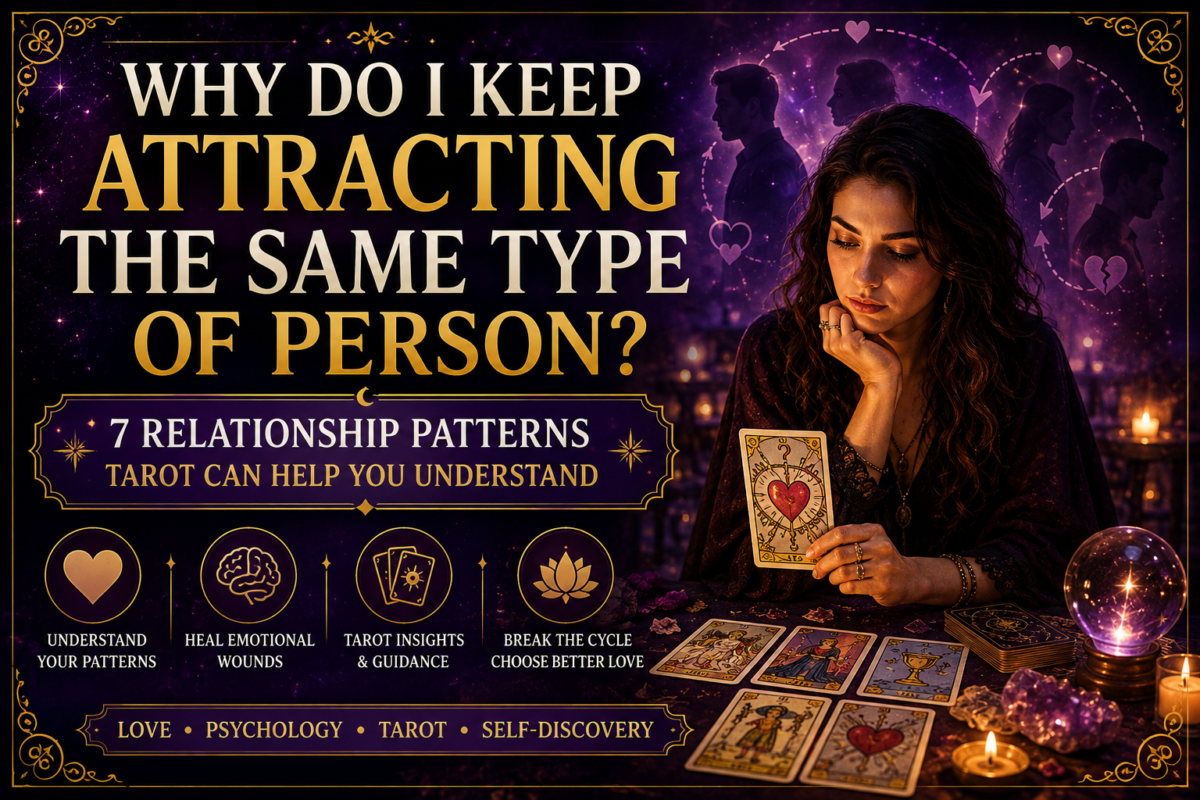
A 7-Card Tarot Spread for Relationship Patterns
If you use Tarot for reflection, try this seven-card spread:
| Card | Question |
|---|---|
| 1 | What am I feeling right now? |
| 2 | What keeps me attached? |
| 3 | What relationship pattern should I notice? |
| 4 | What am I afraid to accept? |
| 5 | What boundary needs attention? |
| 6 | What would emotional security look like? |
| 7 | What should I focus on for my own growth? |
The purpose is not to predict whether the relationship will survive.
Instead, use the spread to slow down and examine emotions that can be difficult to see clearly when you are deeply attached.
7 Questions to Ask Yourself
Before deciding whether to stay, leave or reconnect, pause and answer these honestly:
- Do I feel safe in this relationship?
- Can I express my needs without fear?
- Are apologies followed by consistent changes?
- Do I feel more like myself or less like myself?
- Am I attached to the person or to their potential?
- Would I want this relationship to continue if nothing changed?
- What would I advise someone I love if they described this relationship to me?
Your answers may tell you more than the intensity of your emotions.
Frequently Asked Questions
1. Can a trauma bond feel exactly like love?
It can feel very much like love because the attachment, longing and emotional intensity can be genuine. However, trauma bonding involves an unhealthy attachment associated with repeated harm, manipulation or abuse, often combined with periods of affection or reconciliation.
2. Is intense chemistry a sign of a trauma bond?
Not necessarily.
Strong chemistry can exist in healthy relationships too. The more important question is whether the intensity exists alongside repeated harm, manipulation, fear, instability or dependency.
3. Can a trauma bond happen without physical abuse?
Trauma bonding is generally discussed in connection with abusive or harmful relationship dynamics, which can involve different forms of abuse or manipulation. Physical violence is not the only form of harm.
4. Why is it so hard to leave a trauma bond?
Repeated cycles of distress followed by affection or relief can strengthen attachment. Fear, dependency, isolation and uncertainty can also make leaving more difficult.
5. Does missing someone mean I should go back?
No.
Missing someone is an emotion. It does not automatically tell you whether reconnecting is healthy.
Look at the relationship pattern, the person’s behaviour and whether meaningful changes have actually occurred.
6. Can a trauma bond become healthy?
Healing may involve recognising the harmful pattern, creating boundaries, rebuilding support systems and getting professional help when needed. Whether a particular relationship can become healthy depends on the circumstances, including safety, accountability and sustained behavioural change.
7. Is trauma bonding a mental health diagnosis?
No. “Trauma bonding” is a commonly used psychological term, but it is not an official diagnosis. Cleveland Clinic specifically notes that the term can also be misused for ordinary relationship problems.
Final Thought: Intensity Isn’t the Same as Love
A trauma bond can feel incredibly powerful.
You may miss the person, crave their attention and remember the moments when everything felt perfect. Those emotions can be real.
Still, intensity alone cannot tell you whether a relationship is healthy.
Healthy love leaves room for safety, respect, boundaries, consistency and individuality.
If you are trying to understand your own relationship, look beyond the strongest moments. Look at the pattern.
Ask yourself:
“Do I feel loved, or am I constantly waiting to feel loved again?”
That question can be a powerful starting point for greater relationship clarity.