

Have you ever met someone and immediately felt a powerful connection?
The attraction was strong. Conversations felt effortless. You couldn’t stop thinking about them, and every message gave you butterflies. You may have thought, “This has to be something special.”
But after some time, problems started appearing. Your communication styles were different, your expectations didn’t match, or you kept feeling emotionally confused.
This is where many people discover an important difference:
Chemistry and compatibility are not the same thing.
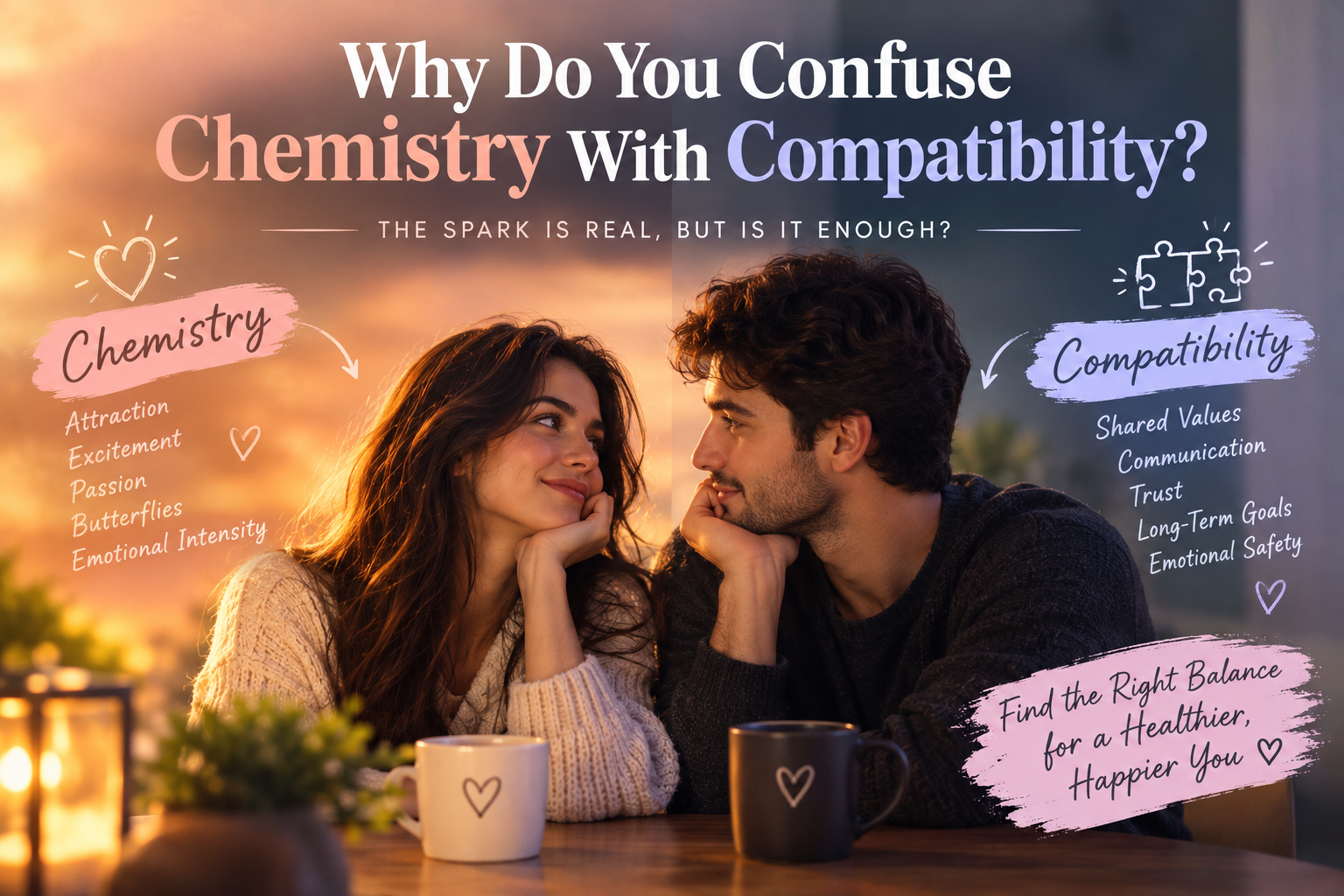
Chemistry creates attraction and excitement. Compatibility helps two people build a relationship that works in everyday life.
Understanding the difference can help you make healthier relationship choices and avoid confusing emotional intensity with genuine long-term connection.
What Is Chemistry in a Relationship?
Chemistry is the feeling of attraction and emotional excitement you experience with another person.
It can include:
- Strong physical attraction
- Butterflies and excitement
- Intense conversations
- Thinking about someone constantly
- Sexual attraction
- Feeling drawn toward someone
- Excitement when they message
- A sense of instant connection
Chemistry can be exciting and completely genuine.
However, strong chemistry doesn’t automatically mean that two people are compatible.
You can feel intense attraction toward someone whose values, lifestyle, communication style, or relationship goals are very different from yours.
What Is Compatibility?
Compatibility is about how well two people can function together over time.
It includes things such as:
- Shared relationship goals
- Communication
- Trust
- Emotional availability
- Core values
- Lifestyle
- Boundaries
- Family expectations
- Long-term plans
- Conflict resolution
For example, two people may have amazing chemistry but completely different ideas about marriage.
One person may want a committed relationship while the other wants something casual.
The attraction can still be real.
But the relationship may not be compatible.
Chemistry vs Compatibility
A simple way to understand the difference is:
Chemistry asks: “Am I strongly attracted to this person?”
Compatibility asks: “Can we build a healthy relationship together?”
A lasting relationship usually needs more than one of these.
7 Signs You’re Confusing Chemistry With Compatibility
1. You Think About Them Constantly
When chemistry is intense, you may find yourself constantly checking your phone, replaying conversations, or imagining your future together.
But ask yourself:
“Do I actually know this person well, or am I mostly thinking about how they make me feel?”
Sometimes we become attached to the feeling before we truly understand the person.
2. You Ignore Major Differences
You might notice that your partner wants something completely different but tell yourself that love will eventually solve the problem.
For example:
“They don’t want commitment yet, but they’ll change.”
“We have different priorities, but our chemistry is incredible.”
Strong attraction shouldn’t require you to ignore important differences.
Healthy relationships need honest conversations about expectations.
3. The Relationship Has Constant Highs and Lows
One day everything feels perfect.
The next day you’re anxious and wondering where you stand.
Then your partner comes back, and everything feels exciting again.
This emotional roller coaster can create powerful feelings, but intensity isn’t always intimacy.
A healthy relationship can be passionate without constantly making you feel uncertain.
4. You Focus on Their Potential
One of the biggest signs of confusing chemistry with compatibility is falling in love with someone’s potential.
You may think:
“They will change.”
“They’ll eventually commit.”
“Once they understand me, everything will be different.”
But relationships are built with the person who exists today—not only the person you hope they will become.
Pay attention to consistent behavior, not just promises.
5. You Excuse Red Flags
Strong attraction can make people overlook behavior they would normally reject.
You may excuse poor communication, inconsistency, disrespect, or emotional unavailability because the connection feels special.
Ask yourself:
“If my best friend described this relationship to me, what advice would I give them?”
Sometimes looking at your relationship from an outside perspective creates clarity.
6. You Feel More Anxious Than Secure
Think about how you usually feel in the relationship.
Do you feel respected, understood, and emotionally safe?
Or are you constantly waiting for messages, worrying about their feelings, and wondering where you stand?
Chemistry can create excitement.
Compatibility often creates a greater sense of stability and emotional safety.
7. You Love the Feeling More Than the Person
This may be the most important question:
“Am I attracted to who this person really is, or to how they make me feel?”
You may love the attention, mystery, excitement, physical attraction, or emotional intensity.
That doesn’t mean your feelings are fake.
It simply means you may need to separate emotional intensity from genuine compatibility.
Can You Have Chemistry and Compatibility?
Yes.
You don’t have to choose between passion and stability.
A healthy relationship can have strong attraction while also providing:
- Respect
- Trust
- Communication
- Emotional safety
- Shared values
- Similar relationship goals
- Healthy boundaries
The goal isn’t to eliminate chemistry.
The goal is to avoid making chemistry your only measure of relationship potential.
Think of chemistry as the spark and compatibility as the foundation.
A spark can start something beautiful, but a foundation helps it last.
Why Do We Sometimes Choose Chemistry Over Compatibility?
Our attraction can sometimes be influenced by familiar emotional patterns.
For example, someone who is used to inconsistent attention may mistake uncertainty for excitement.
Someone who fears rejection may become strongly attached to emotionally unavailable partners.
This doesn’t mean your past controls your future.
It simply means that understanding your relationship patterns can help you make more conscious choices.
If you repeatedly find yourself attracted to the same type of unavailable or inconsistent partner, it may be worth exploring why that pattern feels familiar.
You can also explore our related article, “Why Do I Keep Attracting the Wrong Relationships?”, for deeper reflection.
5 Questions to Ask Before Calling It True Love
Before deciding that an intense connection is meant to be, ask yourself:
- Do we want the same type of relationship?
- Can we communicate honestly when something goes wrong?
- Do they respect my boundaries?
- Can I be myself around them?
- Do our important values and future goals reasonably align?
If the answers are mostly yes, you may be looking at more than simple chemistry.
If the relationship depends mainly on attraction, excitement, and emotional highs, take a closer look before making major decisions.
Can Tarot Help You Understand Relationship Chemistry?
When emotions are strong, it can be difficult to look at a relationship objectively.
A tarot reading can be used as a reflective tool to explore your emotions, relationship patterns, and the questions you may be struggling with.
Instead of only asking:
“Will this person come back?”
you could ask:
- What am I not seeing clearly?
- Why am I so strongly attracted to this person?
- What pattern keeps repeating in my relationships?
- What can I learn from this connection?
- What should I focus on for my emotional growth?
Tarot doesn’t need to replace your own judgment. It can provide another perspective while you reflect on your situation.
If you’re confused about whether you’re experiencing genuine compatibility or simply intense chemistry, a personalized relationship tarot reading at The Astro Palace can give you a space to explore those questions.
Final Thoughts
Chemistry can be powerful.
It can create butterflies, attraction, excitement, and the feeling that you’ve found someone extraordinary.
But chemistry alone doesn’t tell you whether a relationship will work.
Compatibility is about what happens after the butterflies.
Can you communicate? Do you respect each other? Do your values and relationship goals align? Can you handle difficult moments together?
The healthiest relationships often have both chemistry and compatibility.
So the next time you feel an incredibly strong connection with someone, don’t only ask:
“Why is the chemistry so intense?”
Also ask:
“Does this relationship actually support the person I want to become?”
That question may give you more clarity than chemistry alone ever could.
Frequently Asked Questions
1. Is chemistry more important than compatibility?
Chemistry and compatibility are different. Chemistry creates attraction and excitement, while compatibility involves values, communication, trust, emotional needs, and relationship goals. Both can play an important role in a healthy relationship.
2. Can strong chemistry become compatibility?
Yes, compatibility can develop through communication, mutual understanding, trust, and shared effort. However, major differences in core values or long-term goals may still create challenges.
3. Why do I have chemistry with emotionally unavailable people?
Sometimes attraction is influenced by familiar emotional patterns. If uncertainty or inconsistent attention feels familiar, it can sometimes be mistaken for excitement or deep connection.
4. How do I know if a relationship is compatible?
Look beyond attraction. Consider whether you feel respected, emotionally safe, understood, and supported. Also consider whether your important values, boundaries, and relationship goals align.
5. Can tarot tell me if someone is compatible with me?
Tarot can be used for reflection and spiritual guidance around relationship questions and patterns. It should not be treated as guaranteed proof of another person’s thoughts, feelings, or future actions.





One thought on “Why Do You Confuse Chemistry With Compatibility?”