

Have you ever been in a relationship that felt impossible to leave, even though it repeatedly hurt you?
Maybe the connection felt incredibly intense.
One moment you felt deeply loved.
The next, you felt rejected, ignored or emotionally exhausted.
Then something would happen—a loving message, an apology, affection or a beautiful moment together—and suddenly you felt hopeful again.
You might have thought:
“This must be true love because I’ve never felt anything this strong before.”
But intensity and healthy love are not always the same thing.
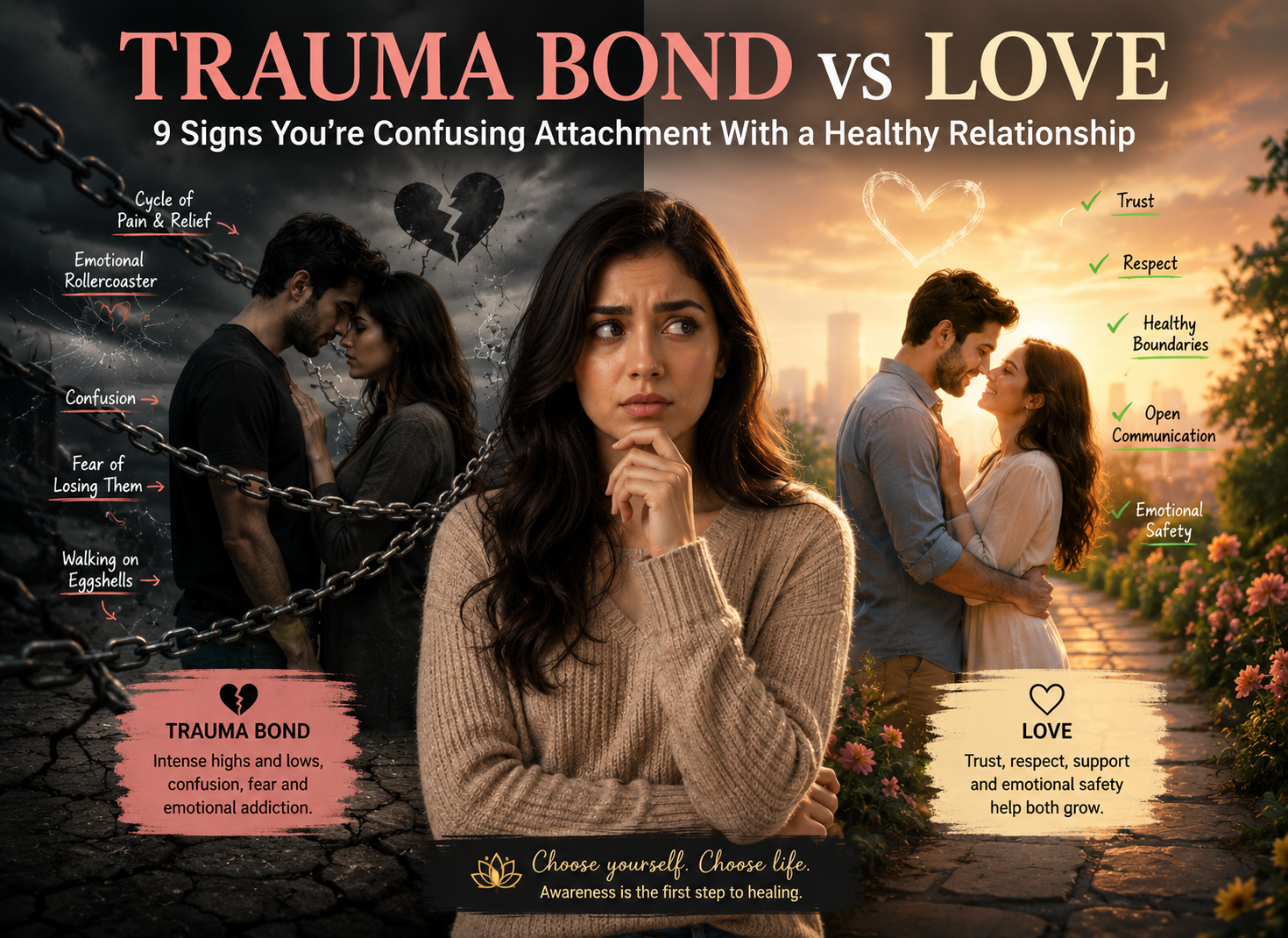
Understanding the difference between trauma bond vs love can help you look at a relationship more clearly, especially when emotional highs and lows have become difficult to separate from genuine connection.
Tarot can also be used as a reflective tool here—not to diagnose a relationship, but to help you explore your emotions, patterns, boundaries and choices.
What Is a Trauma Bond?
The term trauma bond is commonly used to describe a strong emotional attachment that can develop within a relationship involving repeated cycles of harmful behavior and positive reinforcement.
The important part is the cycle.
For example:
Hurt → Distance → Apology → Affection → Hope → Hurt again
The positive moments can make the painful moments harder to leave behind.
You may remember the loving version of the person and keep hoping that version will return permanently.
This can create an emotionally confusing experience.
“I know this relationship hurts me, but I still can’t let go.”
That doesn’t automatically mean every difficult relationship is a trauma bond.
Relationships can be complicated, and people can make mistakes.
The bigger question is whether there is a repeated unhealthy cycle that keeps you emotionally attached despite ongoing harm.
Trauma Bond vs Love: What’s the Difference?
Healthy love can be intense.
It can involve passion, vulnerability and strong emotional attachment.
The difference is that healthy love generally allows safety, respect, boundaries, communication and individuality.
A trauma-bonded dynamic may instead involve repeated cycles of harm, fear, manipulation, instability or emotional distress followed by periods of affection or relief.
| Healthy Love | Possible Trauma-Bond Pattern |
|---|---|
| Emotional safety | Emotional unpredictability |
| Mutual respect | Repeated disrespect |
| Healthy communication | Manipulation or fear |
| Boundaries are respected | Boundaries are repeatedly crossed |
| Conflict can be repaired | Same harmful cycle repeats |
| Trust grows over time | Trust repeatedly breaks |
| You can be yourself | You feel you must change to keep them |
| Love feels supportive | Love feels connected to anxiety |
| You maintain your identity | You gradually lose yourself |
The important thing isn’t whether your relationship has any conflict.
Every relationship has conflict.
The question is what happens after the conflict.
9 Signs You May Be Confusing a Trauma Bond With Love
1. The Relationship Feels Like an Emotional Roller Coaster
One day everything feels perfect.
The next, you’re devastated.
Then they become loving again.
You feel incredible relief.
The highs can feel extremely powerful because they follow emotional lows.
You might interpret that intensity as proof that:
“We have an extraordinary connection.”
But sometimes the intensity comes from instability, not compatibility.
Healthy relationships can still have passionate moments, but emotional security shouldn’t depend on constantly surviving emotional extremes.
2. You Focus More on the Good Moments Than the Overall Pattern
Think about the relationship as a whole.
Not just your best memory.
Not just the night they apologized.
Not just the vacation.
Not just the time they told you how much they loved you.
Ask:
“What happens most of the time?”
If painful experiences are repeatedly followed by wonderful moments, you may find yourself using the good moments to explain away the bad ones.
Try writing down the relationship honestly:
What feels healthy?
What repeatedly hurts?
What keeps happening?
Has anything actually changed?
This can reveal patterns that are difficult to see when you’re emotionally inside them.
3. You Keep Waiting for the Person They Could Become
You may not be attached only to who they are.
You may be attached to their potential.
You think:
“Once they heal…”
“Once they understand…”
“Once they stop doing this…”
“Once they realize how much I love them…”
Then everything will finally become perfect.
Hope is powerful.
But a healthy relationship has to be evaluated based on reality, not only potential.
Ask yourself:
“If nothing about this person changed, would I still choose this relationship?”
That question can be uncomfortable.
It can also be revealing.
4. You Feel Addicted to Their Attention
When they’re distant, you feel desperate for connection.
When they return, you experience enormous relief.
You may repeatedly:
- check your phone
- check their social media
- reread old messages
- wait for notifications
- analyze their tone
- wonder what they’re doing
- look for signs that they still care
This connects strongly with the relationship overthinking cycle you’ve already explored.
5. You Believe the Pain Proves the Connection Is Deep
This is one of the most dangerous ideas in relationships:
“If it hurts this much, it must mean I love them deeply.”
Not necessarily.
Pain can come from:
- insecurity
- fear
- attachment
- uncertainty
- unmet needs
- unhealthy relationship patterns
Healthy love doesn’t have to be painless.
But suffering should not become your measurement of love.
Intensity is not automatically intimacy.
6. You Keep Making Excuses for Harmful Behavior
You may find yourself saying:
“They’re just stressed.”
“They had a difficult childhood.”
“They don’t really mean it.”
“They’re scared of getting close.”
“Deep down, they’re a good person.”
Understanding someone’s behavior doesn’t mean you have to accept behavior that repeatedly hurts you.
Compassion and boundaries can exist together.
You can understand someone’s pain and still decide that their behavior isn’t healthy for you.
7. You Feel Responsible for Saving Them
Do you constantly think:
“I can help them change.”
“They need me.”
“If I leave, they’ll fall apart.”
“Nobody understands them like I do.”
This can turn a relationship into a rescue mission.
A partner can support someone’s growth.
But you cannot do another person’s emotional work for them.
Love isn’t a rehabilitation project.
8. You Are Afraid That Leaving Means Losing Your Only Chance at Love
You might think:
“I’ll never find this connection again.”
“Nobody will understand me like they do.”
“What if this is my soulmate?”
“What if I regret leaving?”
Fear can make an unhealthy relationship feel like your only option.
But fear of losing someone isn’t proof that the relationship is right for you.
Sometimes the fear of starting over is stronger than the evidence that the relationship is working.
9. You Don’t Feel Like Yourself Anymore
This is one of the biggest questions to ask.
Before the relationship:
Who were you?
What did you enjoy?
What were your goals?
Who were your friends?
What made you feel alive?
Now ask:
“What parts of myself have I abandoned to maintain this relationship?”
If your personality, friendships, boundaries, ambitions or confidence have gradually disappeared, something deserves closer attention.
Why Can Unhealthy Relationships Feel So Intense?
One reason is the unpredictable cycle of connection and disconnection.
Imagine this:
Stage 1 — Connection
Everything feels incredible.
Stage 2 — Conflict
Something changes.
Stage 3 — Distance
You feel rejected or anxious.
Stage 4 — Reconnection
They return with affection or an apology.
Stage 5 — Relief
You feel loved again.
Stage 6 — Hope
You believe things will finally change.
Stage 7 — The cycle repeats
Eventually, the pattern begins again.
The emotional contrast can make the good moments feel extraordinarily powerful.
That’s why someone may say:
“But when we’re good, we’re so good.”
The question isn’t whether the good moments are real.
They may be.
The question is:
“Is the overall relationship healthy?”
Trauma Bond vs Healthy Attachment
Healthy attachment allows you to experience closeness without completely losing yourself.
You can say:
“I love you.”
and still say:
“I need some space.”
You can say:
“I want this relationship.”
and still know:
“I will be okay if this relationship ends.”
That second statement isn’t about becoming detached.
It’s about having an identity outside the relationship.
What About Soulmates and Twin Flames?
Spiritual language can sometimes make unhealthy relationship patterns harder to recognize.
You may think:
“We’re twin flames.”
“This connection is karmic.”
“We’re meant to trigger each other.”
“The universe keeps bringing us back together.”
Spiritual beliefs can be personally meaningful.
However, they shouldn’t be used to justify:
- manipulation
- disrespect
- repeated emotional harm
- controlling behavior
- fear
- abuse
- boundary violations
A powerful spiritual connection should not require you to abandon your wellbeing.
A connection can feel meaningful without being healthy.
Can Tarot Help You Understand a Difficult Relationship?
Yes—as a self-reflection tool.
But don’t use Tarot to convince yourself that someone is destined to stay.
Instead of asking:
❌ “Are they my soulmate?”
try:
✅ “What am I learning from this relationship?”
Instead of:
❌ “Will they change?”
try:
✅ “What pattern am I being asked to recognize?”
Instead of:
❌ “Will they come back?”
try:
✅ “What do I need to understand before making my next decision?”
This approach makes Tarot more useful because it brings the focus back to your awareness and choices.
7-Card Tarot Spread: Trauma Bond or Healthy Love?
You can use this spread for journaling and self-reflection.
| Card | Question |
|---|---|
| 1 | What keeps me attached to this relationship? |
| 2 | What pattern am I struggling to see? |
| 3 | What fear is influencing my choices? |
| 4 | What is healthy about this connection? |
| 5 | What is unhealthy about this connection? |
| 6 | What boundary do I need to strengthen? |
| 7 | What would choosing myself look like? |
Don’t interpret one card as a definitive answer about another person’s intentions.
Instead, look for the themes your reading brings to your own awareness.
Tarot Cards That Can Encourage Relationship Reflection
The Devil
Can invite reflection around attachment, unhealthy patterns, temptation and feeling stuck.
The Lovers
Can represent choices, values and conscious relationship decisions—not simply romance.
The Moon
Can encourage you to examine uncertainty, fear and assumptions.
Justice
Can bring attention to accountability, balance and consequences.
Strength
Can represent inner courage and emotional self-control.
The Tower
Can symbolize the collapse of an illusion or an unexpected realization.
The Hermit
Can encourage stepping back and listening to your own inner voice.
These interpretations are for reflection rather than diagnosis or prediction.
How to Break an Unhealthy Relationship Pattern
If you recognize yourself in this article, don’t immediately blame yourself.
Start with awareness.
Step 1: Write the Pattern Down
Instead of:
“Our relationship is complicated.”
Write exactly what happens.
Trigger → Behavior → Response → Reconciliation → Repeat
Patterns become easier to recognize when they’re visible.
Step 2: Stop Measuring Love by Intensity
Ask:
Do I feel safe?
Do I feel respected?
Can I communicate honestly?
Are my boundaries respected?
Can I maintain my own identity?
These questions tell you more about relationship health than how intensely you miss someone.
Step 3: Reconnect With Yourself
Return to:
- friends
- hobbies
- goals
- exercise
- creativity
- work
- spiritual practices
- personal routines
Your life should continue to exist outside the relationship.
Step 4: Set One Clear Boundary
You don’t need to change everything overnight.
Start with one boundary.
For example:
“I won’t continue a conversation when I’m being insulted.”
Then observe what happens.
A healthy relationship should have room for boundaries.
Step 5: Look at Actions, Not Promises
Promises can feel powerful.
But change is demonstrated through consistent behavior over time.
Ask:
“What has actually changed?”
not simply:
“What have they promised?”
Trauma Bond vs Love: Quick Self-Check
| Question | Healthy Love | Warning Sign |
|---|---|---|
| Do I feel emotionally safe? | Usually | Rarely |
| Are boundaries respected? | Yes | Repeatedly ignored |
| Can we disagree safely? | Yes | Fear or punishment |
| Do actions match words? | Usually | Repeated mismatch |
| Do I maintain my identity? | Yes | I’ve lost myself |
| Is affection consistent? | Generally | Extreme highs and lows |
| Can I leave a conversation? | Yes | I feel trapped |
| Do I trust myself? | Yes | I constantly doubt myself |
| Am I staying from choice? | Mostly | Mostly from fear |
One “warning” answer doesn’t automatically define a relationship.
Look at the overall pattern.
Relationship Patterns You Shouldn’t Ignore
Sometimes the hardest part isn’t recognizing one bad moment.
It’s recognizing repetition.
If you’ve noticed:
emotionally unavailable partner → intense attachment → anxiety → overthinking → reconciliation → same problem
you may be repeating a relationship pattern.
That’s why this article connects naturally to:
Why Do I Keep Attracting the Same Type of Person? Tarot & Relationship Patterns
When You Can’t Let Go
Sometimes the hardest part is knowing that a relationship isn’t good for you but still missing the person.
You may understand everything logically and still feel emotionally attached.
That doesn’t mean you’re weak.
Emotional attachment doesn’t disappear simply because you understand the situation.
This is a perfect place to internally link:
Why You Can’t Let Go of Someone: Psychology, Tarot & the Hidden Emotional Pattern
Frequently Asked Questions
1. Is a trauma bond the same as love?
No. A trauma bond refers to a strong attachment that can develop within a repeated cycle involving harmful behavior and positive reinforcement. Healthy love can be intense but generally includes respect, safety, boundaries and mutual care.
2. Can a trauma bond feel like true love?
Yes. The emotional intensity and powerful periods of affection can make an unhealthy relationship feel extremely meaningful. That’s why looking at the overall pattern is more useful than judging the relationship by its strongest moments.
3. What are the main signs of a trauma bond?
Possible signs include repeated cycles of harm and reconciliation, intense attachment despite ongoing distress, difficulty leaving, rationalizing harmful behavior, fear of losing the person and focusing heavily on the positive periods.
4. Can Tarot tell me whether I’m in a trauma bond?
Tarot cannot reliably diagnose a relationship dynamic. However, you can use Tarot for self-reflection by exploring your emotions, boundaries, fears and recurring relationship patterns.
5. Does a difficult relationship automatically mean it’s a trauma bond?
No. Conflict, arguments and difficult periods can happen in healthy relationships. The broader pattern—including repeated harm, fear, manipulation or boundary violations—is more important than one argument.
6. Can you love someone and still need to leave?
Yes. Love and compatibility aren’t always the same thing. You can care deeply about someone while recognizing that a relationship isn’t healthy or sustainable for you.
7. How do I know whether I’m staying because of love or fear?
Ask yourself:
“If I knew I would be completely okay on my own, would I still choose this relationship?”
Your answer may reveal whether fear is influencing your decision.
8. Can a trauma bond be healed?
People can change unhealthy relationship patterns, although the process can be difficult. Building self-awareness, boundaries and support can help. If a relationship involves abuse, coercion or serious emotional harm, consider seeking support from an appropriately qualified professional or trusted support service.
Final Thoughts
Sometimes we mistake intensity for intimacy.
We mistake anxiety for chemistry.
We mistake missing someone for proof that they’re right for us.
And sometimes we mistake the relief after pain for happiness.
Healthy love doesn’t have to feel perfect.
But it should give you enough space to remain yourself.
You shouldn’t have to lose your confidence to keep someone.
You shouldn’t have to abandon your boundaries to prove your love.
And you shouldn’t have to constantly suffer to prove that a connection is meaningful.
If you’re confused about a relationship, step away from the question:
“How much do I love this person?”
and ask:
“How do I feel when I am with this person?”
Then ask an even more important question:
“Who am I becoming because of this relationship?”
Those answers may tell you much more than intensity ever could.
2 thoughts on “Trauma Bond vs Love: 9 Signs You’re Confusing Attachment With a Healthy Relationship”