

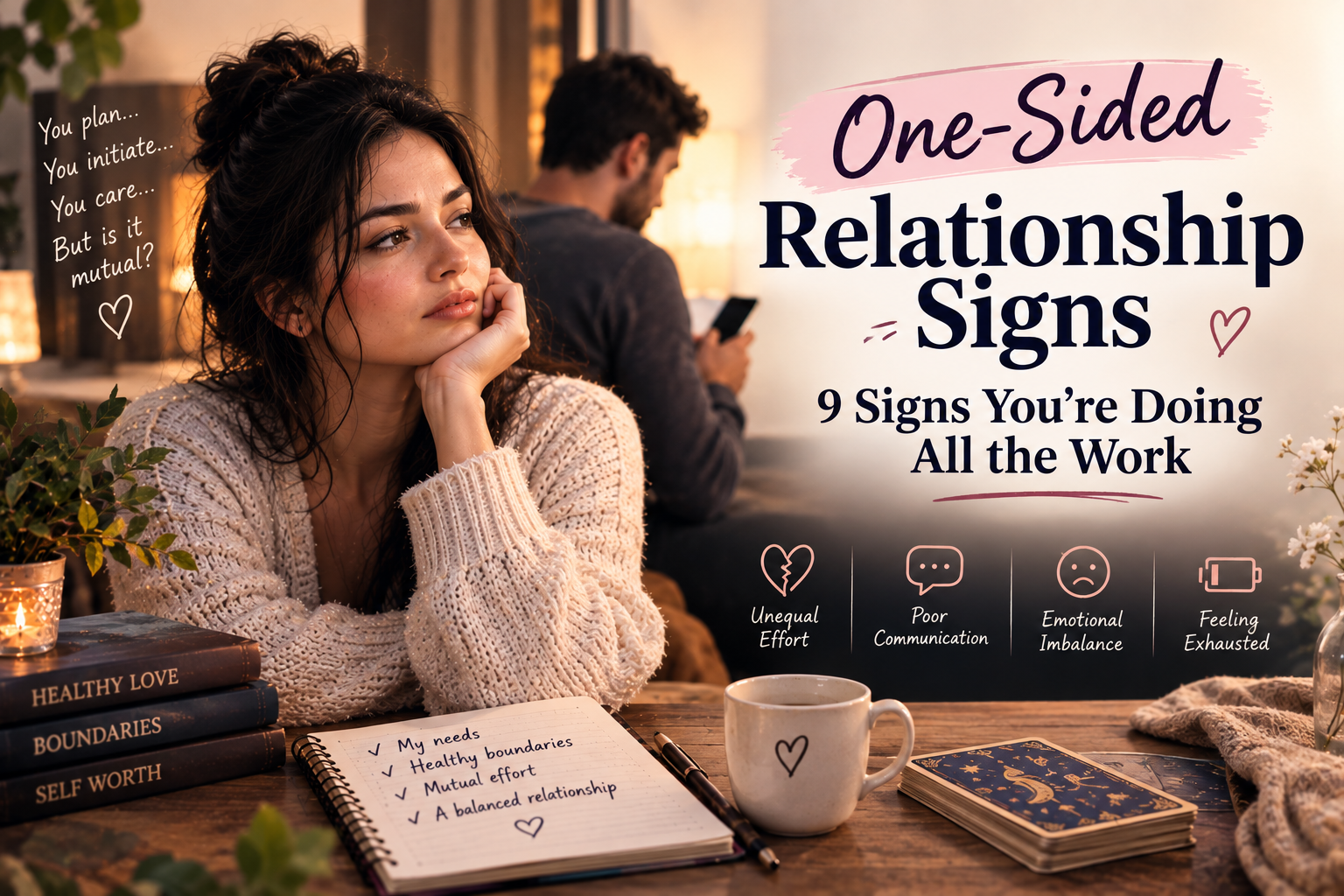
Have you been searching for one sided relationship signs because you feel like you’re always the one trying to keep the relationship alive?
Maybe you initiate most conversations, make the plans, apologise first, or constantly try to fix problems. Your partner may still say they care about you, yet the relationship can leave you feeling tired, uncertain, or emotionally alone.
A relationship does not have to be perfectly 50/50 every day. One person may temporarily give more because the other is dealing with stress, work, family problems, or a difficult period. The concern begins when the imbalance becomes a repeated pattern and there is little effort to restore it.
A one-sided relationship generally involves a persistent lack of reciprocity in emotional, practical, or relational effort. Cleveland Clinic describes it as a situation where effort, energy, or tasks feel imbalanced and one person does not experience the reciprocity they want.
So, how can you tell whether you’re experiencing a temporary imbalance or a genuinely one-sided relationship?
Let’s look at 9 one sided relationship signs that can help you understand the pattern.
What Is a One-Sided Relationship?
A one-sided relationship is a relationship where one person consistently contributes more of the effort required to maintain the connection.
That effort can involve:
- Starting conversations
- Making plans
- Showing emotional support
- Resolving disagreements
- Apologising after conflict
- Initiating affection
- Making compromises
- Checking in regularly
- Trying to improve the relationship
The important word is consistently.
Healthy relationships can have uneven days. One partner might need more support this week, while the other may need it next week.
Psychology Today similarly notes that relationships can become one-sided when the imbalance in energy or investment becomes chronic rather than temporary.
Therefore, don’t judge your entire relationship based on one difficult week.
Look at the pattern over time.
9 One Sided Relationship Signs to Watch For
1. You’re Always the One Initiating Contact
One of the clearest one sided relationship signs is that you’re almost always the person who starts the interaction.
You send the good-morning message.
You ask how their day went.
You call first.
You suggest meeting.
You check whether everything is okay.
Meanwhile, your partner rarely initiates contact unless you reach out first.
Occasionally, this may simply be someone’s communication style. However, if you repeatedly stop initiating and the relationship becomes almost silent, that pattern deserves attention.
Ask yourself:
“If I stopped making the effort, would this relationship continue naturally?”
Your answer may reveal more than another conversation about texting habits.
2. You Feel Responsible for Keeping the Relationship Alive
Another important sign is feeling like the relationship depends entirely on you.
Whenever there is distance, you try to reconnect.
When there’s an argument, you start the repair conversation.
If something feels wrong, you research how to fix it.
You may even feel guilty when the relationship becomes disconnected.
Over time, this creates emotional pressure because you’re no longer simply participating in the relationship.
You feel responsible for maintaining it.
That is a major difference.
A healthy relationship requires participation from both people, even though the exact amount of effort may change from day to day.
3. Difficult Conversations Are Mostly Your Responsibility
Every relationship eventually needs difficult conversations.
Maybe you’re unhappy about communication.
Perhaps you need more affection.
You could be worried about trust, commitment, or emotional distance.
In a balanced relationship, both people should have some willingness to discuss these concerns.
One-sided relationship dynamics can look different.
You may repeatedly bring up the same issue while your partner:
- Avoids the conversation
- Changes the subject
- Becomes defensive
- Gives vague promises
- Says you’re overthinking
- Stops responding
- Waits for the issue to disappear
Cleveland Clinic also identifies a lack of meaningful connection and an imbalance in relationship effort among common signs.
The problem isn’t that every conversation goes perfectly.
The problem is when only one person keeps trying to have the conversation.
4. You Apologise Even When You’re Not the Only One at Fault
Do you find yourself saying sorry simply because you want the relationship to become peaceful again?
Perhaps the argument wasn’t entirely your fault.
Still, you apologise.
You explain yourself.
You soften your position.
Then you become the person responsible for repairing everything.
Repeatedly taking responsibility can create an unhealthy dynamic where one person’s feelings become more important than the other’s.
Psychology Today includes frequently apologising and making excuses for a partner’s behaviour among possible signs of a one-sided relationship.
Healthy accountability sounds different.
You can acknowledge your mistakes without taking responsibility for everything.
5. Your Emotional Needs Keep Getting Pushed Aside
A relationship should have room for both people’s emotional needs.
Maybe you want reassurance.
Perhaps you need more quality time.
You may want deeper conversations or more emotional affection.
However, whenever you communicate those needs, you feel dismissed.
You might hear:
“You’re too sensitive.”
“Why do you need so much attention?”
“You’re overthinking again.”
“Nothing is wrong.”
When this happens repeatedly, you may begin questioning whether your needs are reasonable.
Instead of asking only:
“Am I asking for too much?”
also ask:
“Is there space for my needs in this relationship?”
That distinction can be extremely important.
6. You’re Making Most of the Compromises
Relationships involve compromise.
Sometimes you adjust your schedule.
Sometimes your partner does.
One weekend you visit their family.
Another weekend you spend time with yours.
You make adjustments because you value the relationship.
The problem appears when compromise consistently moves in only one direction.
You change your plans.
You travel farther.
You cancel things.
You accept their preferences.
You accommodate their schedule.
Yet they rarely make similar adjustments for you.
That pattern can create resentment because compromise stops feeling mutual.
7. You Feel Lonely Even When You’re Together
This can be one of the most confusing one sided relationship signs.
You’re technically in a relationship.
You may see each other regularly.
You might even live together.
Still, you feel emotionally alone.
There’s a difference between being alone and feeling alone while connected to someone.
You may notice:
- Conversations feel superficial.
- Your partner rarely asks about your inner world.
- You don’t feel emotionally understood.
- You hesitate to share your problems.
- Affection feels one-directional.
- Important moments don’t feel shared.
A relationship can have physical closeness without enough emotional connection.
When that happens repeatedly, the loneliness can become more painful because you expected the relationship to provide connection.
8. Their Words Sound Caring, But Their Actions Don’t Match
Another important one sided relationship sign is a repeated gap between words and behaviour.
Your partner may say:
“I care about you.”
But they rarely make time for you.
They may say:
“We’ll work on it.”
Yet nothing changes.
They might promise:
“I’ll communicate better.”
Then the same pattern returns.
One disappointing moment does not prove anything.
Instead, look for consistency.
Ask:
Do their actions generally support what they say?
A relationship becomes difficult when promises repeatedly create hope but behaviour repeatedly creates disappointment.
9. You Are Doing All the Emotional Work
This is perhaps the biggest pattern behind many one sided relationship signs.
You analyse the relationship.
You think about their feelings.
You worry about their needs.
You initiate difficult conversations.
You search for relationship advice.
You try to understand their behaviour.
You think about how to communicate better.
You look for ways to repair the connection.
Meanwhile, your partner appears relatively uninvolved in understanding or improving the relationship.
That’s more than simply “trying harder.”
You’re carrying the emotional workload of the relationship.
If the same pattern continues despite honest conversations, it is worth asking whether both people are genuinely participating.
One-Sided Relationship vs Temporary Imbalance
Not every period of unequal effort means your relationship is one-sided.
Life happens.
A partner may temporarily have:
- Work pressure
- Family responsibilities
- Financial stress
- Grief
- Burnout
- Personal problems
- Major life changes
During those periods, you may naturally contribute more.
The bigger question is whether reciprocity returns.
| Temporary imbalance | One-sided relationship pattern |
|---|---|
| Happens during a difficult period | Continues for a long time |
| Partner acknowledges the imbalance | Partner dismisses your concerns |
| They try to improve | Little meaningful change |
| Effort eventually becomes mutual again | You continue doing most of the work |
| Both people care about the relationship | One person carries most of the responsibility |
Therefore, don’t focus on one bad week.
Focus on the repeated pattern.
Why Do One-Sided Relationships Happen?
There isn’t one explanation for every relationship.
Sometimes people have different communication styles.
One partner may naturally be more proactive.
In other situations, one person may have become comfortable receiving more effort without recognising how unequal the relationship has become.
Other possible factors include:
- Different expectations about relationships
- Poor communication habits
- Emotional avoidance
- Fear of conflict
- Unequal commitment
- Different levels of emotional availability
- Stress or life circumstances
- Difficulty expressing affection
- A relationship that has gradually become imbalanced
The reason matters because the solution may depend on whether the imbalance is temporary, unintentional, or deeply established.
What to Do If You Recognise These One Sided Relationship Signs
Recognising the pattern is only the beginning.
The next step is understanding what you actually need.
1. Stop measuring every individual interaction
Don’t keep score of every text message.
Instead, look at the overall pattern.
2. Identify your unmet needs
Write down three things you genuinely need from the relationship.
For example:
- More emotional communication
- More consistent quality time
- Greater effort during conflict
Be specific.
3. Communicate without attacking
Instead of:
“You never make any effort.”
Try:
“I’ve been feeling like I’m carrying most of the effort lately, especially when it comes to communication and making plans.”
Specific language makes the conversation easier to understand.
4. Watch what happens after the conversation
This is crucial.
Don’t only listen to the response.
Observe what happens afterwards.
Does your partner try?
Do they ask questions?
Do they make changes?
Do they dismiss the issue?
Actions over time can give you more information than one reassuring conversation.
5. Decide what your boundaries are
A boundary isn’t a threat.
It is clarity about what you are willing to participate in.
For example:
“I want a relationship where both people communicate and make an effort. I can’t continue carrying the entire relationship alone.”
Your boundary should focus on your actions, not controlling theirs.
What If My Partner Loves Me but Still Doesn’t Put in Effort?
This is an important question.
Someone can care about you and still struggle to provide the type of relationship you need.
Love and relationship compatibility aren’t always the same thing.
A person may genuinely have feelings while still being:
- Emotionally unavailable
- Poor at communication
- Avoidant during conflict
- Unwilling to compromise
- Unable to meet your current needs
That’s why the better question isn’t simply:
“Do they love me?”
Consider asking:
“Can we build a relationship where both of us feel valued, heard, and supported?”
That question moves the focus from guessing someone’s feelings to evaluating the relationship you are actually experiencing.
Can Tarot Help With a One-Sided Relationship?
Tarot can be used as a reflection tool when you’re confused about relationship dynamics.
It shouldn’t be treated as proof of what another person secretly thinks or as a guaranteed prediction of what they will do.
Instead, use the cards to explore your own perspective, needs, patterns, and choices.
For example, you could ask:
- What am I not seeing clearly in this relationship?
- Where am I giving more than feels healthy?
- What emotional need am I avoiding?
- What pattern keeps repeating?
- What boundary do I need to consider?
- What can I control here?
- What would a balanced relationship look like for me?
This approach keeps the reading focused on something you can actually act on.
Biddy Tarot similarly frames Tarot as a way to access reflection and intuition rather than treating the cards as a guaranteed source of future facts.
5 Tarot Cards for Relationship Clarity
If you’re doing a reflective reading about a relationship, these cards can provide useful themes.
| Tarot card | Possible relationship reflection |
|---|---|
| Two of Cups | Mutual connection, emotional exchange and partnership |
| Six of Pentacles | Giving, receiving and balance |
| Justice | Fairness, accountability and consequences |
| The Lovers | Values, choices and relationship alignment |
| Temperance | Patience, balance and finding a healthier middle ground |
For example, the Six of Pentacles can be a useful symbol when you’re reflecting on whether giving and receiving feel balanced.
The Lovers can also invite reflection on values and choices rather than simply asking whether someone is “the one.” Biddy Tarot’s interpretation connects the card with relationships, harmony, values alignment and choices.
A 7-Card Tarot Spread for a One-Sided Relationship
Try this spread when you want clarity about your own position.
Card 1 – What am I feeling right now?
Understand your emotional starting point.
Card 2 – What am I giving to this relationship?
Look at the effort you’re contributing.
Card 3 – What do I need emotionally?
Identify an unmet need.
Card 4 – What pattern am I overlooking?
Look beyond the obvious conflict.
Card 5 – What boundary needs attention?
Focus on what you can control.
Card 6 – What can I do differently?
Turn insight into practical action.
Card 7 – What should I understand about my next step?
Use this as a reflection point rather than a fixed prediction.
This keeps the reading centred on your choices and relationship experience, rather than attempting to read another person’s private thoughts.
One-Sided Love vs One-Sided Relationship
These terms sound similar, but they can describe different experiences.
One-sided love usually means romantic feelings are not equally returned.
A one-sided relationship can involve two people who are both romantically involved, but one person consistently contributes much more effort.
For example:
You may both love each other, yet one person may still be doing almost all the emotional work.
That’s why simply knowing that someone has feelings isn’t enough to determine whether the relationship is healthy or sustainable.
Ask Yourself These 7 Questions
If you’re still unsure whether your relationship is one-sided, write down your answers honestly:
- Who usually initiates contact?
- Who usually makes plans?
- Who starts difficult conversations?
- Who apologises first?
- Do my emotional needs receive genuine attention?
- When I communicate a concern, does anything change?
- If I stopped doing all the extra work, what would happen?
Don’t answer based on one recent argument.
Think about the last few months.
Patterns are usually more revealing than isolated moments.
When Should You Take a Step Back?
You don’t have to make an immediate decision about your relationship simply because you recognise some of these signs.
Instead, consider taking a step back when:
- You’re constantly emotionally exhausted.
- Your needs are repeatedly dismissed.
- Communication attempts go nowhere.
- Promises are repeatedly followed by the same behaviour.
- You feel responsible for another person’s emotions.
- You have stopped feeling like an equal partner.
- You are losing yourself while trying to keep the relationship together.
Cleveland Clinic notes that there isn’t one universal point at which every one-sided relationship must end; what matters can include whether reasonable attempts to address the imbalance lead to meaningful change.
Your situation deserves to be evaluated based on its own circumstances.
Frequently Asked Questions
1. What are the biggest one sided relationship signs?
Common one sided relationship signs include always initiating contact, making most plans, carrying difficult conversations, apologising repeatedly, compromising more often, and feeling emotionally unsupported.
2. Can a relationship be one-sided even if my partner loves me?
Yes. Someone can care about you while still contributing less effort than you need in a relationship. Feelings alone don’t automatically create mutual communication, consistency, or emotional availability.
3. Is every relationship imbalance unhealthy?
No. Temporary imbalance is normal. Problems are more concerning when the imbalance becomes persistent and one person repeatedly avoids addressing it.
4. How do I know if I’m doing too much in my relationship?
Look at the overall pattern. If you consistently initiate communication, solve conflicts, make plans, compromise, and provide emotional support while receiving little effort in return, you may be carrying more than your share.
5. Should I stop initiating contact to test my partner?
Rather than treating silence as a test, communicate your concern directly. You can then observe whether your partner makes a genuine effort without creating a hidden experiment.
6. Can Tarot tell me whether my relationship is one-sided?
Tarot can be used for reflection around your feelings, relationship patterns, needs, boundaries, and choices. It shouldn’t be treated as objective proof of another person’s private thoughts or guaranteed future behaviour.
7. Can a one-sided relationship become balanced?
Sometimes it can, especially when both people recognise the problem and are willing to make meaningful changes. The important part is not only what someone promises but what changes consistently over time.
Final Thought
Recognising one sided relationship signs doesn’t automatically mean your relationship has to end.
Instead, it gives you an opportunity to look honestly at what is happening.
Ask yourself:
Am I being loved in a way that also feels supportive, respectful, and mutual?
You deserve a relationship where you don’t have to constantly chase communication, carry every difficult conversation, or prove that your needs matter.
Love can be meaningful.
But healthy relationships also need reciprocity, communication, respect, effort, and emotional connection.
If you’re confused about what you’re experiencing, give yourself permission to slow down before making a major decision. Look at the pattern. Communicate clearly. Notice the response. Then decide what aligns with your own needs and boundaries.