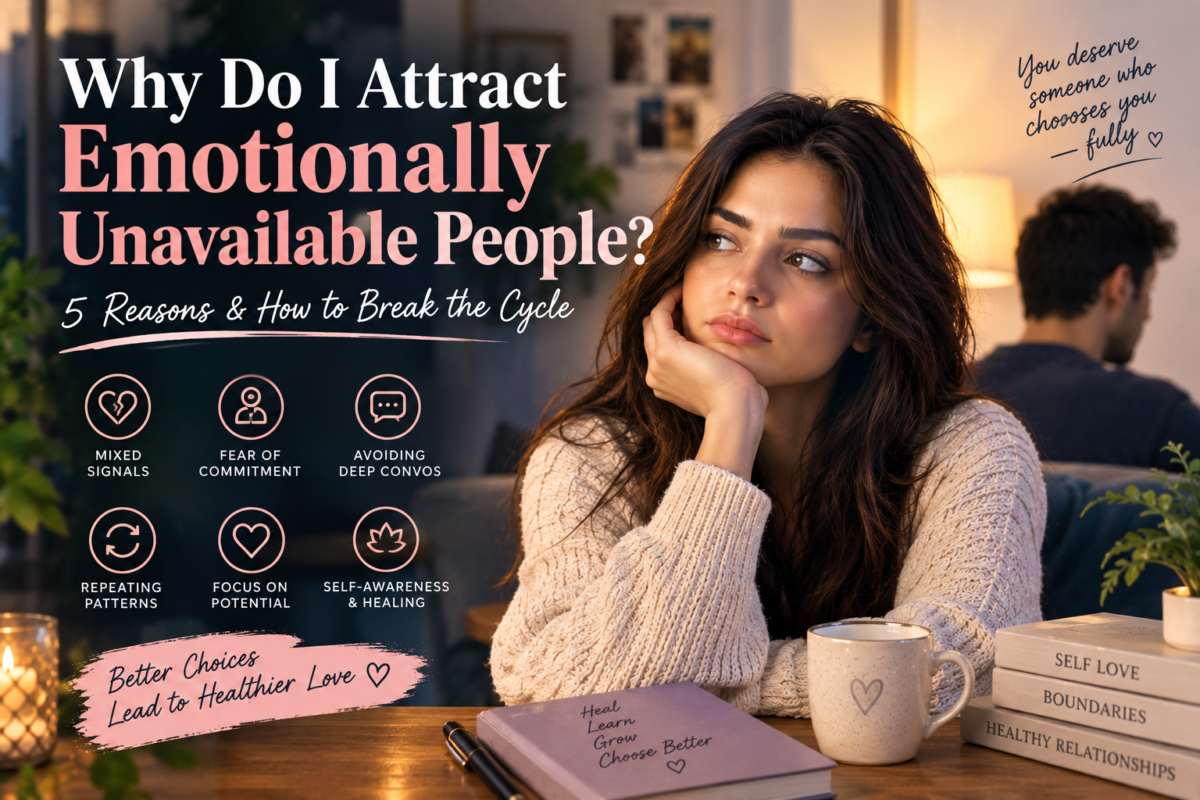



Have you ever been involved with someone who seemed interested one day and distant the next?
Maybe they enjoyed spending time with you, but avoided serious conversations. They could be affectionate and caring, yet became uncomfortable whenever you talked about the future.
You may have found yourself asking:
“Do they actually care about me, or am I imagining the connection?”
This confusion can be emotionally exhausting.
Sometimes the problem isn’t that there is no attraction. The person may genuinely like you but still struggle to create emotional closeness.
This is often described as emotional unavailability.
Understanding the signs of emotional unavailability can help you stop overanalyzing mixed signals and start paying attention to consistent behavior.
What Does Emotionally Unavailable Mean?
An emotionally unavailable person may find it difficult to express feelings, build emotional intimacy, communicate openly, or commit to a deeper relationship.
This doesn’t necessarily mean they are a bad person.
People can become emotionally unavailable for many reasons, including past relationship experiences, fear of vulnerability, difficulty communicating emotions, or simply not being ready for the type of relationship you want.
The important thing is to recognize the difference between understanding someone’s reasons and ignoring how their behavior affects you.
9 Signs of Emotional Unavailability
1. They Avoid Deep Emotional Conversations
One of the most common signs of emotional unavailability is avoiding meaningful conversations.
Whenever you try to discuss feelings, expectations, fears, or the future, they may change the subject or make the conversation into a joke.
They may be comfortable talking about everyday things but become distant when the conversation becomes emotionally vulnerable.
Ask yourself:
“Can I talk honestly about my feelings with this person?”
If the answer is consistently no, it deserves attention.
2. They Send Mixed Signals
One day they seem extremely interested.
The next day they disappear.
Then they return as if nothing happened.
This hot-and-cold behavior can leave you constantly wondering where you stand.
The problem with mixed signals is that you may spend more time interpreting their behavior than actually enjoying the relationship.
Instead of focusing on one romantic moment, look at the overall pattern.
Consistency is often more meaningful than occasional intensity.
3. They Avoid Defining the Relationship
If someone repeatedly avoids conversations about what your relationship actually is, they may not be ready for commitment.
They might say:
“Let’s just see where this goes.”
“Why do we need labels?”
“I don’t like planning too far ahead.”
There is nothing wrong with taking a relationship slowly.
But if you want commitment and the other person continuously avoids the conversation, your needs may not be aligned.
4. They Keep You at an Emotional Distance
You may spend a lot of time together but still feel that you don’t truly know them.
They may share surface-level information but rarely discuss their fears, hopes, struggles, or deeper feelings.
You can be physically close to someone while remaining emotionally disconnected.
True intimacy requires some level of vulnerability from both people.
5. They Talk Constantly About Their Ex
Everyone has a past.
Talking about a previous relationship isn’t automatically a problem.
However, if their ex appears in almost every conversation, they constantly compare you to them, or they are clearly emotionally focused on the past, they may not have enough emotional space for a new relationship.
Before becoming deeply invested, consider whether they are actually available for something new.
6. They Only Come Closer When You Pull Away
This pattern can be especially confusing.
When you are available, they seem distant.
When you start moving on, suddenly they become affectionate and attentive.
This can create an emotional cycle where you repeatedly move closer and farther apart.
Before interpreting this behavior as proof of deep feelings, ask:
“Are they consistently choosing me, or do they only react when they feel they might lose access to me?”
Those are very different things.
7. You Feel Like You Have to Earn Their Attention
Do you constantly feel that you need to prove that you’re worth their time?
You might change your behavior, send the perfect message, avoid expressing your needs, or try harder whenever they become distant.
A healthy relationship shouldn’t require you to constantly compete for someone’s emotional availability.
You deserve a connection where communication and affection don’t feel like rewards you have to earn.
8. They Struggle With Vulnerability
Emotional intimacy requires vulnerability.
An emotionally unavailable person may find it difficult to admit when they are hurt, scared, confused, or emotionally attached.
They may appear extremely independent and insist that they don’t need anyone.
Independence is healthy.
But refusing all emotional vulnerability can make it difficult to build a genuinely close relationship.
9. Their Actions Don’t Match Their Words
Perhaps they tell you that they care about you but repeatedly disappear.
They say they want a relationship but avoid commitment.
They promise to communicate better but continue doing the same thing.
When words and actions consistently disagree, pay attention to the actions.
You don’t have to decide that someone doesn’t care.
Simply recognize that their current behavior may not provide the relationship you need.
Why Are We Sometimes Attracted to Emotionally Unavailable People?
If you repeatedly find yourself attracted to emotionally distant partners, you may eventually wonder:
“Why does this keep happening to me?”
There can be many reasons.
Sometimes uncertainty creates excitement.
Sometimes we become focused on proving that someone will finally choose us.
Sometimes familiar relationship patterns influence what feels attractive.
You may also confuse emotional distance with mystery or strong chemistry.
This doesn’t mean something is wrong with you.
Instead, it can be an opportunity to understand your relationship patterns more deeply.
Ask yourself:
- What type of people am I usually attracted to?
- Do I feel more attracted when someone is difficult to reach?
- Do I ignore my needs when I really like someone?
- Am I attracted to potential rather than reality?
- Do I feel comfortable receiving healthy love?
These questions can reveal patterns that are difficult to notice while you’re emotionally involved.
What Should You Do If Someone Is Emotionally Unavailable?
You cannot force another person to become emotionally ready.
What you can control is how you respond.
Start by becoming clear about your own needs.
If you want commitment, communication, affection, and emotional intimacy, acknowledge that honestly.
Then observe whether the other person’s behavior supports those needs.
You don’t necessarily need to walk away immediately.
But you also shouldn’t spend months or years waiting for someone to become the person you hope they will be.
Believe patterns, not promises alone.
Can Tarot Help With Relationship Confusion?
When you’re emotionally attached to someone, it can be difficult to see the situation clearly.
A tarot reading can be used as a reflective tool to explore your feelings, relationship patterns, and the questions you may be avoiding.
Instead of asking only:
“Does this person love me?”
consider questions such as:
- Why am I so attached to this relationship?
- What pattern am I repeating?
- What am I not seeing clearly?
- What do I need emotionally from a partner?
- What can I learn from this connection?
- What should I focus on for my own growth?
Tarot cannot guarantee another person’s feelings or future actions. But it can provide a structured opportunity for self-reflection and clarity.
If you’re struggling to understand a confusing relationship, a personalized relationship tarot reading at The Astro Palace can help you explore the situation from a different perspective.
Final Thoughts
Recognizing the signs of emotional unavailability isn’t about labeling someone as good or bad.
It’s about understanding whether their current emotional capacity matches what you need from a relationship.
Someone can be a wonderful person and still not be ready for the relationship you want.
And you can care deeply about someone while recognizing that their behavior is not giving you the emotional security you need.
Instead of constantly asking:
“How can I make them open up?”
try asking:
“Is this relationship giving me what I genuinely need?”
That question puts your attention back where it belongs: on your own emotional wellbeing.
Healthy love shouldn’t require you to spend all your time decoding mixed signals.
It should leave room for communication, respect, trust, vulnerability, and consistency.
Frequently Asked Questions
1. What are the biggest signs of emotional unavailability?
Common signs include avoiding emotional conversations, inconsistent communication, fear of commitment, difficulty showing vulnerability, keeping emotional distance, and repeatedly giving mixed signals.
2. Can an emotionally unavailable person fall in love?
Yes. Emotional unavailability doesn’t necessarily mean someone cannot experience love. However, experiencing feelings and being able to communicate them or build a healthy relationship are not always the same thing.
3. How do I know if someone is emotionally unavailable or just shy?
Look at the overall pattern. A shy person may gradually become more comfortable with trust and communication. Someone who is consistently unavailable may repeatedly avoid emotional closeness even after trust has developed.
4. Should I wait for an emotionally unavailable person?
There is no universal answer. Consider what you need from a relationship and whether the person’s current behavior meets those needs. Avoid basing your decision only on their potential to change.
5. Can astrology explain emotional patterns in relationships?
Astrology can be used as a reflective framework for exploring personality, communication styles, relationship patterns, and personal themes. It should be viewed as a tool for reflection rather than a guarantee of how another person will behave.