

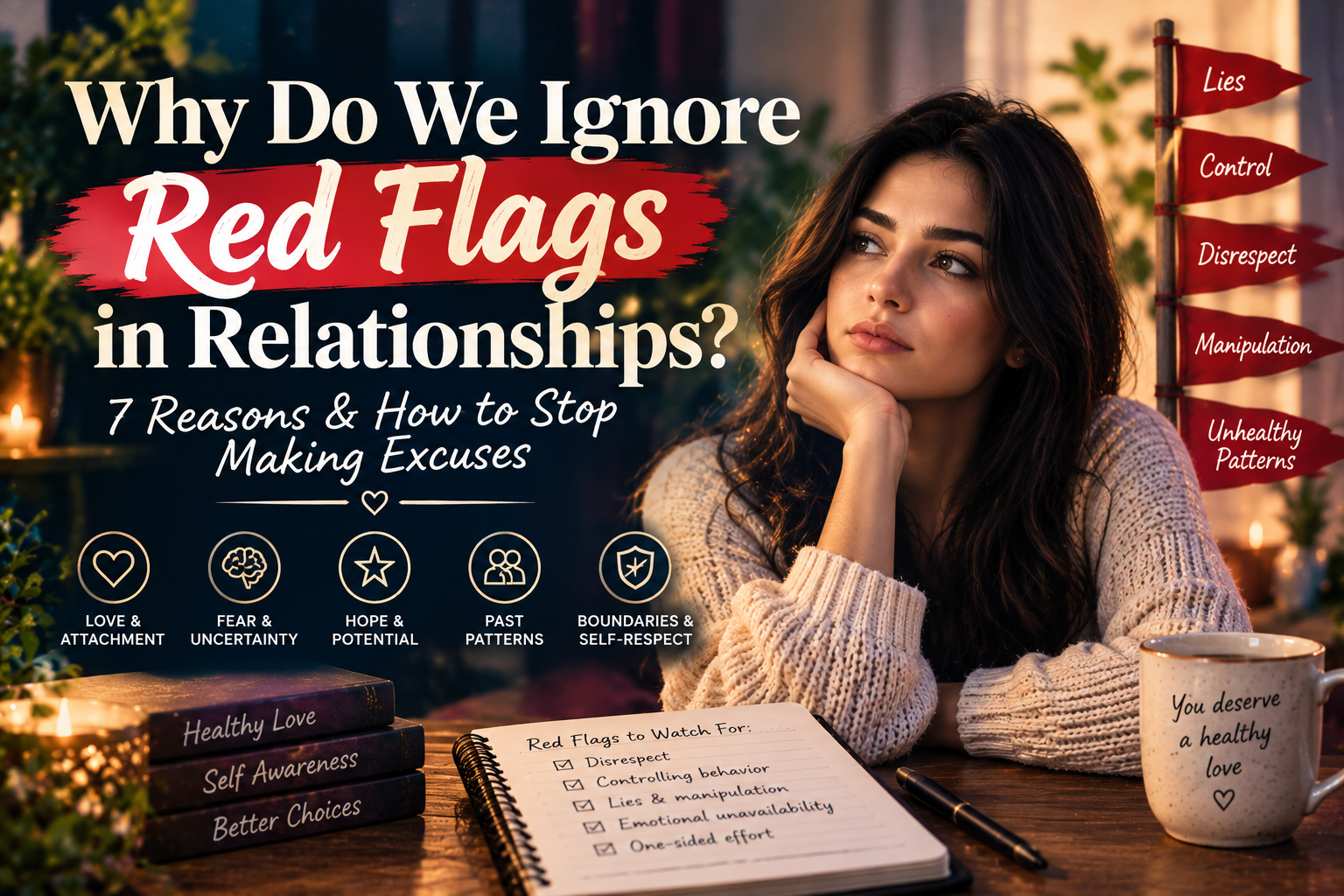
Have you ever noticed something in a relationship that made you uncomfortable, but then found yourself making excuses for it? Maybe they disappeared for days, crossed a boundary, lied about something small, avoided commitment, or treated you differently when they were upset. You noticed it — but you told yourself it wasn’t a big deal.
So, why do we ignore red flags in relationships even when we sometimes recognize them clearly?
The answer isn’t always that someone is naive or unable to judge people. Hope, emotional attachment, fear of losing the relationship, positive first impressions, and the desire to believe things will improve can all influence how we interpret warning signs.
Understanding this pattern can help you become more aware of what you’re accepting — without becoming suspicious of everyone you meet.
What Is a Red Flag in a Relationship?
A relationship red flag is a behavior or pattern that may indicate a serious problem with compatibility, respect, boundaries, trust, or emotional safety.
Examples can include:
- Repeated dishonesty
- Controlling behavior
- Disrespect for your boundaries
- Excessive jealousy
- Isolation from friends or family
- Manipulation or guilt-tripping
- Refusing to take responsibility
- Constant criticism
- Pressure to move faster than you’re comfortable with
- Making you afraid to express your feelings
One uncomfortable moment doesn’t automatically define an entire relationship. What matters is the pattern, frequency, severity, impact, and willingness to change.
Healthy relationships generally involve mutual respect, communication, trust, support and the ability to negotiate differences without fear or control.
Why Do We Ignore Red Flags in Relationships?
1. We Focus on the Person We Hope They Will Become
One of the biggest reasons people ignore relationship red flags is potential.
You might think:
“They’re amazing when they’re not stressed.”
Or:
“They’ll change once they feel secure.”
Or:
“Deep down, they’re a good person.”
Hope isn’t necessarily a bad thing. But problems arise when future potential becomes more important than present behavior.
If someone repeatedly hurts you, promises to change, and then repeats exactly the same behavior, the promise shouldn’t automatically erase the pattern.
Change is demonstrated through consistent behavior over time — not simply through apologies or promises.
2. Strong Chemistry Can Make Warning Signs Easier to Dismiss
When you’re intensely attracted to someone, it can become difficult to separate chemistry from compatibility.
You may feel:
- Excited whenever they message
- Extremely attracted to them
- Obsessed with seeing them
- Nervous when they pull away
- Relieved when they return
- Convinced that the connection must be special
That intensity can make you overlook problems that would seem obvious if you were emotionally detached.
This is one reason it’s important to ask yourself:
“Do I actually feel safe and respected with this person, or do I simply feel intensely attracted to them?”
You can explore this further in our article on why you may confuse chemistry with compatibility.
3. You Don’t Want to Lose the Relationship
Sometimes the red flag isn’t difficult to recognize.
The difficult part is accepting what it might mean.
If you’ve already invested months of emotional energy into someone, admitting that the relationship has serious problems can feel painful.
You may think:
“I’ve already given this so much time.”
“What if I never find someone else?”
“Maybe I’m expecting too much.”
“I don’t want to start over.”
This can create a powerful reason to minimize problems.
Instead of asking, “How much have I already invested?”, try asking:
“If I met this person today and knew everything I know now, would I still choose this relationship?”
That question can sometimes provide a different perspective.
4. You Become Attached to the Good Moments
A relationship doesn’t have to be bad all the time for problems to matter.
You may remember the beautiful conversations, surprise gifts, amazing dates, and moments when your partner made you feel special. Those positive experiences can make difficult behavior easier to explain away.
However, a healthy relationship isn’t measured only by its best moments. Pay attention to how someone behaves when they’re disappointed, angry, stressed, or told “no.”
Those difficult moments can reveal how a person handles boundaries, disagreement, and conflict.
5. You Believe You Can Fix Them
Love can sometimes create a “rescuer” mindset.
You see someone’s emotional wounds and begin thinking:
“If I love them enough, they’ll heal.”
Maybe they had a difficult childhood.
Maybe their previous relationship hurt them.
Maybe they’ve never experienced healthy communication.
Understanding someone’s past can create compassion — but compassion doesn’t require you to tolerate behavior that hurts you.
You can understand someone’s wounds while still maintaining boundaries.
Their healing is ultimately their responsibility.
6. Your First Impression Is Too Powerful
Another reason why do we ignore red flags in relationships is that our first impression of someone can influence how we interpret everything that happens afterward.
If you initially decide that someone is kind, trustworthy, or perfect for you, it can become easier to notice information that supports that belief while dismissing information that challenges it.
Psychology literature discusses concepts such as the primacy effect and confirmation bias, which can influence how people interpret warning signs.
Instead of protecting your first impression, focus on observing the person’s behavior over time. Consistency matters more than a perfect beginning.
7. The Relationship Feels Familiar
Sometimes an unhealthy dynamic can feel strangely familiar.
If you’ve experienced inconsistency, criticism, emotional distance, or unstable relationships before, you may become accustomed to those patterns.
That doesn’t mean everyone repeats their past automatically.
It simply means that familiarity can sometimes influence what feels normal.
You might even mistake emotional uncertainty for excitement.
This is why self-awareness matters.
Ask:
“Does this relationship feel healthy, or does it simply feel familiar?”
Red Flags You Shouldn’t Keep Explaining Away
Not every relationship problem means you need to leave immediately.
However, certain behaviors deserve serious attention, especially when they become repeated patterns.
These include:
Controlling behavior
Someone tries to control who you see, where you go, what you wear, or how you spend your time.
Boundary violations
You clearly communicate that something makes you uncomfortable, but the person repeatedly ignores it.
Isolation
They attempt to distance you from friends, family, or other sources of support.
Gaslighting or reality manipulation
They repeatedly make you question your own experiences or shift responsibility for their behavior onto you.
Fear
You feel afraid of their anger, reactions, punishment, or what might happen if you disagree.
Repeated dishonesty
You repeatedly discover lies and are expected to simply move past them.
These behaviors can be signs of unhealthy or abusive dynamics. Cleveland Clinic recommends paying attention to patterns involving control, isolation, boundary violations and manipulation rather than dismissing them as isolated incidents.
If you feel unsafe or threatened, prioritize your safety and seek help from trusted people or appropriate professional/domestic-violence resources rather than relying only on relationship or spiritual guidance.
How to Stop Ignoring Red Flags
Recognizing a red flag is one thing. Changing your response to it is another.
Start by writing down what actually happened rather than immediately creating an explanation for the behavior. Separating facts from assumptions can make the situation easier to evaluate.
Next, look for patterns. Has this happened before? Is it becoming more frequent? Do apologies lead to actual change?
Finally, pay attention to how the person responds when you establish a boundary. Their reaction can tell you much more than a temporary promise to behave differently.
What If You Still Love Someone Who Has Red Flags?
This is where things can become emotionally complicated.
You may still love someone while recognizing that the relationship isn’t healthy for you. Missing a person doesn’t automatically mean the relationship should continue.
Beautiful memories can remain meaningful without becoming a reason to ignore harmful patterns.
If you’re struggling to understand why you keep returning to the same relationship dynamic, exploring your emotional patterns may help you gain a clearer perspective.
You may also want to read Why Do I Attract Emotionally Unavailable People? and Why Do I Keep Thinking About My Ex? for related perspectives.
Can Tarot Help You Understand Relationship Red Flags?
Tarot can be used as a reflective tool when you’re emotionally confused about a relationship.
Instead of asking:
“Is this person definitely my soulmate?”
you could ask:
- What am I not seeing clearly?
- What pattern keeps repeating?
- What do I need to understand about this connection?
- What should I pay attention to?
- What boundary do I need to strengthen?
- What can I learn from this experience?
A Tarot reading shouldn’t replace direct communication, professional support, or your own judgment.
But it can provide a structured moment for reflection when your emotions are making the situation difficult to process.
If you want to explore a personal relationship situation in more depth, you can consider a personalized Tarot reading through The Astro Palace.
Final Thoughts
Sometimes the hardest part isn’t recognizing a red flag. It’s accepting what that red flag may be telling you.
Hope, attraction, attachment, and memories can all make warning signs easier to dismiss. Awareness gives you an opportunity to pause and look at the situation more objectively.
A healthy relationship shouldn’t require you to constantly explain away your discomfort.
Instead of asking only, “How can I make this relationship work?”, consider asking:
“What is this relationship showing me about what I need, what I value, and what I am willing to accept?”
Frequently Asked Questions
1. Why do we ignore red flags in relationships?
People may ignore red flags because of emotional attachment, hope, loneliness, strong first impressions, fear of losing the relationship, or the belief that a partner will eventually change. Research and relationship psychology literature also discuss confirmation bias and motivated perception as factors that can influence how people interpret warning signs.
2. Does ignoring red flags mean I am naive?
No. Emotional investment can make difficult information harder to process. Recognizing a problem and being emotionally ready to act on it are two different things.
3. Can someone change after showing red flags?
People can change, but promises alone aren’t enough evidence. Look for consistent behavior, accountability, respect for boundaries, and meaningful change over time.
4. What is the biggest relationship red flag?
There isn’t one universal red flag for every situation. Repeated control, intimidation, isolation, serious dishonesty, boundary violations, and behavior that makes you feel unsafe deserve particular attention.
5. Should I trust my intuition about relationship red flags?
Your feelings can be useful information, but they don’t have to be treated as absolute proof. Slow down, observe the behavior, look for patterns, and seek perspective from people you trust.
6. Can Tarot tell me whether my relationship is toxic?
Tarot should not be treated as a diagnostic tool or as proof that another person is abusive or dangerous. It can be used for personal reflection, while decisions about safety and relationships should also consider real-world behavior and appropriate professional support.