


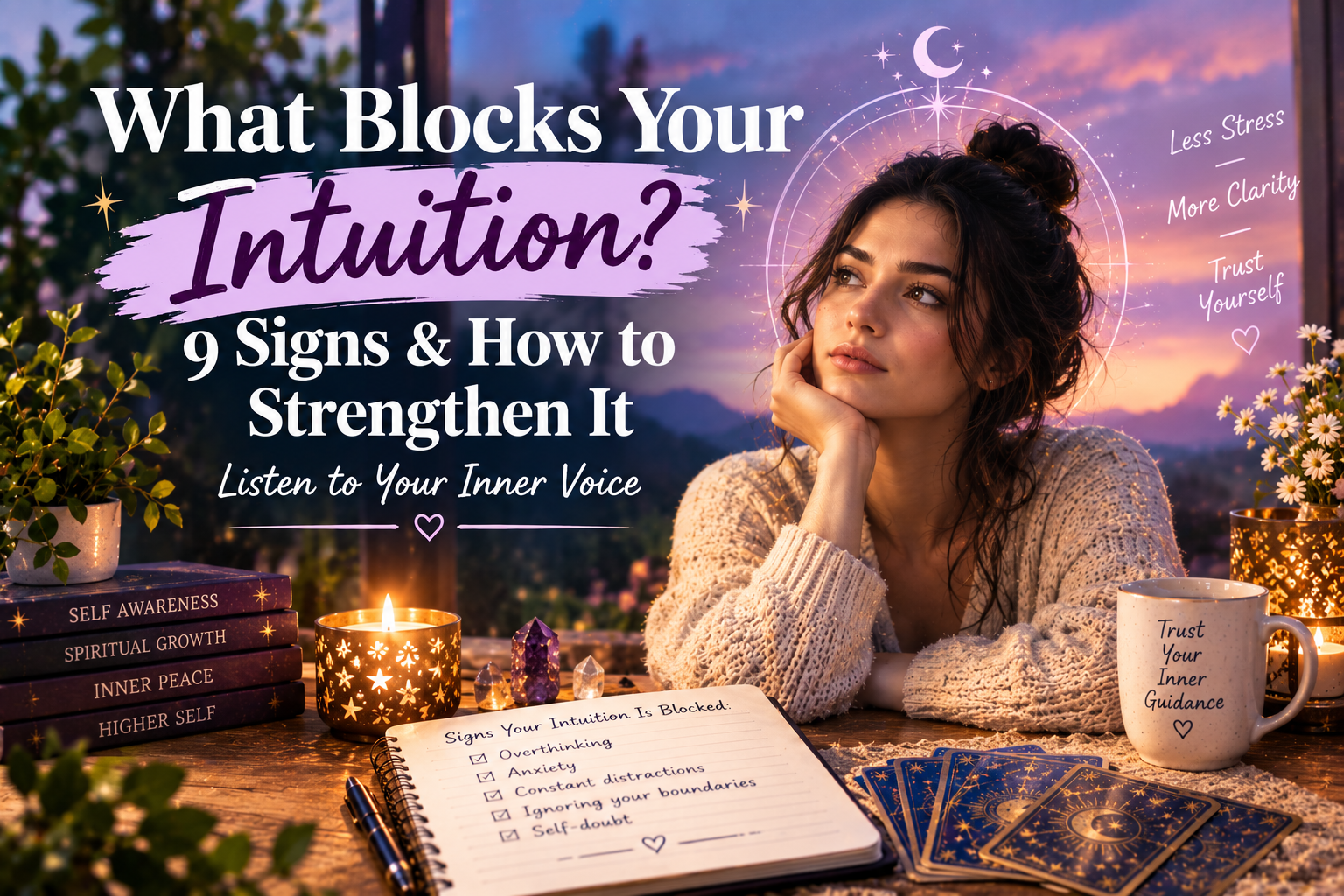
Have you ever had a feeling about someone or something, but then talked yourself out of it? Maybe you sensed that a situation wasn’t right, felt drawn toward a particular decision, or suddenly knew something without being able to explain why. If this happens often, you may wonder what blocks your intuition and why your inner voice sometimes feels difficult to hear.
Intuition is often described as an inner sense of knowing. However, stress, fear, overthinking, outside opinions, emotional exhaustion, and constant distractions can make it harder to notice what you’re feeling.
The good news is that you don’t necessarily need to “find” your intuition. Instead, you can create more space to notice it.
What Is Intuition?
Intuition is a feeling or impression that appears without deliberate step-by-step reasoning.
For example, you might meet someone and immediately feel uncomfortable even though they haven’t obviously done anything wrong. Alternatively, you might feel unexpectedly drawn toward an opportunity that makes sense to you on a deeper level.
Intuition isn’t the same as a guaranteed prediction.
Sometimes a feeling can come from past experiences, learned patterns, anxiety, or assumptions. Therefore, developing intuition also means learning to distinguish your inner signals from fear and overthinking.
What Blocks Your Intuition?
1. Overthinking Everything
One of the biggest answers to what blocks your intuition is excessive thinking.
You may receive an initial feeling, but then your mind starts asking:
“What if I’m wrong?”
“What if I’m imagining this?”
“What if everyone disagrees with me?”
“What if something goes badly?”
Soon, the original feeling becomes buried under dozens of possibilities.
Thinking carefully is useful. However, constantly analyzing every decision can make it difficult to recognize your first impression.
Try pausing before immediately searching for another person’s opinion. Give yourself a few quiet moments to notice what you already feel.
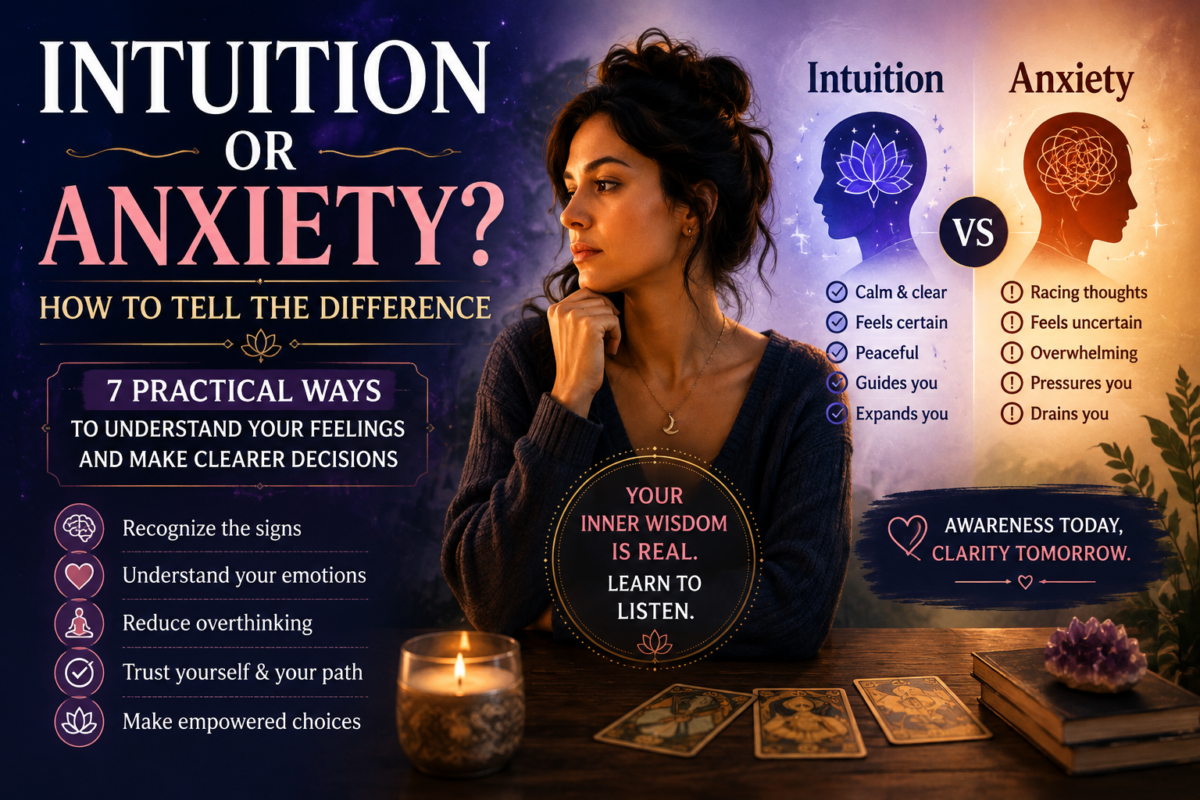
2. Anxiety Can Sound Like Intuition
This is an important distinction.
An anxious thought may feel extremely convincing because your nervous system is focused on potential danger. As a result, you might mistake fear for intuition.
For example:
Anxiety: “Something terrible is going to happen. I need to figure this out immediately.”
Intuition: “Something doesn’t feel right. I should slow down and pay attention.”
The difference isn’t always obvious.
If you’re interested in this topic, our article on intuition vs anxiety can help you explore the distinction further.
3. You Ignore Your Own Boundaries
Every time you repeatedly ignore your discomfort, you may become less confident in your own judgment.
Suppose you don’t want to answer a message, but you feel pressured and do it anyway. Or perhaps someone repeatedly crosses a boundary, yet you convince yourself that you’re being too sensitive.
Over time, you may stop listening to those internal signals.
Instead, start treating discomfort as information.
It doesn’t automatically mean that something is wrong. Nevertheless, it can be worth asking why you feel uncomfortable.
4. Constant Digital Distraction
Your intuition can be difficult to notice when your attention is constantly occupied.
Notifications, social media, videos, messages, and endless scrolling leave very little quiet space.
Therefore, creating moments without stimulation can be surprisingly useful.
Try taking a short walk without your phone. Sit quietly for five minutes. Journal before checking social media in the morning.
You don’t need hours of meditation.
Even a few quiet minutes can help you become more aware of your thoughts and emotions.
5. You Depend Too Much on Other People’s Opinions
Advice can be valuable. However, asking everyone else what you should do can make your own voice harder to hear.
You might ask:
“What would you do?”
“Do you think I should leave?”
“Does this seem like a good idea?”
“Do you think they like me?”
After receiving several opinions, you may become even more confused.
Before asking someone else, ask yourself:
“What do I think?”
You don’t have to follow your first instinct every time. The goal is simply to give your own perspective a place in the decision.
6. Emotional Exhaustion
When you’re exhausted, stressed, or emotionally overwhelmed, everything can feel confusing.
You may struggle to identify whether you’re genuinely uncomfortable or simply tired.
For that reason, don’t expect yourself to make every important decision while emotionally drained.
Rest first when possible.
Eat properly, sleep, take a break, and return to the situation when your mind feels calmer.
Sometimes clarity arrives after your nervous system has had an opportunity to settle.
7. Past Experiences Affect Your Reactions
Your past can influence how you interpret present situations.
For example, if someone you trusted previously lied to you, you may become suspicious when another person behaves similarly. That reaction could contain useful information, but it could also be influenced by an old experience.
This is why self-awareness matters.
Ask:
“Am I responding to what is happening now, or am I reacting to something that happened before?”
That question can help you separate present-moment awareness from old emotional patterns.
8. You Don’t Trust Yourself
Sometimes the biggest block isn’t a lack of intuition.
It’s a lack of confidence in your ability to make decisions.
Perhaps you’ve made mistakes before and now second-guess everything.
However, trusting yourself doesn’t mean believing you’ll always be right.
Instead, self-trust means knowing that even when you make a mistake, you can learn, adjust, and make another decision.
Start with small choices.
Choose what you want to eat. Decide how you want to spend your weekend. Say no when something doesn’t feel right.
Each time you listen to yourself, you’re practicing self-trust.
9. You Expect Intuition to Be Dramatic
Many people imagine intuition as a powerful spiritual sign, a sudden vision, or an unmistakable feeling.
Sometimes it can feel dramatic.
However, intuition may also be very subtle.
It might simply sound like:
“Wait.”
“Something feels different.”
“I should ask another question.”
“This feels right.”
Don’t dismiss a quiet feeling just because it isn’t dramatic.
At the same time, don’t assume every unusual feeling is a spiritual message. Staying grounded helps you evaluate your intuition more clearly.
How to Strengthen Your Intuition
If you want to strengthen your intuition, start with simple habits.
Spend Time in Silence
Give yourself a few quiet minutes every day without your phone or other distractions.
Journal Your Feelings
Write down important decisions and what your first reaction was. Later, look back and see what actually happened.
Notice Your Body
Pay attention to tension, relaxation, excitement, heaviness, or discomfort. Your body can provide useful information about your emotional state.
Practice Making Small Decisions
You don’t need to begin with a major life decision. Start by trusting yourself with small choices.
Reduce Overthinking
When you notice yourself analyzing the same issue repeatedly, pause and ask:
“Do I need more information, or am I simply afraid to decide?”
Give Yourself Time
Intuition becomes easier to recognize when you regularly create space for reflection.
Intuition vs. Impulse: What’s the Difference?
Intuition and impulse can feel similar, but they aren’t necessarily the same.
An impulse may push you toward immediate action.
Intuition can encourage you to pause and observe.
For example, suddenly wanting to send an angry message may be an emotional impulse. Feeling that you should wait until you’re calmer before responding may be a more reflective signal.
Therefore, whenever you feel a strong urge, give yourself a little time before acting.
Clarity often improves when urgency decreases.
Can Tarot Help You Understand Your Intuition?
Tarot can be used as a reflective practice when you’re trying to understand your inner feelings.
Rather than asking Tarot to make every decision for you, consider questions such as:
- What am I currently not seeing clearly?
- What emotion is influencing my decision?
- What should I pay closer attention to?
- What pattern keeps repeating?
- What can help me trust myself more?
A Tarot reading shouldn’t replace practical evidence, communication, or professional advice. Instead, it can provide another framework for reflection.
If you’re considering your first reading, you can also explore how to prepare for a Tarot reading.
Final Thoughts
Understanding what blocks your intuition can help you become more aware of your own thoughts, emotions, and reactions.
Overthinking, anxiety, exhaustion, outside opinions, past experiences, and self-doubt can all make your inner voice harder to recognize. However, you can gradually create more space for self-awareness.
Start small.
Spend a few quiet minutes alone. Journal your first impressions. Pay attention to repeated patterns. Give yourself permission to make decisions without asking everyone else what they think.
Most importantly, remember that trusting your intuition doesn’t mean ignoring logic.
The healthiest approach combines inner awareness with real-world information.
Your intuition can be one source of guidance. Your judgment, experience, and evidence matter too.
Frequently Asked Questions
1. What blocks your intuition the most?
Overthinking, anxiety, emotional exhaustion, constant distraction, dependence on other people’s opinions, and lack of self-trust can make intuition harder to recognize.
2. How can I strengthen my intuition?
Create quiet time, journal your feelings, notice your body responses, reduce distractions, and practice making small decisions independently.
3. How do I know if it’s intuition or anxiety?
Anxiety often creates urgency and repeated fear-based thoughts. Intuition may feel quieter and more observational. However, the two can overlap, so it’s useful to consider evidence and give yourself time before acting.
4. Can intuition be wrong?
Yes. A feeling isn’t automatically a fact. Intuition can be influenced by past experiences, assumptions, anxiety, and incomplete information. That’s why it should be considered alongside evidence and judgment.
5. Does meditation improve intuition?
Meditation can help some people become more aware of their thoughts and emotions by creating quiet space for observation. It isn’t necessary for everyone, but it can be one useful practice.
6. Can Tarot strengthen intuition?
Tarot can encourage reflection and help you pay attention to your thoughts, emotions, and patterns. However, it should be treated as a reflective practice rather than proof that a particular prediction will happen.



One thought on “What Blocks Your Intuition? 9 Signs & How to Strengthen It”