

Have you ever had a gut feeling about someone that you couldn’t explain?
Maybe everything looked perfectly normal on the surface, yet something inside you felt uncomfortable. Or perhaps you met someone new and immediately felt calm, safe and strangely familiar around them.
You might ask yourself:
“Is this my intuition, or am I overthinking?”
A gut feeling can be difficult to understand, especially when emotions, attraction and past experiences are involved. Sometimes your intuition may be picking up on subtle information that your conscious mind hasn’t processed yet. At other times, fear or anxiety can create a feeling that seems just as convincing.
Learning to recognize the difference can help you make clearer decisions in love and relationships.
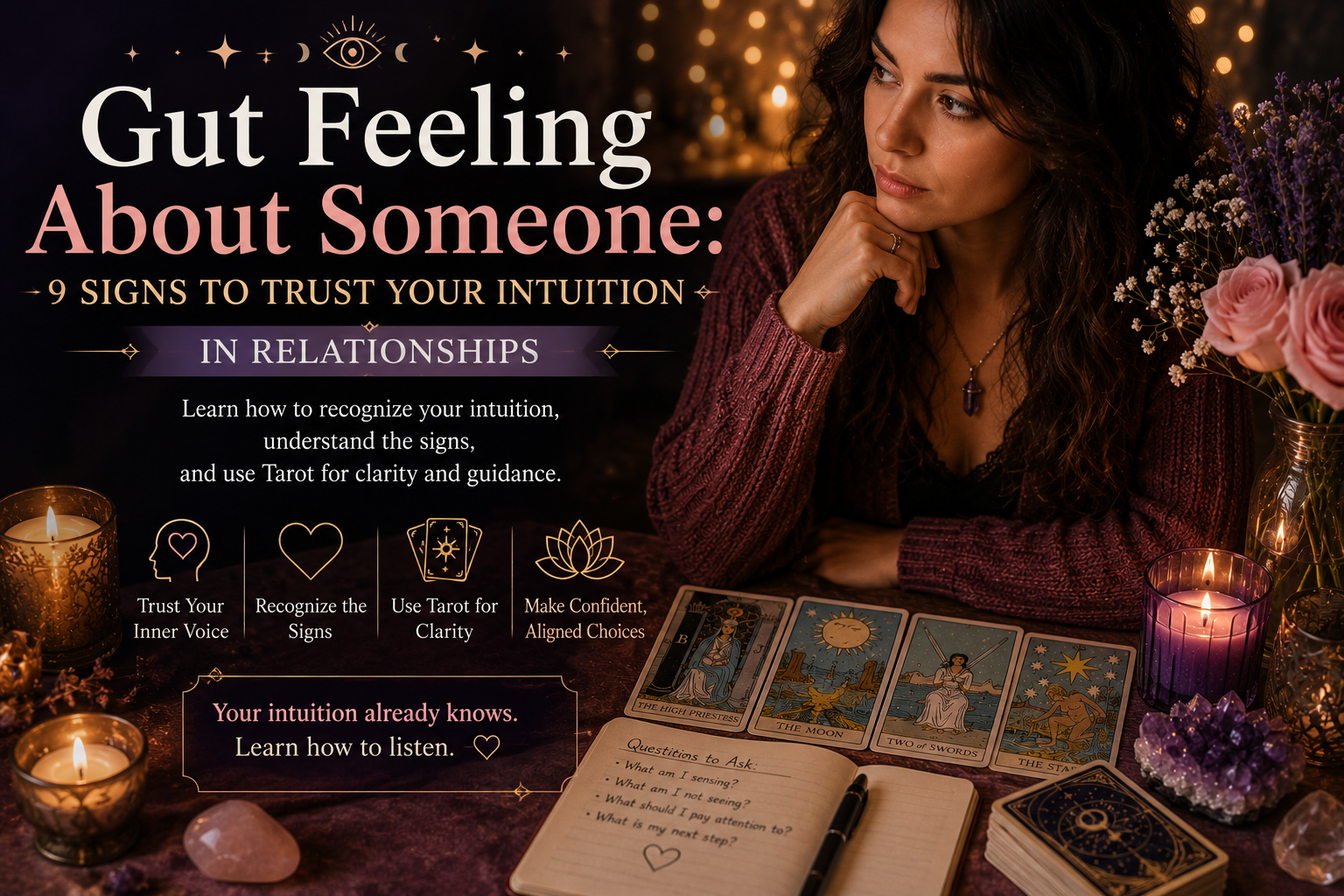
In this guide, we’ll explore 9 signs your gut feeling about someone may be worth paying attention to, how intuition works in relationships, and how Tarot can be used as a reflection tool when you’re uncertain.
What Is a Gut Feeling About Someone?
A gut feeling is an immediate sense that something feels right, wrong, safe or uncertain without you consciously knowing exactly why.
You might experience it as:
- a sudden feeling of calm
- discomfort around someone
- a strong sense of familiarity
- a feeling that something doesn’t add up
- an unexpected urge to slow down
- a quiet feeling that you can trust someone
- a strong inner sense that you should pay attention
Your gut feeling isn’t automatically a prediction.
Instead, think of it as information worth exploring.
Your mind constantly notices tone of voice, facial expressions, behavior, inconsistencies and patterns. You may consciously notice only a small portion of this information.
That is why a feeling can sometimes appear before you can explain its reason.
Intuition vs. Anxiety: Why the Difference Matters
One of the biggest challenges is knowing whether you’re experiencing intuition or anxiety.
Both can feel intense.
However, they often have different qualities.
| Intuition | Anxiety |
|---|---|
| Often feels quiet | Often feels urgent |
| Gives you something to consider | Creates repeated “what if?” thoughts |
| Can feel calm even when serious | Usually feels overwhelming |
| Focuses on what you’re noticing | Focuses heavily on imagined outcomes |
| Doesn’t always demand immediate action | Often pushes you to act immediately |
| Can remain consistent | May change from moment to moment |
This isn’t a perfect test.
Your emotions and experiences are complicated, so don’t treat one sensation as absolute proof.
If you’re struggling with this distinction, see your existing article Intuition or Anxiety? 7 Ways to Tell the Difference for a deeper comparison.
9 Signs Your Gut Feeling About Someone May Be Worth Listening To
1. Their Actions Don’t Match Their Words
One of the clearest reasons you may feel uncomfortable around someone is inconsistency.
They might say:
“You can trust me.”
But their behavior repeatedly gives you reasons not to.
For example, they may:
- make promises they don’t keep
- give contradictory explanations
- disappear and return repeatedly
- say they want commitment but avoid meaningful conversations
- behave differently in private and public
Your gut may react to the pattern, even before you’ve consciously put it into words.
However, don’t rely only on a feeling.
Look at the actual behavior.
2. You Feel Unusually Calm Around Them
Intuition isn’t always a warning.
Sometimes your gut feeling about someone is positive.
You may notice that you feel:
- comfortable
- relaxed
- accepted
- emotionally safe
- free to speak honestly
You don’t feel the constant need to perform or impress them.
That doesn’t automatically mean the person is perfect.
Still, emotional ease can be meaningful information when combined with consistent behavior.
3. Something Feels “Off” Even Though You Can’t Explain It
This is probably the experience most people mean when they talk about a gut feeling.
Nothing obvious has happened.
Yet something doesn’t feel right.
Instead of immediately assuming the person is bad, pause and observe.
Ask yourself:
“What exactly am I noticing?”
Maybe their words don’t match their body language.
Maybe they’re avoiding a particular topic.
Maybe their behavior reminds you of a previous experience.
Or perhaps you’re reacting to an old emotional wound.
The goal isn’t to blindly trust the feeling.
The goal is to investigate it.
4. Your Body Reacts Before Your Mind Understands Why
Sometimes emotional reactions appear physically.
You might notice:
- tension
- a racing heart
- heaviness
- restlessness
- relaxation
- warmth
- a feeling of ease
But physical sensations alone don’t prove that your intuition is correct.
Stress, attraction and anxiety can create similar physical responses.
That’s why your body can provide a signal to explore, rather than a final answer.
5. You Keep Noticing the Same Pattern
Imagine someone repeatedly cancels plans.
You initially dismiss it.
Then they do it again.
Then again.
Eventually, something inside you says:
“Pay attention.”
That feeling may not be mysterious at all.
Your brain may simply be recognizing a repeated pattern.
This is especially important in relationships because patterns often tell you more than isolated incidents.
You can explore this idea further in Why Do I Keep Attracting the Same Type of Person? Tarot & Relationship Patterns.
6. Your Intuition Remains Even After the Emotion Settles
Here’s a useful experiment.
If something feels wrong, don’t immediately act.
Give yourself time.
Take a walk.
Sleep on it.
Write down what happened.
Then ask yourself the next day:
“Do I still feel the same way?”
If the concern remains even after the emotional intensity has decreased, it may be worth investigating further.
This is one reason slowing down can make intuition easier to recognize.
7. You Feel Drawn to Someone Without Needing to Chase Them
Positive intuition doesn’t necessarily feel obsessive.
You may feel naturally interested in someone while still being able to maintain your own life.
You don’t need constant reassurance.
You don’t need to check your phone every few minutes.
You don’t need to force the connection.
There is room for curiosity without losing yourself.
That distinction can be especially important when attraction is strong.
8. You Feel Like You Can Be Yourself
A healthy connection often gives you room to be authentic.
You don’t constantly wonder:
“Did I say the wrong thing?”
“Do they still like me?”
“Should I act differently?”
Instead, communication feels natural.
You can have differences without feeling that the entire relationship is at risk.
A strong connection should ideally create space for honesty rather than requiring constant performance.
9. Your Inner Voice Encourages You to Slow Down
Sometimes intuition doesn’t tell you:
“Leave.”
It simply says:
“Wait.”
That can be extremely valuable.
You don’t need to make a major relationship decision immediately.
You can:
- observe
- ask questions
- communicate directly
- establish boundaries
- gather more information
- give the relationship time
Sometimes clarity appears when you stop trying to force an answer.
How to Know If Your Gut Feeling Is Actually Intuition
Before making a decision based on your feelings, ask yourself these five questions:
1. What actually happened?
Separate facts from interpretations.
2. What am I feeling?
Name the emotion.
Is it fear, attraction, excitement, insecurity, peace or discomfort?
3. What am I assuming?
Are you filling gaps with a story?
4. Has this happened before?
Your personal history can influence how you interpret people.
5. What happens when I slow down?
If the feeling becomes clearer after you’ve calmed down, that’s useful information.
For more detail, connect this section to How to Know If Your Intuition Is Right: 9 Signs Your Inner Voice Is Guiding You.
Can Tarot Help You Understand a Gut Feeling About Someone?
Tarot can be useful when you don’t want someone else to simply tell you what will happen.
Instead, use Tarot to ask better questions.
For example:
- What am I sensing about this person?
- What am I overlooking?
- What is influencing my judgment?
- What emotional pattern is being activated?
- What should I observe?
- What boundary may be important?
- What do I need to understand before moving forward?
This approach makes Tarot a tool for reflection and self-awareness.
A 6-Card Tarot Spread for a Gut Feeling About Someone
If you use Tarot yourself, try this spread.
| Card | Question |
|---|---|
| 1 | What am I sensing? |
| 2 | What is influencing my feelings? |
| 3 | What am I not seeing clearly? |
| 4 | What should I pay attention to? |
| 5 | What boundary or lesson matters here? |
| 6 | What is my healthiest next step? |
The goal isn’t to prove that your intuition is supernatural.
Instead, the cards give you another way to slow down, reflect and examine your thoughts.
Tarot Cards That Can Reflect Intuition
Certain cards can bring themes of intuition, uncertainty or emotional awareness into a reading.
The High Priestess
Often associated with intuition, inner knowledge, silence and what lies beneath the surface.
The Moon
Can highlight uncertainty, hidden fears, confusion or perceptions that need further examination.
The Hermit
Encourages stepping back and looking inward before making a decision.
Queen of Cups
Can represent emotional sensitivity, empathy and awareness of feelings.
The Star
May suggest hope, healing and renewed trust.
Two of Swords
Can reflect indecision or difficulty seeing a situation clearly.
Remember that no Tarot card can independently prove that your gut feeling is correct.
The meaning depends on the question, surrounding cards and your real-life circumstances.
Gut Feeling About Someone You Just Met
A strong first impression can be powerful.
You might instantly think:
“I really like this person.”
Or:
“Something about them makes me uncomfortable.”
Give yourself permission to notice the feeling without immediately turning it into a conclusion.
You don’t have to decide:
good person / bad person
after one interaction.
Instead:
Notice → Observe → Communicate → Reassess
This allows intuition and evidence to work together.
What If Your Gut Feeling Is Wrong?
Everyone misreads situations sometimes.
Intuition isn’t a magical guarantee.
Your interpretation can be influenced by:
- past relationships
- fear
- insecurity
- attraction
- expectations
- previous experiences
- stress
- attachment patterns
That’s why healthy intuition doesn’t mean never questioning yourself.
It means being willing to listen to yourself while remaining open to evidence.
Should You Trust Your Gut in Love?
You can respect your gut feeling without allowing it to make every decision for you.
A balanced approach is:
Feel it.
Notice your immediate reaction.
Question it.
Ask what may be causing it.
Observe it.
Look at the person’s actual behavior.
Communicate.
Ask direct questions when appropriate.
Decide.
Make your choice using both emotional awareness and real-world information.
This is much healthier than either extreme:
“I should ignore my feelings.”
or
“Every feeling I have must be true.”
When a Gut Feeling Becomes Overthinking
Sometimes you can become so focused on interpreting someone’s behavior that intuition turns into mental exhaustion.
You may start analyzing:
- every message
- every emoji
- every delay
- every social media activity
- every change in tone
At that point, you’re no longer simply listening to yourself.
You’re searching for certainty.
If this sounds familiar, read How to Stop Overthinking in a Relationship: 9 Ways to Find Clarity.
What Your Gut Feeling Can Teach You About Yourself
Perhaps the most valuable part of intuition isn’t predicting another person’s behavior.
It can teach you about your own needs.
Your reaction might reveal:
- what makes you feel safe
- what triggers uncertainty
- what boundaries matter to you
- what you need in communication
- what relationship patterns you repeat
- what you are unwilling to tolerate
In this way, intuition becomes a pathway toward self-awareness.
Frequently Asked Questions
1. What does it mean when you have a gut feeling about someone?
It means you are experiencing an immediate internal response to a person or situation. It may come from subtle observations, previous experiences, emotional patterns or intuition.
2. Can a gut feeling about someone be wrong?
Yes. Gut feelings aren’t guaranteed predictions. Anxiety, attraction, fear and past experiences can influence your perception.
3. How do I know if my gut feeling is intuition or anxiety?
Intuition may feel quieter and more consistent, while anxiety often creates urgency and repeated “what if” thoughts. However, these aren’t universal rules, so examine both your feelings and the facts.
4. Should I trust my gut feeling in a relationship?
Take it seriously, but don’t treat it as unquestionable proof. Observe behavior, communicate openly and give yourself time before making important decisions.
5. Why do I have a strong gut feeling about someone I just met?
You may be responding to subtle social cues, familiarity, attraction, emotional compatibility or something that reminds you of a previous experience.
6. Can Tarot confirm my intuition about someone?
Tarot can help you explore your thoughts, emotions and perceptions, but it should not be treated as definitive proof of another person’s intentions or future behavior.
7. Which Tarot card represents intuition?
The High Priestess is one of the strongest Tarot symbols associated with intuition and inner knowing. Other cards can add themes of uncertainty, reflection or emotional awareness depending on the reading.
8. Can intuition help with love decisions?
Yes, intuition can be one source of self-awareness. It works best when combined with observation, communication, boundaries and practical judgment.
Final Thoughts
A gut feeling about someone can be difficult to explain.
Sometimes it tells you to pay attention.
Sometimes it reflects attraction.
Sometimes it comes from an old emotional pattern.
And sometimes your mind simply needs more information before it can understand what you’re experiencing.
You don’t have to choose between intuition and logic.
Use both.
Notice what you feel.
Look at what actually happens.
Give yourself time.
And when you’re uncertain, use Tarot not simply to predict another person’s actions, but to ask better questions about your own emotions, boundaries and choices.
The strongest form of intuition isn’t about knowing exactly what will happen.
It’s about becoming more aware of what you’re experiencing—and having the courage to respond consciously.