

Have you ever wanted a quick answer to a question about love, career, or an important decision? When your mind feels full of possibilities, a yes or no tarot spread can offer a simple way to pause, reflect, and look at your situation from a different perspective.
Unlike a large Tarot reading, a yes-or-no spread uses just one or a few cards to explore whether a situation appears favourable, challenging, uncertain, or dependent on certain conditions.
However, Tarot should not be treated as a guaranteed prediction of the future. Your circumstances, decisions, and other people’s choices can change. The cards are most useful when you use them to reflect on your options rather than surrender your decisions to a reading.
In this guide, you will learn five simple yes or no Tarot spreads, how to interpret the cards, which questions work best, and how to avoid common reading mistakes.
What Is a Yes or No Tarot Spread?
A yes or no Tarot spread is a Tarot layout designed to explore a question that appears to have two possible answers: yes or no.
For example, you might ask:
- Is this relationship moving in a healthy direction?
- Is this a good time to apply for a new job?
- Should I have an honest conversation with this person?
- Is this opportunity worth exploring?
- Am I ready to move forward with this decision?
Depending on the spread, you may draw one, two, three, or more cards.
Some readers interpret cards as Yes, No, or Maybe. Others examine the traditional card meanings, the surrounding circumstances, and the conditions that could influence an outcome.
There is no single universal system for yes-or-no Tarot readings. The best approach is to choose a method before you begin and apply it consistently.
If you want to understand how individual cards are commonly interpreted, read our guide to yes or no Tarot cards: the complete 78-card list.
How to Prepare for a Yes or No Tarot Reading
Before choosing a spread, take a moment to prepare your question.
1. Focus on one situation. Avoid combining several questions into one. For example, asking whether your ex will return, whether you will get married, and whether you will be happy creates three different questions.
2. Be specific. Instead of asking, “Will everything work out?”, try, “Is this relationship moving toward greater stability?”
3. Choose a useful timeframe. When appropriate, ask about the next few weeks or months rather than an undefined future.
4. Decide how you will interpret the cards. You might use Yes, No, and Maybe categories or interpret the card in the context of your question.
5. Stay open to reflection. A card that seems challenging does not mean you are destined to fail. Consider what the symbolism might help you notice.
For more examples, explore our guide to how to ask yes or no questions in Tarot.
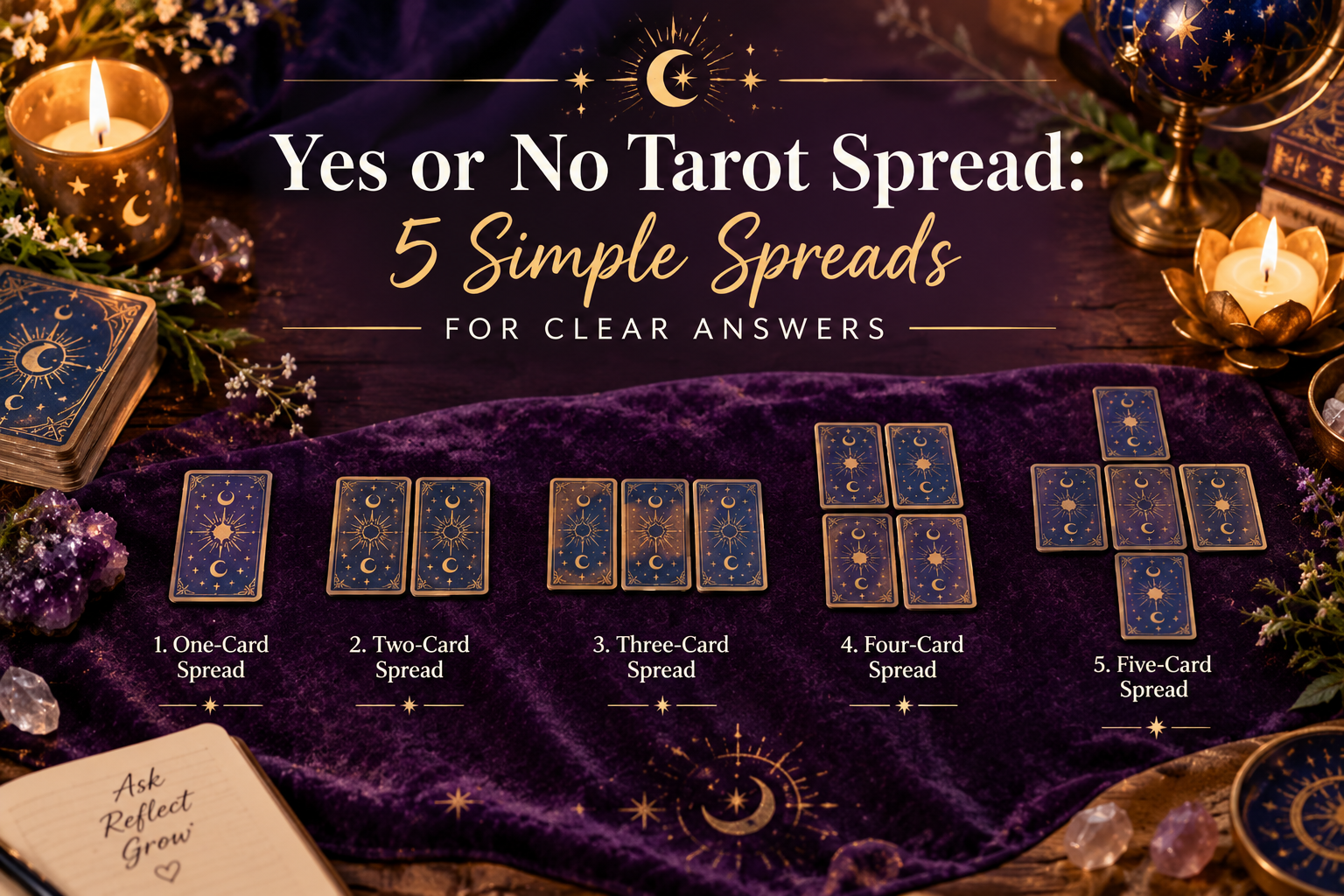
5 Simple Yes or No Tarot Spreads
Each spread below serves a slightly different purpose. Choose the one that fits the complexity of your question rather than automatically drawing more cards.
1. One-Card Yes or No Tarot Spread
Best for: Simple, focused questions.
The one-card spread is the easiest method for beginners. It is quick, requires no complicated layout, and helps you practise interpreting a card in context.
How to do it:
- Shuffle your Tarot deck while focusing on your question.
- Draw one card and place it face up.
- Observe the imagery and your first reaction.
- Consider the card’s traditional meaning.
- Decide whether the card suggests Yes, No, Maybe, or a conditional answer.
For example, suppose you ask, “Is this a good time to begin a new creative project?” You draw the Ace of Wands.
This card is associated with inspiration, enthusiasm, and new beginnings. You might interpret it as an encouraging sign to explore the project, provided you have a realistic plan.
Now imagine drawing the Four of Swords. Rather than forcing a yes or no, you might interpret it as a reminder to rest, prepare, or take time before acting.
Why this spread works: It encourages you to focus on one message instead of searching for several cards that confirm the answer you want.
Remember that a single card does not guarantee an outcome. Use it as a starting point for reflection.
2. Two-Card Yes or No Tarot Spread
Best for: Questions where you want to understand both the direction and the main condition.
A two-card spread adds context without making the reading complicated.
Place two cards side by side.
- Card 1 — Current direction: What does the situation appear to be showing me?
- Card 2 — Important influence: What condition, challenge, or opportunity should I consider?
Suppose you ask, “Is this job opportunity worth pursuing?”
The first card might suggest enthusiasm or potential, while the second might highlight the need for patience, research, or careful planning.
Rather than interpreting the cards as two separate votes, read them together.
The first card provides a starting point. The second helps you understand what might influence your decision.
Example interpretation: “This opportunity may be worth exploring, but I should research the responsibilities and expectations before committing.”
This spread is useful when a simple yes or no feels too limited.
3. Three-Card Yes or No Tarot Spread
Best for: Situations that need more context.
The three-card spread is a useful middle ground between a quick answer and a full Tarot reading.
Place three cards in a horizontal row.
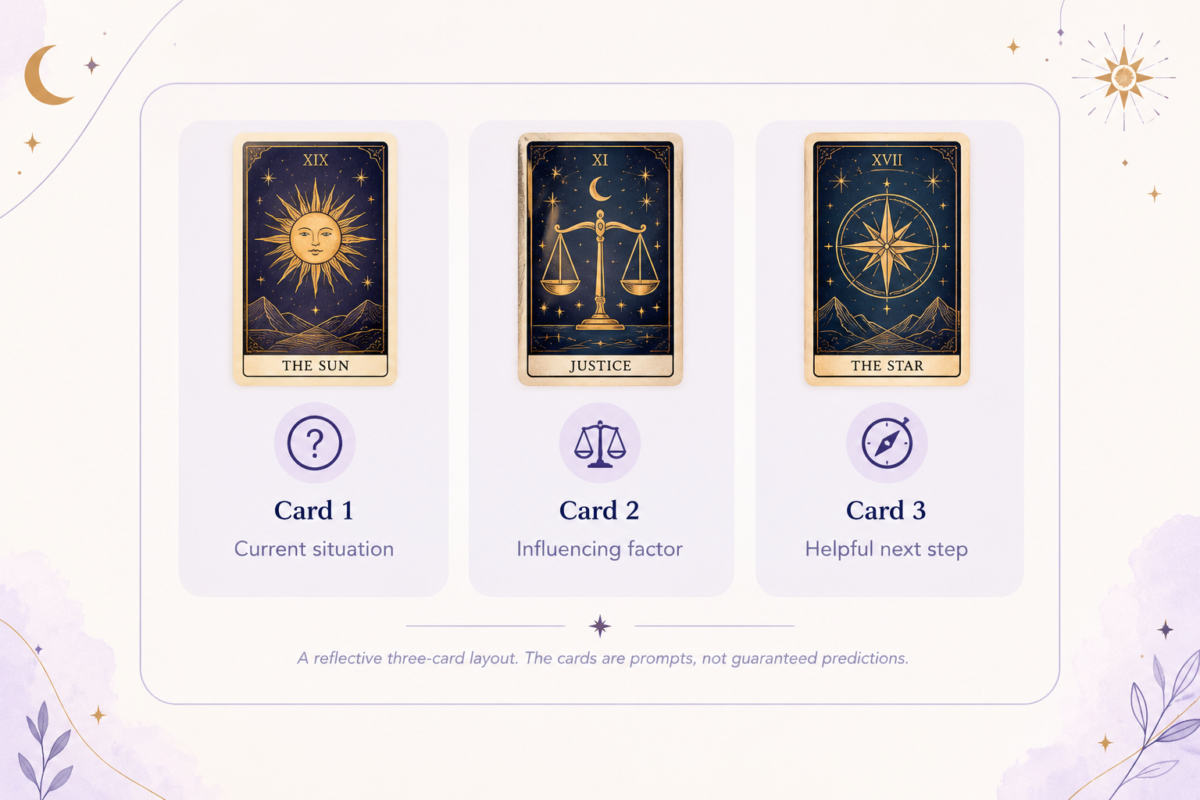
Use these questions:
- What is happening in this situation right now?
- What is helping or challenging the outcome?
- What should I consider doing next?
For example, if you ask whether you should have a difficult conversation, the cards might encourage you to recognise your feelings, prepare for possible disagreement, and choose a calm time to speak.
Notice that this spread does not force all three cards into Yes or No categories. Instead, it explores the situation behind your question.
Why this spread works: It gives you more information about your choices and circumstances while remaining simple enough for beginners.
4. Four-Card Yes or No Tarot Spread
Best for: Important personal decisions that involve competing priorities.
Sometimes the question is straightforward, but the decision itself is not. You may be considering a career change, deciding whether to continue a relationship, or wondering whether to accept a major opportunity.
For these situations, try a four-card spread.
Place four cards in a row or in a square.
- Card 1 — The current situation: What do I need to understand?
- Card 2 — The favourable factors: What supports moving forward?
- Card 3 — The challenges: What might make this difficult?
- Card 4 — The next step: What should I consider before deciding?
Imagine asking, “Is this the right time to change careers?”
The cards might highlight your motivation, transferable skills, financial concerns, and the importance of making a realistic transition plan.
You can then assess whether the opportunity fits your circumstances.
How to interpret the result: Look at the overall message rather than counting positive and negative cards. Three apparently favourable cards do not automatically outweigh one important warning.
This spread is particularly helpful when a decision requires practical research alongside personal reflection.
5. Five-Card Yes or No Tarot Spread
Best for: Complicated questions where you want to explore several influences.
The five-card spread offers the most detailed reflection of these five methods.
Arrange the cards in a cross or a horizontal line.
| Card | Position | Question |
|---|---|---|
| 1 | Present | What is happening now? |
| 2 | Support | What is working in my favour? |
| 3 | Challenge | What obstacle should I understand? |
| 4 | Possibility | What direction could this situation take? |
| 5 | Advice | What is a helpful next step? |
For example, you might ask, “Is this relationship worth working on?”
The cards can help you reflect on the current relationship, the strengths you share, recurring problems, possible directions, and the actions needed to improve the situation.
A challenging card does not necessarily mean the relationship must end. Likewise, a traditionally positive card does not guarantee that everything will work out.
Instead, consider whether the reading raises questions that deserve honest discussion.
Why this spread works: It explores multiple dimensions of a decision without pretending that a complicated situation can always be reduced to a single word.
For decisions involving safety, abuse, finances, legal matters, or health, rely on appropriate professional support and real-world evidence rather than Tarot alone.
Yes, No, or Maybe: How to Interpret Your Cards
Once you draw your cards, you need a consistent way to interpret them.
One option is to use three categories.
Yes
A card may suggest openness, progress, confidence, harmony, or favourable conditions.
Examples that many readers interpret positively include:
- The Sun
- The World
- The Star
- Ace of Wands
- Ace of Cups
- Six of Wands
However, their meanings depend on the question. The Sun might encourage confidence in one situation, while another card may highlight the practical work required to reach your goal.
No
Some cards may highlight conflict, obstacles, endings, or circumstances that are not currently supportive.
Examples can include:
- Ten of Swords
- Three of Swords
- Five of Pentacles
- Eight of Swords
These cards do not automatically predict failure. They may encourage you to recognise a problem, reconsider your approach, or acknowledge that a situation needs to change.
Maybe or Not Yet
Some cards suggest uncertainty, delay, missing information, or competing possibilities.
Examples include:
- The Moon
- Two of Swords
- The Hanged Man
- Seven of Cups
- The Hermit
When one of these cards appears, ask what you still need to understand. Sometimes the most useful response is to gather more information before making a decision.
There is no universal list that assigns every Tarot card a fixed Yes or No. Your question, the card’s symbolism, and your circumstances all matter.
Should You Use Reversed Cards in a Yes or No Tarot Spread?
You can use reversed cards if they are part of your usual reading practice.
Some readers interpret an upright card as Yes and a reversed card as No. Others consider the meaning of the reversed card itself, such as blocked energy, delays, internal resistance, or a need for reassessment.
Neither method is a universal rule.
If you are a beginner, start with upright cards until you feel comfortable interpreting them. You can add reversals later if they make your readings more meaningful.
Most importantly, decide how you will interpret reversed cards before drawing them. Changing the rules after seeing a card can make the reading harder to understand.
Common Mistakes to Avoid
Even a simple spread can become confusing if you approach it with unrealistic expectations.
Pulling more cards until you get a Yes: Repeatedly drawing cards for the same question can create uncertainty rather than clarity.
Asking several questions at once: Separate different decisions so that each reading has a clear focus.
Ignoring the card’s context: A card associated with challenges may point to an issue that needs attention, not necessarily a permanent No.
Treating Tarot as a guarantee: Cards cannot establish what another person will do or exactly what the future holds.
Using a reading to avoid a necessary conversation: If you need to understand another person’s intentions, direct communication and consistent behaviour provide more reliable information than trying to predict their private thoughts.
Which Yes or No Tarot Spread Should You Choose?
The right spread depends on how much context you need.
| Spread | Best for | Cards |
|---|---|---|
| One-card | Quick, simple questions | 1 |
| Two-card | Direction and an important condition | 2 |
| Three-card | Situation, influence, and next step | 3 |
| Four-card | Pros, challenges, and a decision | 4 |
| Five-card | Complicated situations needing reflection | 5 |
Start with one card if you are new to Tarot. Move to a larger spread only when the situation genuinely requires more context.
You do not need to use five cards for every question. A larger layout is not automatically more accurate or meaningful.
Final Thoughts
A yes or no tarot spread can be a simple way to reflect on a question when you feel uncertain about your next step.
The one-card spread is ideal for quick reflection, while the two-card and three-card methods add useful context. Four-card and five-card spreads can help you explore decisions with several competing factors.
Whichever method you choose, remember that Tarot is a tool for reflection rather than a guarantee of what will happen.
Ask a clear question, interpret the cards in context, and consider what you can learn from the reading. If the answer is Maybe, give yourself permission to gather more information instead of forcing certainty.
Sometimes the most valuable outcome is not a simple Yes or No. It is a clearer understanding of your situation and the choices available to you.
Explore more Tarot guidance at The Astro Palace to learn how card meanings, spreads, and thoughtful questions can support your personal reflection.
Frequently Asked Questions
1. What is the best yes or no Tarot spread for beginners?
The one-card spread is the easiest place to start. Draw one card, consider its traditional meaning, and interpret it in relation to your question. If you need more context, try a three-card spread.
2. How many cards should I pull for a yes or no Tarot reading?
You can use one to five cards depending on the complexity of your question. One card works for a simple question, while larger spreads help you explore additional influences and possible next steps.
3. Can Tarot cards really answer Yes or No?
Tarot can be used for Yes/No-style readings, but it cannot guarantee future events. Treat the result as a reflective interpretation of the question rather than an unquestionable prediction.
4. What does it mean when I get a Maybe card?
A Maybe card can suggest uncertainty, delay, missing information, or a situation that is still developing. Consider what you need to understand before making a decision.
5. Can I use reversed Tarot cards for Yes or No?
Yes. Some readers use upright cards for Yes and reversed cards for No, while others interpret reversals according to each card’s symbolism. Choose a method that makes sense to you and apply it consistently.
6. Can I use a yes or no Tarot spread for love questions?
Yes. You can explore questions about communication, relationship direction, and your own choices. However, Tarot cannot reliably establish another person’s private thoughts or guarantee that a relationship will succeed.
7. Should I repeat a yes or no Tarot reading if I dislike the answer?
Avoid repeating the same reading simply to obtain a different answer. Reflect on the original cards, consider the real-world circumstances, and revisit the question only if something meaningful has changed.