


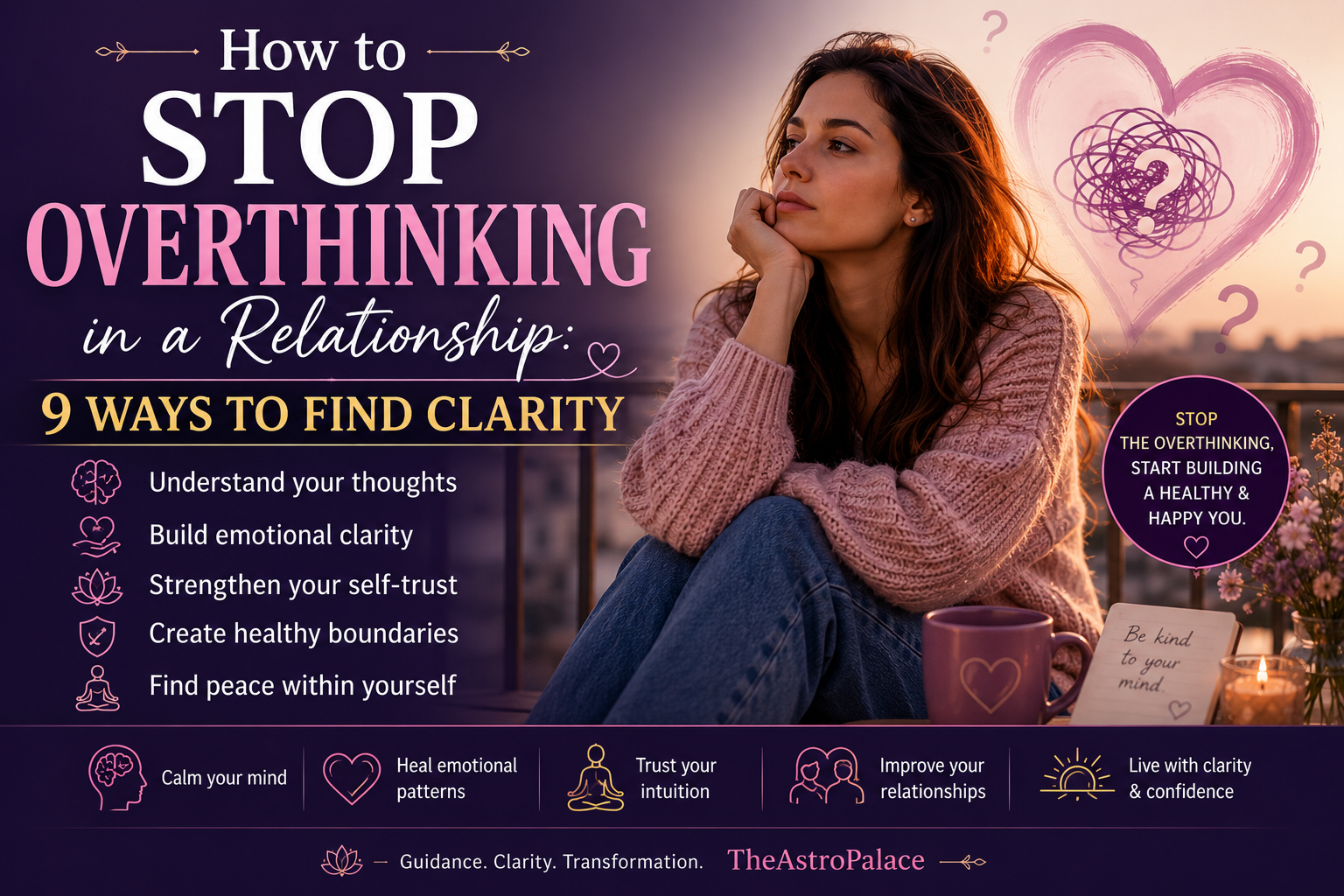
“Why didn’t they reply?”
“Did I do something wrong?”
“Are they losing interest?”
“Why did their tone suddenly change?”
If you’ve ever spent hours analyzing a text message, replaying a conversation, checking someone’s online activity, or imagining everything that could go wrong in your relationship, you’re not alone.
Relationship overthinking can turn a small moment of uncertainty into an endless cycle of questions.
The difficult part is that sometimes your concerns may come from genuine relationship problems, while other times they may come from fear, past experiences, insecurity, or anxiety.
So how do you know the difference?
And more importantly, how can you stop overthinking in relationships without ignoring your feelings or genuine red flags?
The answer isn’t to stop caring. It’s to learn how to separate facts from assumptions, intuition from fear, and healthy awareness from constant mental checking.
In this guide, we’ll explore why relationship overthinking happens, nine practical ways to manage it, and how reflective practices such as Tarot can help you understand your relationship patterns more clearly.
What Is Relationship Overthinking?
Relationship overthinking happens when your mind repeatedly analyzes your relationship, your partner’s behavior, or the future of the relationship without reaching a satisfying conclusion.
You might repeatedly ask yourself:
- Does my partner really love me?
- Why haven’t they texted me?
- Are they interested in someone else?
- Did I say something wrong?
- What if they leave?
- Why do they seem different today?
- Should I stay or walk away?
- Is this relationship meant to be?
Thinking about your relationship isn’t automatically a problem. Reflection can help you identify genuine concerns.
The problem begins when thinking becomes repetitive rather than productive.
You may analyze the same situation again and again, but instead of gaining clarity, you become more confused.
Why Do We Overthink Relationships?
There isn’t one reason everyone overthinks.
For some people, it may be connected to previous heartbreak. For others, inconsistent communication from a partner may create uncertainty. Past relationship experiences, attachment patterns, low self-confidence, or fear of rejection can also influence how we respond to uncertainty.
Sometimes the relationship itself may genuinely lack clarity.
For example, if someone frequently disappears, avoids conversations about commitment, gives mixed signals, or repeatedly breaks promises, feeling uncertain isn’t necessarily “just overthinking.”
That’s why learning to distinguish anxiety from information is important.
9 Ways to Stop Overthinking in a Relationship
1. Separate Facts From the Story in Your Head
One of the most effective ways to reduce relationship overthinking is to separate what you know from what you’re assuming.
For example:
Fact:
Your partner hasn’t replied for several hours.
Story:
“They don’t care about me anymore.”
The first statement is something you know.
The second is an interpretation.
There could be many explanations for the delayed response.
Try asking yourself:
“What do I actually know right now?”
Then ask:
“What am I imagining?”
This simple distinction can prevent your mind from turning uncertainty into certainty.
2. Stop Trying to Decode Every Small Detail
When you’re worried about a relationship, everything can start feeling like a clue.
A shorter text.
A different emoji.
A missed call.
A social media post.
A change in someone’s routine.
You may start looking for hidden meanings in ordinary behavior.
But healthy communication isn’t a detective investigation.
Instead of analyzing every detail, look at patterns over time.
One unusual day doesn’t necessarily tell you much.
Consistent behavior tells you much more.
Ask:
“What pattern am I seeing over several weeks rather than what happened today?”
3. Communicate Instead of Assuming
Sometimes overthinking grows because we’re trying to answer questions that should simply be discussed.
Instead of thinking:
“Maybe they’re upset with me.”
You can ask:
“I’ve noticed things feel a little different lately. Is everything okay between us?”
Healthy communication doesn’t mean constantly asking for reassurance.
It means being willing to have honest conversations when something genuinely matters.
A relationship cannot become emotionally secure if both people are communicating through assumptions instead of words.
4. Learn the Difference Between Intuition and Anxiety
This is one of the most important skills when dealing with relationship uncertainty.
Intuition and anxiety can sometimes feel similar, especially when you’re emotionally invested in someone.
A useful starting point is to observe the quality of the thought.
Anxiety often sounds like:
“What if something terrible happens?”
“What if they leave me?”
“What if they secretly don’t love me?”
“I need to check again.”
It can create an endless loop of hypothetical scenarios.
Intuition can feel more like:
“Something doesn’t feel right here.”
It may draw your attention to a specific pattern or situation without requiring you to create dozens of possible explanations.
However, intuition isn’t infallible, and anxiety can feel extremely convincing.
That’s why it’s useful to combine your feelings with observable facts and communication.
If you often struggle with this distinction, you may also find our guide on intuition vs anxiety helpful.
5. Don’t Make Your Partner the Center of Your Entire Life
When you’re deeply invested in someone, it’s easy for your attention to become completely focused on the relationship.
You may start organizing your entire emotional state around:
- Their messages
- Their availability
- Their mood
- Their plans
- Their attention
- Their approval
When your partner becomes your only source of emotional security, every change in their behavior can feel enormous.
Create space for your own life.
Spend time with friends.
Work toward personal goals.
Exercise.
Read.
Travel.
Create something.
Learn something new.
Spend time alone.
A healthy relationship should be part of your life, not the entirety of your identity.
6. Notice Your Relationship Patterns
Sometimes the current relationship isn’t the beginning of the story.
Ask yourself:
“Have I felt this same fear before?”
Maybe you’ve repeatedly worried about being abandoned.
Maybe you’ve been attracted to people who are emotionally distant.
Maybe you become extremely attached when someone becomes less available.
Maybe you constantly feel like you have to prove your worth.
Recognizing a repeating pattern doesn’t mean blaming yourself.
It means becoming aware of what you’re bringing into your relationships.
You can ask:
- What kind of people am I usually attracted to?
- What behavior do I tolerate?
- What makes me feel emotionally unsafe?
- Do I confuse emotional intensity with compatibility?
- Do I ignore red flags because I’m afraid of losing someone?
- Do I struggle to express my needs?
Self-awareness can change the choices you make in future relationships.
7. Create Healthy Emotional Boundaries
Overthinking becomes especially exhausting when you constantly take responsibility for another person’s emotions.
You may think:
“If I say the wrong thing, they’ll leave.”
“I need to keep them happy.”
“I have to fix their mood.”
But a healthy relationship requires two emotionally responsible people.
A boundary might sound like:
“I’m happy to discuss this, but I don’t want to continue the conversation while we’re disrespecting each other.”
Or:
“I need consistency and honest communication in a relationship.”
Boundaries aren’t punishments.
They’re a way of communicating what you need to feel respected and emotionally safe.
8. Stop Seeking Constant Reassurance
Reassurance can feel comforting.
You ask:
“Do you still love me?”
They say yes.
For a few hours, you feel better.
Then another thought appears.
“But what if they were only saying it?”
So you ask again.
This can create a cycle where reassurance provides temporary relief but doesn’t resolve the underlying fear.
Instead of repeatedly asking someone else to prove that you’re safe, begin asking yourself:
“What would help me feel secure even when I don’t have complete certainty?”
That might involve communication, boundaries, self-reflection, journaling, mindfulness, or professional support.
9. Learn to Trust Yourself Again
The ultimate goal isn’t to become completely certain about what another person is thinking.
You can’t control someone else’s feelings, choices, or future behavior.
What you can control is your ability to respond.
Try replacing:
“How can I make sure they never leave?”
with:
“If this relationship changes, I trust myself to handle it.”
That shift is powerful.
Emotional security doesn’t come from knowing exactly what another person will do.
It comes partly from knowing that you won’t abandon yourself regardless of what happens.
Are You Overthinking, or Is Something Actually Wrong?
This is an important question.
Not every concern is anxiety.
Sometimes your mind is responding to real inconsistencies.
Pay attention if there is a repeated pattern of:
- Dishonesty
- Broken promises
- Manipulation
- Disrespect
- Avoidance of important conversations
- Controlling behavior
- Constant inconsistency
- Emotional invalidation
- Refusal to acknowledge your concerns
You don’t need to convince yourself that you’re “overthinking” simply because someone tells you that you are.
At the same time, one delayed message or one bad day doesn’t automatically mean a relationship is unhealthy.
Look at patterns, not isolated moments.
How to Stop Overthinking When Your Partner Doesn’t Text Back
This is one of the most common triggers.
When someone doesn’t respond, try this:
Step 1: Notice the thought
“They haven’t replied.”
Step 2: Don’t immediately create a conclusion
Avoid jumping directly to:
“They’re ignoring me.”
Step 3: Give the situation time
People have work, responsibilities, family, social commitments, and personal issues.
Step 4: Return to your own life
Put the phone down.
Do something that requires your attention.
Step 5: Look at the bigger pattern
Is this unusual behavior or something that happens constantly?
Step 6: Communicate if necessary
If inconsistent communication is becoming a genuine relationship issue, discuss it openly.
How Tarot Can Help With Relationship Overthinking
Tarot isn’t a substitute for communication, mental-health care, or making important decisions based on evidence.
But it can be used as a reflective tool.
Instead of asking only:
“Will they come back?”
Consider questions such as:
- What am I not seeing clearly?
- What emotional pattern am I repeating?
- What fear is influencing my decisions?
- What boundary do I need to strengthen?
- What can this situation teach me about myself?
- What should I focus on for my emotional growth?
This approach makes a Tarot reading less about trying to control an uncertain future and more about gaining perspective on your current emotional situation.
At TheAstroPalace, a relationship Tarot reading can be approached as a space for reflection, clarity, and self-understanding.
When Should You Consider Professional Support?
If relationship-related thoughts are becoming overwhelming or significantly affecting your sleep, work, daily functioning, or wellbeing, consider speaking with a qualified mental-health professional.
Spiritual practices can complement personal growth, but they shouldn’t replace appropriate professional care.
A Simple 5-Minute Exercise for Relationship Overthinking
The next time you feel overwhelmed, take a piece of paper and create three columns:
| What I Know | What I Assume | What I Can Do |
|---|---|---|
| They haven’t replied today | They may be losing interest | Wait and communicate |
| We had an argument | The relationship is over | Have an honest conversation |
| They seem distant | They don’t love me | Look at the overall pattern |
Relationship overthinking can be influenced by uncertainty, fear of rejection, previous relationship experiences, attachment patterns, low self-confidence, or inconsistent behavior from a partner. Understanding the underlying trigger can help you respond more effectively.
Pause before creating a conclusion, give the situation reasonable time, focus on your own activities, and look at your partner’s overall communication pattern rather than one delayed response.
Start by separating facts from assumptions. Look for consistent behavioral patterns and communicate directly when appropriate. Intuition can provide a feeling or perspective, but it shouldn’t be treated as unquestionable proof.
Constant reassurance-seeking, checking, accusations, or withdrawing because of imagined scenarios can create relationship stress. Learning healthier communication and emotional-regulation skills can help break the cycle.
Trust develops through consistent behavior, honest communication, reliability, and mutual respect. You can also work on trusting your own ability to handle uncertainty and communicate your needs.
Tarot can be used as a reflective practice to explore emotions, relationship patterns, fears, boundaries, and personal perspectives. It should not be treated as guaranteed proof of another person’s thoughts or future actions.
This exercise moves your mind from fear → facts → action.
You don’t need to solve the entire relationship in one moment.
You only need to identify your next healthy step.






3 thoughts on “How to Stop Overthinking in a Relationship: 9 Ways to Find Clarity”