

Have you ever been stuck between two choices and wished you could see the situation more clearly?
Maybe you’re deciding whether to accept a new job, leave a relationship, move to another city, start something new, or simply choose between two paths.
You make a list of pros and cons.
You ask your friends.
You think about it at night.
And somehow, you’re still confused.
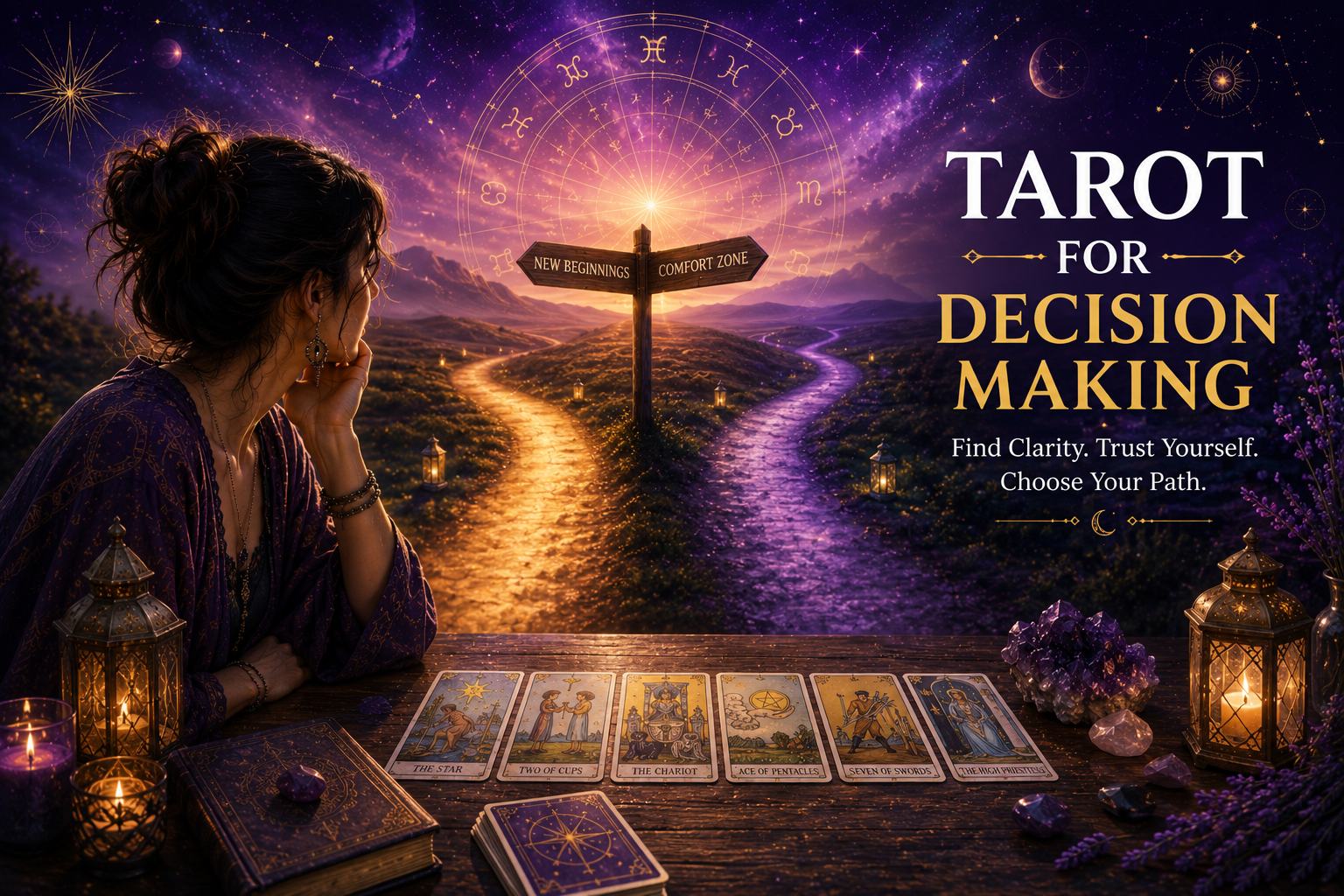
This is where Tarot for decision making can become a useful reflective practice.
Tarot cannot guarantee which option will produce a particular future. Instead, it can help you slow down, uncover what you’re feeling, recognize what you may be overlooking, and listen more carefully to your own intuition.
The goal isn’t to let the cards make the decision for you.
The goal is to make the decision with greater awareness.
Can Tarot Really Help With Decisions?
Tarot can be useful when you approach it as a tool for reflection.
When you’re emotionally involved in a situation, it’s easy to focus on only one part of the problem.
You might concentrate on:
- what you want
- what you’re afraid of
- what other people expect
- what could go wrong
- what you might lose
A Tarot reading can give you a structured way to step back and examine the situation from different perspectives.
For example, instead of asking:
“Should I take this job?”
you could ask:
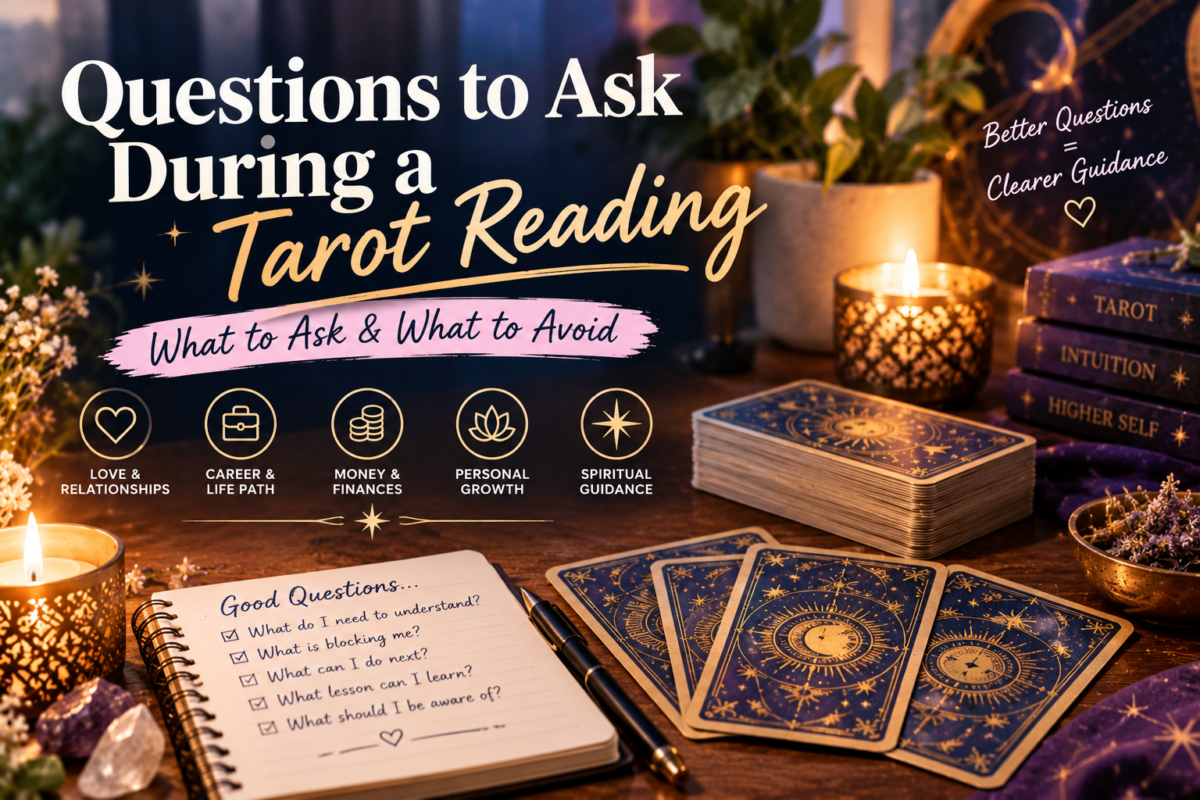
- What am I not considering about this opportunity?
- What motivates me to choose this option?
- What fear is influencing my decision?
- What could I learn from this path?
- What should I prioritize right now?
These questions can produce much more useful reflection than simply asking for a yes or no.
7 Reasons Tarot Can Be Helpful When You’re Stuck
1. It Slows Down Your Thinking
When you’re overwhelmed, you may keep thinking about the same question without actually getting closer to an answer.
Tarot introduces structure.
You pull a card.
You interpret its symbolism.
You reflect on how it relates to your situation.
That process creates space between your emotional reaction and your decision.
Sometimes that space is exactly what you need.
2. It Helps You Ask Better Questions
The quality of your question can completely change the quality of your reflection.
Compare:
“Will I be successful?”
with:
“What do I need to understand about pursuing this opportunity?”
The second question gives you something practical to think about.
Good Tarot questions don’t simply ask for a prediction.
They help you explore your situation.
3. It Can Reveal What You’re Avoiding
Sometimes you already know what you want.
The problem is that you’re afraid of what choosing it might mean.
You might be afraid of:
- disappointing someone
- making the wrong choice
- starting over
- losing security
- being judged
- failing
- regretting your decision
A Tarot reading can act as a mirror for those fears.
The card isn’t necessarily revealing an objective future.
It may be helping you notice something that was already present within you.
4. It Can Help You Separate Fear From Intuition
This is one of the most useful applications of Tarot.
Suppose you’re considering leaving a job.
One part of you says:
“I know I need a change.”
Another says:
“What if I regret it?”
Which voice should you trust?
Instead of immediately choosing either one, explore both.
Ask:
“What is my fear trying to protect me from?”
Then:
“What is my intuition trying to show me?”
If you haven’t already, your article understanding the difference between intuition and anxiety can support readers who struggle to distinguish emotional fear from an intuitive feeling.
5. It Can Show You Different Perspectives
When you are deeply involved in a decision, you naturally see the situation from your own viewpoint.
Tarot can help you deliberately examine another angle.
For example:
Card 1: What I currently believe
Card 2: What I may be overlooking
Card 3: What fear is influencing me
Card 4: What opportunity exists here
Card 5: What deserves my attention
This doesn’t mean the cards have access to hidden facts.
Instead, the symbolism encourages you to consider possibilities you might not have consciously explored.
6. It Can Help You Understand Your Priorities
Sometimes the problem isn’t that you don’t know the options.
It’s that you don’t know which value should come first.
For example:
Job A
- Higher salary
- Less personal time
Job B
- Lower salary
- Better work-life balance
Which one is right?
There isn’t necessarily one universal answer.
It depends on what matters most to you right now.
Tarot can help you explore those priorities.
7. It Encourages You to Take Ownership
A healthy Tarot reading shouldn’t make you feel powerless.
It should do the opposite.
Instead of:
“The cards said I have to do this.”
Try:
“The reading helped me understand what I need to consider.”
That’s a much healthier relationship with Tarot.
You make the decision.
The cards simply provide another perspective.
The Best Tarot Questions for Difficult Decisions
If you’re using Tarot for decision making, try questions that encourage reflection rather than dependency.
Instead of:
❌ “Will this work?”
Try:
✅ “What should I understand about this option?”
Instead of:
❌ “Should I leave?”
Try:
✅ “What do I need to consider before making this decision?”
Instead of:
❌ “Will they choose me?”
Try:
✅ “What do I need to understand about this relationship?”
Instead of:
❌ “Will I become successful?”
Try:
✅ “What strength can I use to move toward my goal?”
The difference is subtle but powerful.
A 7-Card Tarot Decision-Making Spread
Here’s a practical spread readers can try.
| Card | Question |
|---|---|
| 1 | What is the real decision I’m facing? |
| 2 | What is influencing my current thinking? |
| 3 | What fear is affecting me? |
| 4 | What am I overlooking? |
| 5 | What strength can I rely on? |
| 6 | What should I prioritize? |
| 7 | What is the healthiest next step? |
Notice that the final card asks about a next step, not a guaranteed future.
That’s intentional.
Your decision-making process should remain grounded in reality.
Should You Use Tarot Yes or No Questions?
Yes-or-no Tarot questions are popular.
You may have seen readings such as:
“Will I get the job?”
“Will they contact me?”
“Should I move?”
They’re simple, but they can oversimplify complicated situations.
Real-life decisions usually contain multiple variables.
For example, getting a job isn’t only about whether you get an offer.
You may also need to consider:
- salary
- commute
- work environment
- career growth
- responsibilities
- stability
- personal priorities
A single “yes” or “no” doesn’t tell you all of that.
Therefore, open-ended questions are usually more useful when you’re genuinely trying to understand a situation.
How to Use Tarot Without Giving Your Power Away
This is particularly important if you frequently use Tarot for guidance.
Use Tarot to explore.
Not to surrender responsibility.
Use it to reflect.
Not to replace evidence.
Use it to understand your feelings.
Not to prove another person’s private thoughts.
Use it to identify possibilities.
Not to guarantee the future.
For major decisions involving finances, employment, legal matters, or health, combine reflection with appropriate professional advice and real-world information.
Tarot can be part of your personal reflection process, but it shouldn’t replace practical decision-making.
Tarot and Intuition: How They Work Together
Tarot becomes especially interesting when you combine symbolism with intuition.
Imagine you pull The Hermit.
Instead of immediately searching:
“What does The Hermit mean?”
Pause.
Look at the image.
What stands out to you?
Does the card make you think about:
- solitude?
- patience?
- stepping away?
- searching for answers?
- slowing down?
Then compare that reaction with the traditional symbolism.
This creates a conversation between:
Tarot knowledge + personal intuition + real-life context.
That’s much more meaningful than simply memorizing card definitions.
What If the Tarot Says Something You Don’t Like?
This happens.
You may pull a card and immediately think:
“I don’t want this answer.”
That’s actually an opportunity for reflection.
Ask:
“Why does this interpretation make me uncomfortable?”
Perhaps the card represents:
- a possibility you were avoiding
- a fear
- an uncomfortable truth
- a necessary change
- something you don’t agree with
You don’t have to blindly accept every interpretation.
Tarot is a reflective practice.
You are allowed to question the reading.
What If I Keep Pulling Cards Until I Get the Answer I Want?
This is one habit to avoid.
Suppose you ask:
“Should I leave this relationship?”
You get a card you dislike.
So you shuffle again.
Then again.
Eventually, you pull a card that seems more positive.
Now you feel relieved.
But what happened?
You weren’t really using Tarot to gain clarity.
You were using it to obtain the answer you wanted.
This can make you even more confused.
A better approach is:
Pull → Reflect → Pause → Act based on the full situation.
A Simple 3-Card Tarot Reading for Everyday Decisions
If you don’t want a seven-card spread, try this:
Card 1 – What am I not seeing?
Look for information or emotions you’ve overlooked.
Card 2 – What should I consider?
Think about your priorities and circumstances.
Card 3 – What is my healthiest next step?
Focus on something actionable.
This works well for smaller decisions and can be completed in just a few minutes.
When You Feel Completely Confused
Sometimes the best decision is not to decide immediately.
If you’re emotionally overwhelmed, give yourself time.
You can:
- Write down your options.
- List what you know for certain.
- Separate facts from assumptions.
- Identify your biggest fear.
- Identify what you actually want.
- Use Tarot for reflection.
- Review the practical consequences.
- Give yourself permission to pause.
If your thoughts are becoming repetitive, you can also read stop overthinking and find clarity for additional grounding techniques.
Tarot Decision-Making vs Traditional Pros and Cons
You don’t have to choose between Tarot and practical thinking.
You can use both.
| Practical Decision Making | Tarot Reflection |
|---|---|
| Looks at facts | Explores emotions |
| Compares consequences | Explores perspectives |
| Uses evidence | Uses symbolism |
| Considers practical risks | Highlights internal concerns |
| Focuses on circumstances | Focuses on self-awareness |
| Helps evaluate options | Helps formulate better questions |
Together, they can give you a more complete picture.
10 Questions to Ask Tarot When You’re Stuck
Save these questions for your next reading:
- What am I not seeing clearly?
- What fear is influencing this decision?
- What does my intuition want me to notice?
- What am I assuming without evidence?
- What is my biggest priority right now?
- What strength can I use?
- What lesson is this situation offering me?
- What potential challenge should I prepare for?
- What would help me feel more confident?
- What is the healthiest next step?
These questions keep the reading focused on clarity, self-awareness and action.
FAQs
Can Tarot help with decision making?
Yes. Tarot can be used as a reflective practice to explore emotions, priorities, fears and different perspectives. It should not replace practical evidence or professional advice.
What Tarot cards are best for decision making?
There isn’t one fixed list of “best” cards. Any Tarot card can offer useful symbolism depending on the question, surrounding cards and your circumstances.
Should I ask Tarot yes or no questions?
You can, but open-ended questions often provide more useful reflection because real-life decisions are usually more complicated than a simple yes or no.
Can Tarot tell me which choice I should make?
Tarot can help you explore your options, but the final decision should remain yours. Consider real-world evidence, consequences, values and circumstances alongside the reading.
Can Tarot help me trust my intuition?
It can create a structured space for reflection and help you notice your internal reactions. However, intuition should be balanced with evidence, especially for major life decisions.
How many cards should I pull for a decision?
Three to seven cards is usually enough for a focused reflective reading. Pulling increasingly more cards can make a confusing situation even harder to interpret.
Final Thought
When you’re stuck between two choices, the hardest part isn’t always finding the right answer.
Sometimes it’s becoming quiet enough to hear what you already know.
That’s where Tarot for decision making can become meaningful.
The cards don’t have to predict your future.
They can help you slow down, question your assumptions, understand your emotions and look at the situation from a different perspective.
Use Tarot as a mirror—not as a remote control for your life.
Because ultimately, clarity doesn’t mean knowing exactly what will happen.
It means understanding yourself well enough to choose your next step consciously.