


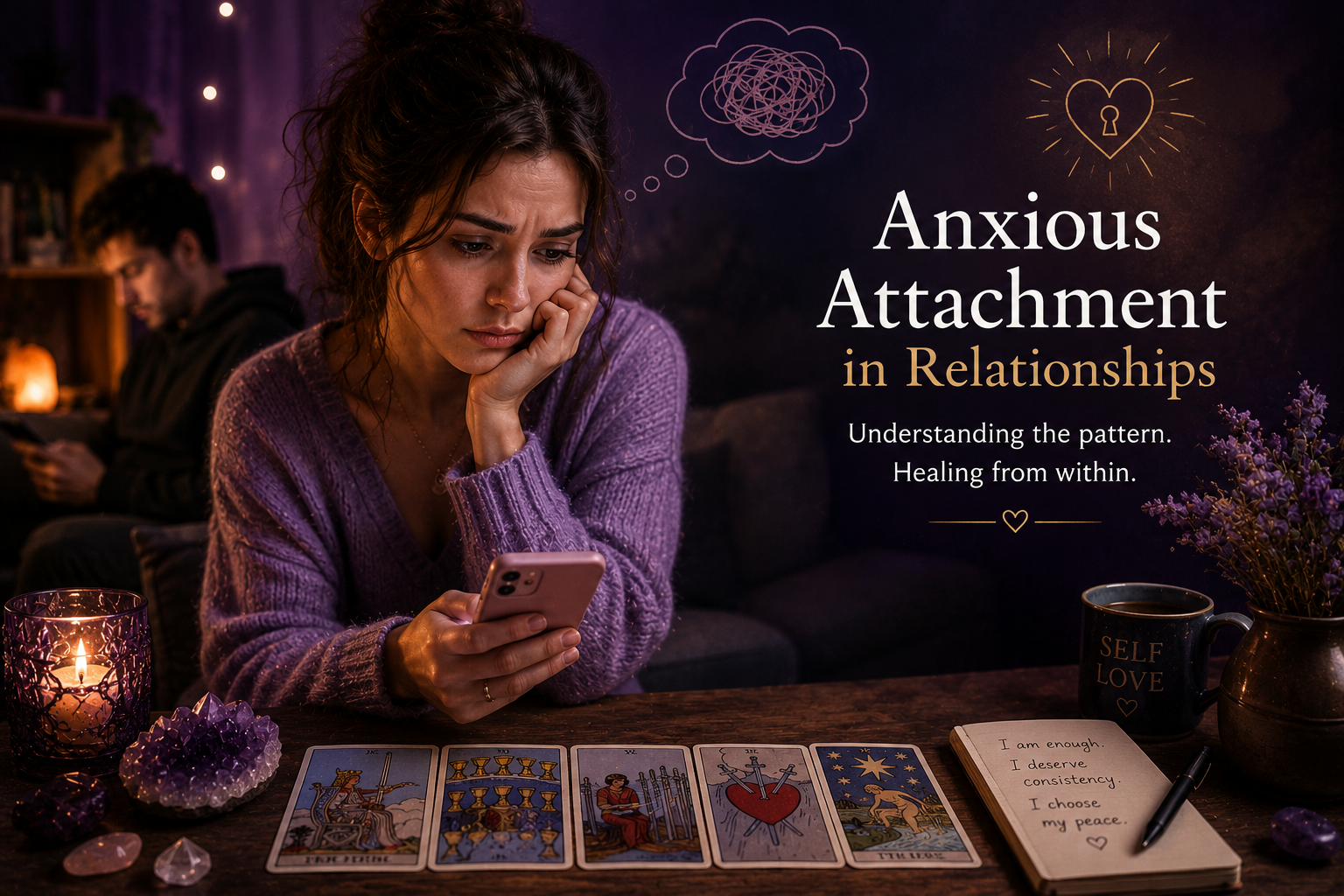
Have you ever felt completely fine in a relationship until someone takes longer than usual to reply?
Maybe one delayed message suddenly makes you wonder:
“Did I do something wrong?”
“Are they losing interest?”
“Why are they acting differently?”
“What if they leave?”
This is where anxious attachment in relationships can become important to understand.
An anxious attachment style can make uncertainty feel much bigger than it actually is. A delayed reply, a change in tone or a little emotional distance may trigger intense worry and a strong desire for reassurance.
That doesn’t mean you’re “too needy” or incapable of having a healthy relationship.
It may simply mean that your nervous system has learned to look for signs of rejection or abandonment when emotional security feels uncertain.
Understanding the pattern is the first step toward changing it.
And while psychology can help explain the pattern, Tarot can also be used as a reflective tool to explore your emotions, relationship expectations and deeper fears.
What Is Anxious Attachment?
Anxious attachment is commonly associated with a strong desire for emotional closeness combined with fear that the other person may withdraw, reject you or leave.
A person experiencing anxious attachment may become highly focused on:
- changes in communication
- signs of emotional distance
- reassurance
- relationship uncertainty
- whether their partner still cares
- possible rejection
The important thing is that having anxious feelings doesn’t automatically mean you have an anxious attachment style.
Everyone can feel insecure sometimes.
The pattern becomes more important when these fears repeatedly affect relationships and your emotional wellbeing.
9 Signs of Anxious Attachment in Relationships
1. You Overanalyze Small Changes
A normal message:
“Okay, talk later.”
can suddenly feel different because it doesn’t contain the usual emoji.
You start comparing today’s communication with yesterday’s.
Then your mind starts searching for an explanation.
This is where your previous article can naturally connect.
2. You Feel Anxious When Someone Doesn’t Reply
A few hours without a response can create a surprising amount of anxiety.
You may check:
- last seen
- story views
- online status
- previous conversations
The issue isn’t necessarily the unanswered message.
It’s the story your mind creates around it.
3. You Need Frequent Reassurance
You may repeatedly want to hear:
“Are we okay?”
“Do you still love me?”
“Are you sure you want this relationship?”
Reassurance can feel comforting temporarily.
However, if anxiety quickly returns, you may find yourself needing reassurance again and again.
4. You Fear That People Will Leave
Even when there is no obvious sign of a breakup, your mind may prepare for it.
You might think:
“What if they find someone better?”
“What if they stop loving me?”
“What if they suddenly disappear?”
This fear can make emotional closeness feel both comforting and frightening.
5. You Become Highly Sensitive to Distance
Your partner wants some alone time.
Instead of seeing it as normal personal space, you may interpret it as:
“They’re pulling away.”
That interpretation can trigger even more anxiety.
This is why learning the difference between intuition and anxiety is valuable.
6. You Try to Fix the Relationship Immediately
When you sense distance, you may feel an urge to:
- send another message
- ask what’s wrong
- explain yourself
- apologize
- start a serious conversation
- seek reassurance
The goal is usually not to create drama.
The goal is to make the uncertainty disappear.
But reacting immediately can sometimes make the anxiety stronger.
7. You Put Their Needs Before Your Own
You might cancel your plans.
You become constantly available.
You avoid saying what you actually want because you’re afraid the other person may become unhappy.
Over time, this can create an unhealthy imbalance.
A secure relationship doesn’t require you to abandon yourself to keep someone else close.
8. You Feel Attracted to Emotionally Unavailable People
This can become especially complicated.
If you’ve repeatedly experienced relationships where affection is inconsistent, uncertainty may begin to feel familiar.
You may mistake:
uncertainty for chemistry
or
anxiety for intensity.
9. You Struggle to Let Go Even When the Relationship Hurts
Sometimes the strongest attachment isn’t created by consistent love.
It can be created by hope.
You remember:
- their best moments
- the affection they once showed
- promises about the future
- the potential of the relationship
And you keep thinking:
“Maybe things will go back to how they were.”
This is a perfect place to internally link:
why you can’t let go of someone
Anxious Attachment vs Genuine Intuition
This is one of the most important sections for your audience.
| Anxious Attachment | Intuition |
|---|---|
| Often feels urgent | Often feels quieter |
| Wants immediate certainty | Can tolerate uncertainty |
| Repeats “what if?” thoughts | May provide a simple sense of knowing |
| Searches for reassurance | Doesn’t always need reassurance |
| Can focus on worst-case scenarios | Usually feels more grounded |
| May react to very small changes | Often considers the bigger pattern |
This doesn’t mean every strong feeling is anxiety or every calm feeling is intuition.
The goal is to pause before treating an emotion as a fact.
Why Does Anxious Attachment Develop?
There isn’t one simple explanation.
Attachment patterns can be influenced by early relationships, later experiences, emotional inconsistency and repeated relationship dynamics.
For some people, inconsistent affection can create a strong desire to monitor relationships for signs of safety.
That can lead to a cycle:
Distance → Anxiety → Reassurance Seeking → Temporary Relief → More Anxiety
Recognizing the cycle is often more useful than blaming yourself for having it.
Anxious Attachment and Breadcrumbing
This is where your previous article becomes extremely powerful for internal linking.
Breadcrumbing can involve intermittent attention without meaningful relationship progress.
If someone already struggles with attachment anxiety, inconsistent attention can become particularly difficult to interpret.
You may constantly wonder:
“Do they actually like me?”
“Why did they disappear?”
“Why are they back again?”
“Should I wait?”
How to Become More Secure in Relationships
1. Pause Before Reacting
When you feel triggered, don’t immediately send five messages.
Take a moment.
Ask:
What actually happened?
Then ask:
What am I assuming happened?
Those are two different things.
2. Don’t Make One Message Your Evidence
One short text doesn’t define a relationship.
Look at the person’s behavior over time.
Consistency gives you much more information than one conversation.
3. Communicate Directly
Instead of:
“You’re acting weird. Do you even care anymore?”
try:
“I’ve noticed we’ve been communicating differently lately. Is everything okay between us?”
Clear communication reduces unnecessary guessing.
4. Maintain Your Own Life
Keep:
- friendships
- hobbies
- work
- personal goals
- routines
- interests
A healthy relationship should become part of your life-not your entire emotional world.
5. Learn Your Triggers
Notice what activates your anxiety.
Is it:
- delayed replies?
- cancelled plans?
- social media?
- emotional distance?
- arguments?
- lack of reassurance?
Once you know your triggers, you can respond consciously instead of automatically.
Can Tarot Help With Anxious Attachment?
Tarot shouldn’t be used to repeatedly ask:
“Does he love me?”
“Will she text me?”
“Are they talking to someone else?”
That can sometimes feed the same reassurance-seeking cycle you’re trying to escape.
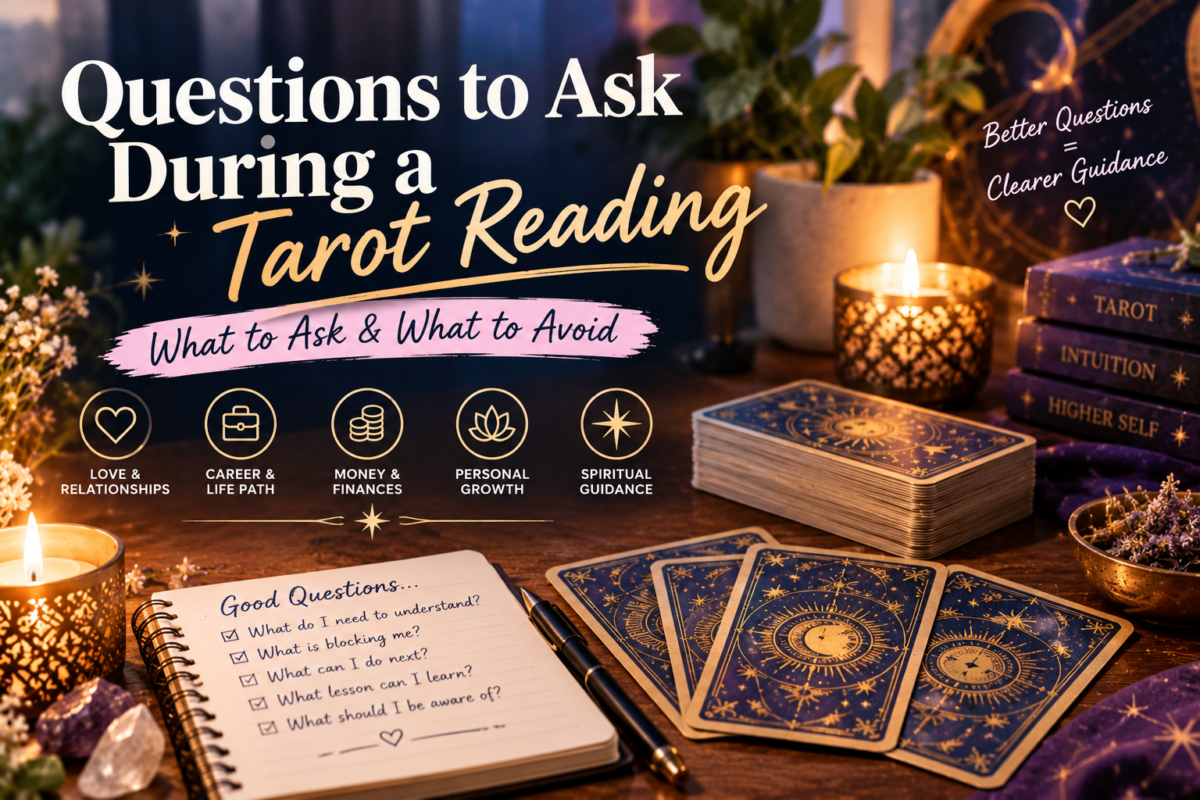
Instead, use Tarot for self-reflection.
Ask:
“What am I feeling right now?”
“What fear is influencing my interpretation?”
“What boundary do I need?”
“What would emotional security look like for me?”
This turns Tarot from a tool for repeatedly checking another person’s behavior into a tool for understanding yourself.
5-Card Tarot Spread for Anxious Attachment
Card 1 – What is triggering my anxiety?
Identify the emotional trigger.
Card 2 – What fear is underneath it?
Explore the deeper concern.
Card 3 – What am I assuming?
Separate assumptions from observable facts.
Card 4 – What boundary would support me?
Identify what you need to protect your emotional wellbeing.
Card 5 – What would a secure response look like?
Focus on your next healthy action.
Tarot Cards That Can Encourage Self-Reflection
The Moon
Questions around uncertainty, fear and unclear information.
Nine of Swords
Reflection on worry, mental pressure and repetitive thoughts.
Two of Swords
Difficulty making a decision or facing an uncomfortable truth.
Queen of Swords
Clarity, boundaries and honest communication.
Strength
Emotional regulation, patience and inner confidence.
The Star
Hope, healing and rebuilding trust in yourself.
Remember:
A Tarot card doesn’t diagnose attachment style or prove another person’s intentions.
Use the reading as reflection-not as a replacement for communication or professional psychological support.
Anxious Attachment vs Secure Attachment
| Situation | Anxious Response | Secure Response |
|---|---|---|
| Partner doesn’t reply | “Something is wrong.” | “They’re probably busy.” |
| Partner needs space | “They’re leaving me.” | “Everyone needs personal space.” |
| Relationship uncertainty | Constant checking | Honest conversation |
| Conflict | Fear of abandonment | Focus on resolving the issue |
| Delayed plans | Personal rejection | Ask for clarification |
| Reassurance | Repeatedly needed | Appreciated but not constantly required |
| Personal identity | Relationship becomes central | Individual life remains important |
The goal isn’t to become someone who never feels anxious.
The goal is to feel the anxiety without allowing it to control every decision.
When Anxious Attachment Meets an Unavailable Partner
This combination can create a powerful cycle.
One person seeks closeness.
The other creates distance.
The first person becomes more anxious.
The second person pulls away further.
Then the first person seeks even more reassurance.
This can become:
Pursue → Withdraw → Pursue → Withdraw
If this pattern feels familiar, don’t immediately ask:
“How can I make them stay?”
Ask:
“Is this relationship capable of giving me the consistency I need?”
That’s a much healthier question.
7 Questions to Ask Yourself
Before reacting to relationship anxiety, ask:
- What actually happened?
- What am I assuming?
- Is this a current problem or an old fear?
- Has this person consistently behaved this way?
- Have I communicated what I need?
- Am I abandoning my own boundaries to keep them close?
- Would I advise my best friend to accept this dynamic?
These questions can help turn emotional reaction into conscious reflection.
FAQ
What is anxious attachment in relationships?
Anxious attachment describes a pattern where a person strongly desires emotional closeness while also experiencing significant fear of rejection, abandonment or emotional distance.
What are the signs of anxious attachment?
Common signs can include overthinking communication, needing reassurance, fearing abandonment, becoming highly sensitive to distance and struggling with uncertainty.
Why do I get anxious when someone doesn’t text back?
A delayed response can activate fears of rejection or abandonment, particularly when uncertainty already feels emotionally threatening.
Can anxious attachment be healed?
Attachment patterns can change. Self-awareness, healthier communication, boundaries and supportive relationships can help people develop more secure ways of relating.
Is anxious attachment the same as relationship anxiety?
They can overlap, but they aren’t necessarily identical. Relationship anxiety can happen for many reasons, while anxious attachment refers to a broader relational pattern.
Can Tarot help with relationship anxiety?
Tarot can be used as a reflective practice to explore emotions, fears and relationship patterns. It should not be treated as proof of another person’s thoughts or intentions.
Can an anxious person have a healthy relationship?
Absolutely. Experiencing anxious attachment doesn’t mean someone cannot have a healthy relationship. Awareness and healthy communication can make a significant difference.
Should I keep asking Tarot if someone loves me?
Repeatedly asking the same question for reassurance may increase anxiety rather than resolve it. Try shifting the questions toward your own emotions, boundaries and choices.
Final Thoughts
Anxious attachment in relationships doesn’t mean something is wrong with you.
It means there may be a pattern worth understanding.
The goal isn’t to stop caring.
It’s to stop allowing fear to make every unanswered message feel like rejection.
You can care deeply and still maintain boundaries.
You can love someone and still maintain your own identity.
You can feel anxious without immediately reacting.
And you can use Tarot not to chase certainty about another person’s mind, but to develop greater awareness of your own.
Sometimes the most powerful relationship question isn’t:
“Do they still want me?”
It’s:
“Do I feel safe, respected and emotionally secure in this connection?”
That question can lead you toward much clearer answers.

One thought on “Anxious Attachment in Relationships: 9 Signs, Psychology & How Tarot Can Help”