

Have you ever wanted to try Tarot but don’t have a Tarot deck nearby?
Fortunately, you can start with something much simpler: a standard 52-card playing deck.
Reading ordinary playing cards for guidance is commonly called cartomancy. Although it has its own traditions and meanings, playing-card reading can be a useful way to explore Tarot-style symbolism.
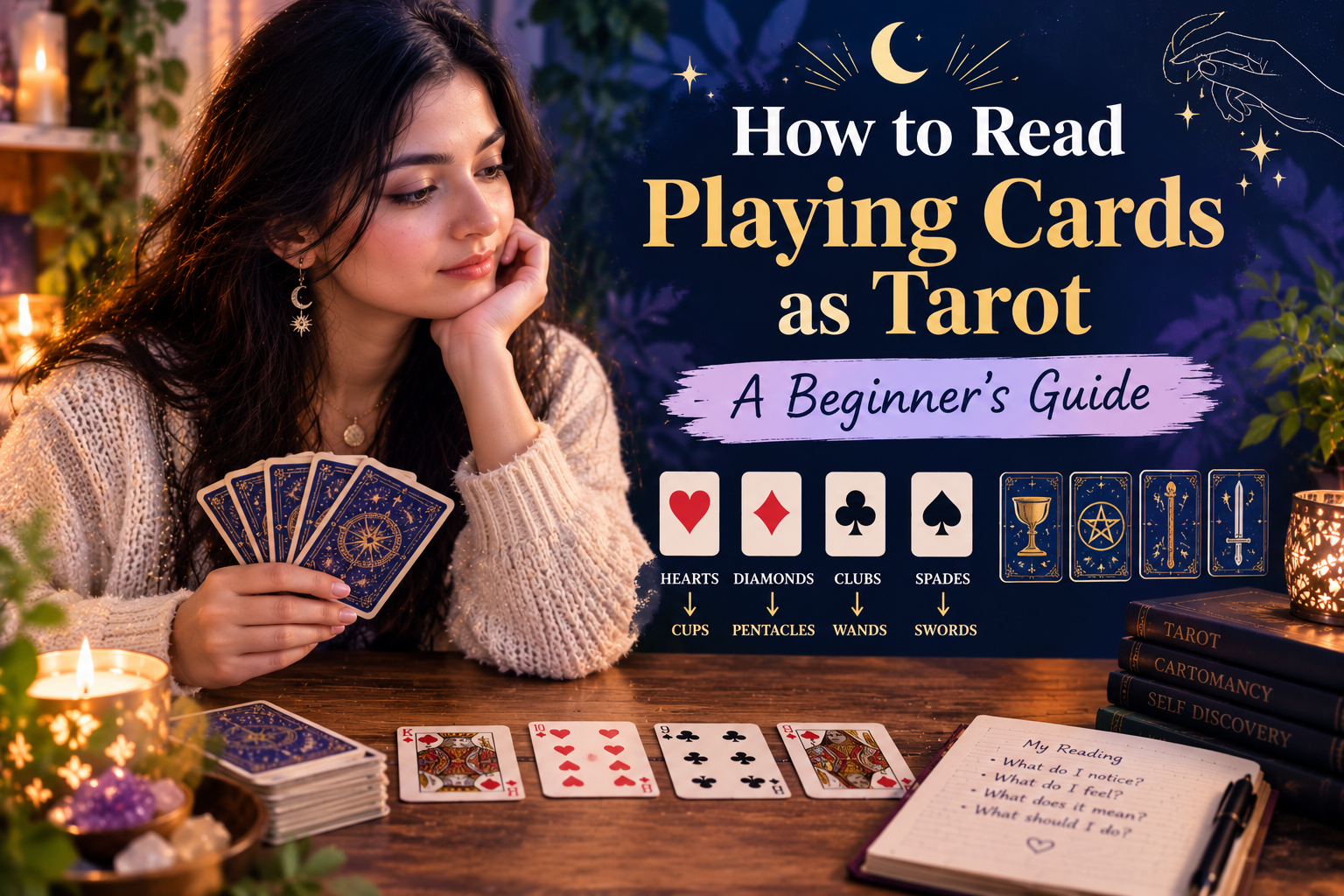
For beginners, the four suits provide an easy starting point. Hearts can be connected with emotions, Diamonds with practical matters, Clubs with action, and Spades with thoughts or challenges.
In this guide, you’ll learn how to read playing cards as Tarot, understand the four suits, interpret numbers and court cards, and perform your first simple reading.
“Can You Use Playing Cards as Tarot?”
Yes, a normal 52-card deck can be used for cartomancy and Tarot-style reflective readings.
However, playing cards and Tarot are not exactly the same system. A traditional Tarot deck contains 78 cards, including 22 Major Arcana cards and 56 Minor Arcana cards. A standard playing deck contains 52 cards and does not have a Major Arcana.
Because of this difference, it’s better to treat playing-card and Tarot correspondences as a learning framework rather than an exact replacement.
For example, Hearts are commonly compared with Cups, while Diamonds are often connected with Pentacles. Similarly, Clubs can be associated with Wands, and Spades with Swords.
Once you understand these basic connections, you can begin combining the suit, number, question, and spread position to create an interpretation.
There are commonly used correspondences between the four playing-card suits and Tarot’s Minor Arcana:
| Playing Card | Tarot Suit | Common Theme |
|---|---|---|
| ♥ Hearts | Cups | Love, emotions, relationships |
| ♦ Diamonds | Pentacles | Money, work, material matters |
| ♣ Clubs | Wands | Action, ambition, creativity |
| ♠ Spades | Swords | Thoughts, conflict, challenges |
These correspondences are widely used in modern beginner guides, although different cartomancy traditions can interpret individual cards differently.
So don’t worry about finding one “perfect” meaning for every card.
The goal is to develop a consistent system that helps you interpret the cards in context.
Playing Cards vs Tarot: What’s the Difference?
Before you begin, understand what your deck can and cannot do.
Tarot has:
- 22 Major Arcana cards
- 56 Minor Arcana cards
- Four suits
- Illustrated cards with rich visual symbolism
- Four court cards per suit
A standard playing deck has:
- 52 cards
- Four suits
- Cards Ace through 10
- Jack, Queen and King
- No traditional Major Arcana
That means you cannot simply say:
“The Ace of Hearts is exactly the Ace of Cups.”
It’s better to think of them as related symbolic systems, not identical cards.
This distinction is particularly important when you’re learning Tarot.
The Four Playing Card Suits
Learning the four suits is the easiest way to start.
1. Hearts ♥ – Love & Emotions
First, Hearts are commonly associated with emotional experiences. They can represent love, relationships, family, friendship, compassion, and emotional connection.
Therefore, a reading containing several Hearts may encourage you to look more closely at your emotional life or relationships.
For example, if you ask, “What should I understand about my relationship?” and several Hearts appear, you could explore the emotional side of the situation first.
2. Diamonds ♦ – Money & Practical Life
Next, Diamonds are generally connected with practical and material matters. These cards can relate to money, career, work, business, security, possessions, and opportunities.
For instance, when asking about your career, several Diamonds may encourage you to consider practical circumstances, financial decisions, or professional opportunities.
3. Clubs ♣ – Action & Growth
Meanwhile, Clubs are often associated with activity, movement, creativity, and personal effort. They can point toward ambition, projects, motivation, communication, and growth.
As a result, a strong Club presence may encourage you to focus on what you can actively do next.
4. Spades ♠ – Thoughts & Challenges
Finally, Spades are often connected with thoughts, decisions, conflict, obstacles, and difficult situations. Nevertheless, a Spade does not automatically represent something negative.
Instead, the card may highlight an issue that requires awareness, honest communication, clearer boundaries, or a thoughtful decision.
What Do the Numbers Mean?
OOnce you understand the suits, you can begin working with the card numbers.
Rather than memorizing 52 individual meanings, start by recognising broad number patterns. The suit tells you the general area of life, while the number can suggest the stage or type of energy involved.
For example, the Three of Hearts combines the emotional themes of Hearts with the developmental quality associated with the number three. Depending on your question, it could encourage reflection on emotional growth, friendship, communication, or a developing relationship.
Keep in mind that these meanings are flexible. The same number can feel different depending on the question, surrounding cards, and position within a spread.
A simple beginner framework is:
| Card | General Theme |
|---|---|
| Ace | Beginning, opportunity, seed |
| 2 | Partnership, choice, balance |
| 3 | Growth, expression, development |
| 4 | Stability, structure |
| 5 | Change, disruption, challenge |
| 6 | Harmony, adjustment, cooperation |
| 7 | Reflection, test, evaluation |
| 8 | Movement, progress, momentum |
| 9 | Near completion, fulfilment |
| 10 | Completion, culmination, cycle |
These are frameworks rather than fixed predictions. Context matters.
For example, a Five of Hearts could feel very different in a relationship reading compared with a career reading.
What About Jack, Queen and King?
Playing cards have three court cards:
- Jack
- Queen
- King
In Tarot, the Minor Arcana traditionally has four court ranks — Page, Knight, Queen and King.
Because playing cards don’t contain both Page and Knight, different cartomancy systems handle the Jack differently.
A simple beginner approach is:
Jack
Can represent:
- A younger person
- A message
- Curiosity
- New energy
- Learning
- Immaturity
Queen
Can represent:
- Emotional intelligence
- Receptivity
- Nurturing
- Intuition
- A mature feminine role
King
Can represent:
- Leadership
- Authority
- Responsibility
- Confidence
- Mature energy
However, don’t automatically assume that a court card represents another person.
It can also describe your own behaviour, qualities or role in a situation.
How to Read Playing Cards as Tarot: Step by Step
Now that you understand the basic system, you can try your first reading.
First, choose a standard deck. No special Tarot deck is required.
Next, decide on one clear question. Instead of asking, “Tell me everything about my future,” try something more focused, such as:
“What should I understand about my current relationship?”
or:
“What should I focus on in my career right now?”
After that, shuffle the cards while keeping your question in mind. Use whichever shuffling method feels comfortable.
Then, draw one or three cards. Starting small makes it easier to understand how the cards work together.
Finally, consider the suit, number, question, and card position before creating your interpretation..
A Simple 3-Card Playing Card Reading
Once you’re comfortable with individual cards, try a three-card reading.
First — Situation: What is happening right now?
Second — What to Understand: What should I pay attention to?
Third — Guidance: What can I do next?
This structure is particularly useful for beginners because each card has a clear purpose. As a result, you can focus on the relationship between the cards instead of trying to interpret everything at once.
For example, the first card may describe your current circumstances, while the second highlights something you need to understand. Finally, the third card can help you reflect on a practical next step.
If you want to learn more about Tarot spreads, you can also read our guide:
Read Here: Tarot Spreads for Beginners: 7 Easy Tarot Readings for Clear Guidance
How to Read Playing Cards for Love
Love questions are one of the easiest places to practise because Hearts naturally give you an emotional starting point.
For example, you might ask:
“What should I understand about my current relationship?”
Then draw three cards.
Card 1 – My emotional position
Card 2 – Relationship dynamic
Card 3 – Guidance
Don’t immediately interpret one card as:
“They definitely love me.”
Instead ask:
- What behaviour am I noticing?
- What emotions are present?
- What am I avoiding?
- What needs communication?
- What action is within my control?
This keeps the reading reflective rather than treating a card as proof of another person’s private thoughts.
For relationship-focused Tarot guidance, you can also connect this article to:
Internal link: Tarot for Relationship Clarity: 7 Questions to Ask When You Feel Confused About Love
Can Playing Cards Predict the Future?
Playing-card readings are traditionally used for divination, but a card reading shouldn’t be treated as guaranteed proof of what will happen.
A useful approach is to use the cards as symbolic prompts for reflection.
For example, instead of:
“The Seven of Spades means my relationship will end.”
consider:
“What conflict, uncertainty or boundary does this card make me think about?”
This gives you something practical to examine.
Your decisions should still be based on real-world information, communication, circumstances and your own judgment.
How to Develop Intuition With Playing Cards
Developing intuition doesn’t require you to memorize every card meaning.
Instead, begin with a simple one-card exercise. Look at the card for about 30 seconds and notice your first reaction.
Then identify the suit. Ask yourself what area of life it could represent.
Next, consider the number or court card. Think about what stage, quality, or energy it might suggest.
Write down your first interpretation before checking a guidebook or reference.
Afterward, compare your interpretation with traditional meanings. Over time, this practice can help you become more comfortable with your own intuitive process.
You can continue with:
Read Here: How to Develop Intuition with Tarot: 9 Simple Practices
5 Beginner Mistakes to Avoid
There are also a few common mistakes worth avoiding when you start.
1. Trying to memorize 52 meanings
Rather than learning every card immediately, begin with the four suits and basic number patterns.
2. Asking the same question repeatedly
If you keep drawing cards until you receive the answer you want, the reading can become confusing. Instead, give yourself time to reflect on the first reading.
3. Treating every Spade as negative
Although Spades can represent challenges, they don’t automatically mean something bad. Sometimes, recognising a difficult issue can help you respond more thoughtfully.
4. Ignoring context
A card can have different meanings depending on the question, spread position, surrounding cards, and your circumstances. Therefore, avoid relying on a single fixed definition.
5. Assuming the cards reveal someone else’s thoughts
A card reading cannot provide verified access to another person’s private thoughts. Instead, use relationship readings to reflect on observable behaviour, communication, emotions, boundaries, and your own choices.
A 5-Card Playing Card Spread for Beginners
Once you’re comfortable with three cards, try five.
Card 1 – What is happening?
Card 2 – What is influencing the situation?
Card 3 – What am I not seeing clearly?
Card 4 – What can I do?
Card 5 – What should I keep in mind?
This spread can be used for:
- Love
- Career
- Personal growth
- Decisions
- Emotional clarity
Write your interpretation down before looking up meanings.
After a few weeks, review your journal.
You may start noticing patterns in the way you naturally interpret certain cards.
Playing Cards as Tarot: Quick Reference
| Playing Card | Tarot Connection | Main Theme |
|---|---|---|
| Hearts ♥ | Cups | Emotions & relationships |
| Diamonds ♦ | Pentacles | Money & practical life |
| Clubs ♣ | Wands | Action & creativity |
| Spades ♠ | Swords | Thoughts & challenges |
| Ace | Ace | Beginning |
| 2 | 2 | Choice / partnership |
| 3 | 3 | Growth |
| 4 | 4 | Stability |
| 5 | 5 | Change |
| 6 | 6 | Harmony |
| 7 | 7 | Reflection |
| 8 | 8 | Movement |
| 9 | 9 | Near completion |
| 10 | 10 | Completion |
Remember: these are learning correspondences, not a universal rulebook for every cartomancy tradition.
Frequently Asked Questions
1. Can I use normal playing cards instead of Tarot?
Yes. A normal 52-card deck can be used for cartomancy and Tarot-style reflective readings. However, playing cards and Tarot have different structures and traditions.
2. Which playing cards represent Tarot Cups?
Hearts are commonly compared with Cups because both are associated with emotions, relationships and connection.
3. Which playing cards represent Tarot Pentacles?
Diamonds are commonly compared with Pentacles, particularly around money, work and material matters.
4. Which playing cards represent Tarot Wands?
Clubs are commonly compared with Wands, especially around action, creativity and ambition.
5. Which playing cards represent Tarot Swords?
Spades are commonly compared with Swords, particularly around thoughts, conflict and challenges.
6. Can I do a three-card reading with playing cards?
Absolutely. A simple structure is Situation → What to Understand → Guidance.
7. Do I need to memorize every card?
No. Start with the four suits, basic numbers and court cards. Then practise combining those elements with the question and spread position.
8. Is playing-card reading the same as Tarot?
No. Cartomancy has its own history and traditions. The playing-card/Tarot suit comparisons are useful learning correspondences, but a standard deck doesn’t contain Tarot’s 22 Major Arcana.
Final Thought
You don’t need a special deck to begin exploring card reading.
A simple deck of playing cards can give you a structured way to slow down, examine a question and notice patterns you may have overlooked.
Start with one card.
Learn the four suits.
Understand the numbers.
Practise a simple three-card spread.
And most importantly, don’t treat a card as a fixed sentence about your future. Use it as a prompt to explore what is happening, what you feel, what you may be overlooking and what you can do next.
With regular practice, your interpretations can become more natural — and the familiar 52-card deck can become a surprisingly useful tool for reflection and intuitive practice.
One thought on “How to Read Playing Cards as Tarot: A Beginner’s Guide”