

Have you ever wondered whether Tarot and Astrology are actually connected – or whether they are two completely different spiritual practices?
Both can be used to explore questions about relationships, personal growth, career, emotions and life direction. However, they approach those questions differently.
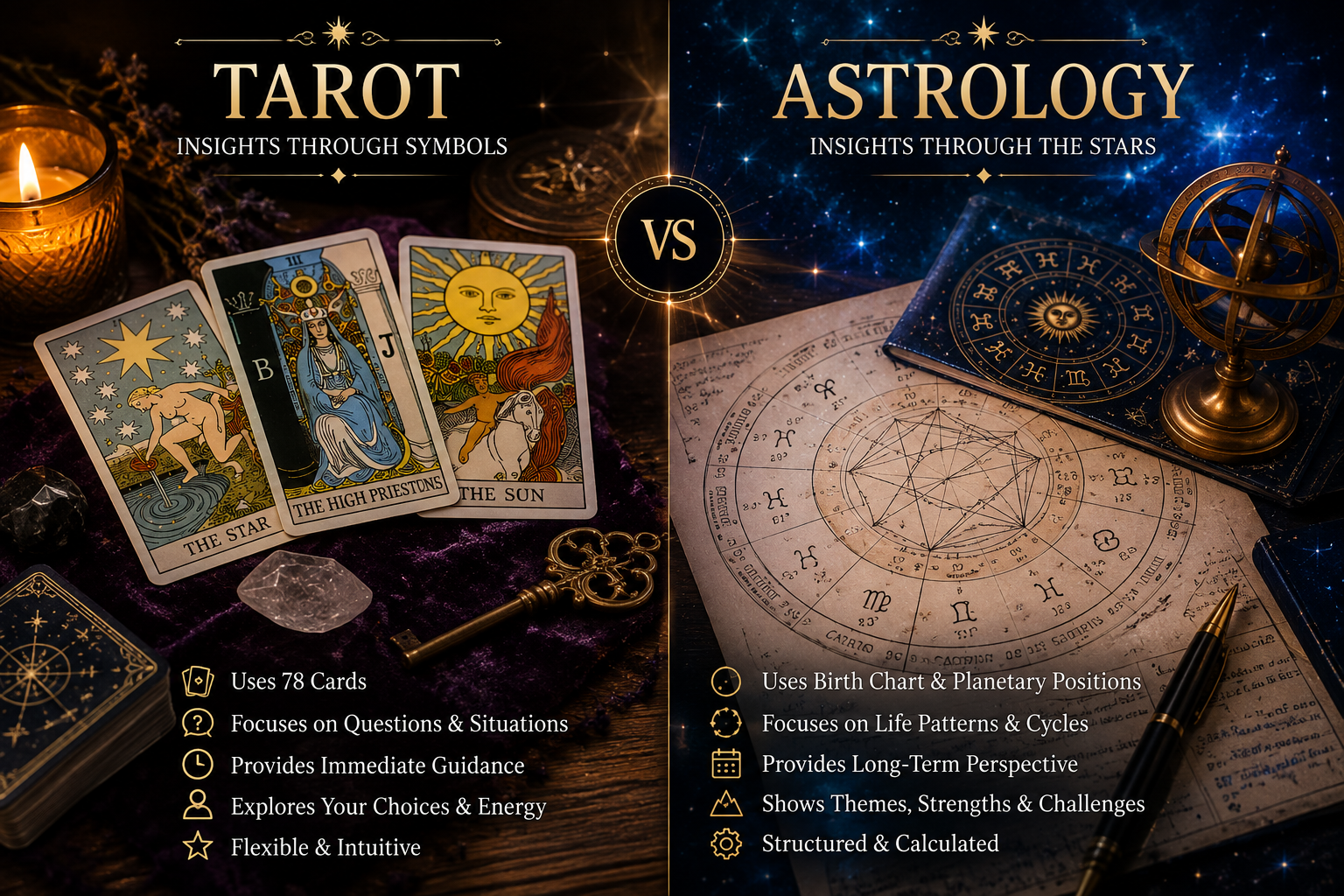
Astrology looks at celestial patterns and birth-chart placements, while Tarot works through cards, symbols and the specific question or situation you’re exploring.
That doesn’t mean you have to choose one.
When used thoughtfully, Tarot and Astrology can complement each other by giving you different perspectives on the same situation.
In this guide, we’ll explore the key differences between Tarot and Astrology, how they overlap, and seven practical ways you can use both together.
What Is Tarot?
Tarot is a card-based symbolic system consisting of 78 cards divided into the Major Arcana and Minor Arcana.
A Tarot reading typically involves drawing cards in response to a question, theme or intention.
For example, you might ask:
- What do I need to understand about my relationship?
- What should I focus on in my career?
- What is influencing my current situation?
- What am I overlooking?
- What can help me move forward?
The cards provide imagery and symbolism that can be interpreted in relation to the question.
Tarot can therefore work particularly well as a reflective tool.
Instead of simply asking what will happen, you can use a reading to explore what you’re thinking, feeling and noticing.
What Is Astrology?
Astrology is a symbolic system that interprets the positions and relationships of celestial bodies such as the Sun, Moon and planets.
Your birth chart is calculated using information such as:
- Date of birth
- Time of birth
- Place of birth
The resulting chart contains different planetary placements, zodiac signs, houses and aspects.
For example, someone might explore:
Sun sign – identity and self-expression
Moon sign – emotional tendencies and inner responses
Venus – relationships, attraction and values
Mars – motivation, action and desire
Saturn – responsibility, boundaries and lessons
Astrology therefore tends to provide a broader framework for understanding patterns associated with a person’s birth chart and current astrological cycles.
Tarot vs Astrology: The Key Difference
The simplest way to understand the difference is:
Astrology looks at the sky. Tarot looks at the cards.
But there is more to it than that.
| Tarot | Astrology |
|---|---|
| Uses Tarot cards | Uses birth charts and celestial positions |
| Often focuses on a specific question | Often explores broader life patterns |
| Uses symbolic imagery | Uses planets, signs, houses and aspects |
| Can be used spontaneously | Usually requires birth information for natal work |
| Useful for reflective readings | Useful for chart-based interpretation |
| Can explore current situations | Can explore longer-term themes and cycles |
Neither system needs to be treated as a replacement for the other.
They can simply offer different perspectives.
Are Tarot and Astrology Connected?
Yes, there are traditional correspondences between Tarot and Astrology.
Many Tarot cards have been associated with:
- Zodiac signs
- Planets
- Elements
- Astrological symbolism
For example, The Emperor is traditionally associated with Aries in many Tarot systems, while The Moon has strong lunar symbolism.
These correspondences can make studying both systems together particularly interesting.
However, you don’t need to memorize every astrological association before you can read Tarot.
Start with the system you understand best and gradually build connections.
7 Ways to Use Tarot and Astrology Together
1. Use Your Birth Chart to Understand Yourself, Then Tarot to Reflect
Astrology can provide a framework for exploring personality patterns and tendencies.
Tarot can then help you reflect on how those themes are showing up in your current life.
For example, suppose your birth chart encourages you to explore themes around communication.
Instead of stopping at:
“Communication is important for me.”
you could pull a Tarot card and ask:
“What should I understand about how I’m communicating right now?”
This creates a bridge between broader self-understanding and present-moment reflection.
2. Use Your Moon Sign for Emotional Reflection
Your Moon sign is often explored through emotional patterns, comfort needs and instinctive responses.
You can use this as a starting point for a Tarot reading.
Ask:
“How can I better understand my emotional needs?”
Then pull three cards:
Card 1
What am I feeling?
Card 2
What do I need?
Card 3
How can I respond in a healthier way?
This approach can be particularly useful when you’re trying to understand emotional reactions instead of immediately acting on them.
If you’re already working on distinguishing intuitive feelings from anxiety, your article on intuition and anxiety fits naturally into this section.
3. Combine Venus Themes With Relationship Tarot
Astrology often uses Venus when exploring themes such as attraction, affection, values and relationships.
Tarot can then be used to explore the situation from another angle.
Instead of asking:
“Will this person become my partner?”
try:
“What should I understand about my relationship patterns?”
You could use a five-card spread:
- What am I looking for?
- What am I attracting?
- What pattern should I recognize?
- What boundary needs attention?
- What can help me create healthier relationships?
This makes the reading about self-awareness, rather than attempting to control another person’s choices.
4. Use Astrology to Choose a Tarot Theme
You can also reverse the process.
Instead of starting with Tarot, begin with an astrological theme you’re currently interested in.
For example:
Mercury → communication and thinking
Venus → relationships and values
Mars → motivation and action
Saturn → responsibility and boundaries
Jupiter → growth and expansion
Choose one theme.
Then pull one Tarot card asking:
“What do I need to understand about this area of my life?”
This gives your Tarot practice a clear focus.
5. Use Tarot During Personal Transitions
Astrology can encourage you to reflect on broader cycles and periods of change.
Tarot can then help you explore the personal side of that transition.
Try asking:
What am I leaving behind?
What am I learning?
What am I being encouraged to notice?
What strength can I use?
What is my next grounded step?
This can be particularly useful during periods when you’re changing careers, relationships, priorities or personal goals.
6. Create a Tarot + Astrology Journal
If you want to genuinely learn both systems, keep one combined journal.
For each entry, record:
Date:
Astrological theme:
Tarot card:
First impression:
Traditional meaning:
How it relates to my life:
What I learned:
After several weeks, review your entries.
You may begin noticing recurring themes.
Perhaps the same Tarot cards appear when you’re dealing with particular emotions.
Maybe certain astrological themes consistently make you reflect on similar areas of life.
The journal turns isolated readings into an ongoing learning process.
7. Use Both Systems Without Becoming Dependent on Either
This is perhaps the most important practice.
Tarot and Astrology can be valuable tools for reflection, but they don’t need to make every decision for you.
You don’t need to ask:
“Should I take this job because Mercury is doing something?”
or:
“Should I date this person because our signs match?”
or:
“The Tarot card was negative, so I shouldn’t do it.”
Instead, use spiritual tools alongside real-world information.
Ask:
What am I feeling?
What does the symbolism make me consider?
What evidence do I have?
What choices are actually available?
What aligns with my values?
That creates a more grounded approach to spiritual practice.
Tarot and Astrology for Love
Relationships are one of the areas where people frequently combine Tarot and Astrology.
You might use Astrology to explore compatibility themes and Tarot to reflect on the current emotional dynamic.
For example:
Astrology question
What relationship themes appear in my chart?
Tarot question
What should I understand about this connection right now?
These are different questions.
Trying to make Tarot prove whether someone is “the one” can create unnecessary anxiety.
A more useful approach is to explore:
- Communication
- Boundaries
- Emotional needs
- Attraction
- Compatibility
- Repeating patterns
- Personal growth
This also connects naturally with your existing content on emotionally unavailable partners and repeating relationship patterns.
Tarot and Astrology for Career
You can also combine both systems when reflecting on career goals.
Astrology may provide a framework for exploring themes around ambition, work and personal direction.
Tarot can then help you ask:
“What should I focus on right now?”
Try a three-card spread:
Card 1 – Current Career Energy
What is influencing me?
Card 2 – Hidden Challenge
What am I overlooking?
Card 3 – Next Step
What practical action can I take?
The final card is important.
A reading becomes much more useful when it leads to a real-world action.
Can Beginners Learn Tarot and Astrology Together?
Absolutely.
But don’t try to memorize everything at once.
Start with the basics.
Tarot
Learn:
- Major Arcana
- Four suits
- Basic card symbolism
- Simple spreads
- Reversed cards later, if you want
Astrology
Learn:
- 12 zodiac signs
- Sun, Moon and Rising
- Planets
- Houses
- Basic aspects
Once those foundations are comfortable, start connecting the systems.
For example:
The Sun → identity and vitality
The Moon → emotions and intuition
Venus → attraction and values
Mars → action and desire
This makes learning more manageable.
A Simple 5-Card Tarot + Astrology Spread
Try this when you want to explore an important life theme.
Card 1 – My Current Energy
What am I experiencing right now?
Card 2 – My Emotional Need
What does my inner world need?
Card 3 – My Challenge
What should I pay attention to?
Card 4 – My Strength
What can I rely on?
Card 5 – My Next Step
What practical action can I take?
You can then journal about how the reading relates to the astrological themes you’re currently studying.
Should You Use Tarot or Astrology First?
There is no universal answer.
Choose Tarot first when you have a specific question or situation.
For example:
“What should I understand about this decision?”
Choose Astrology first when you’re interested in broader personal patterns.
For example:
“Why do I approach relationships this way?”
Use both when you want to explore a topic from multiple perspectives.
For example:
“What relationship patterns do I have, and what should I understand about my current relationship?”
Tarot and Astrology Aren’t About Predicting Every Detail
One of the biggest misconceptions is that spiritual tools should tell you exactly what will happen.
Real life doesn’t work that neatly.
People make choices.
Circumstances change.
New information appears.
Your own goals can change.
Therefore, a healthier approach is to use Tarot and Astrology to support:
reflection
self-awareness
questioning
personal growth
and intentional decision-making.
You can still enjoy the spiritual side without giving away your personal agency.
Final Thoughts
Tarot and Astrology may use different systems, but they can complement each other beautifully.
Astrology can provide a broader symbolic framework through planets, signs, houses and birth-chart patterns.
Tarot can provide a more immediate visual and reflective experience through cards and spreads.
You don’t have to decide which one is “better.”
Instead, ask what each tool can help you explore.
Use Astrology to understand broader themes.
Use Tarot to ask focused questions.
Use journaling to connect the insights.
And most importantly, combine spiritual reflection with your own judgment and real-world information.
The goal isn’t to predict every moment of your future.
It’s to understand yourself a little better as you move through it.
FAQs
No. Tarot is a card-based symbolic practice, while Astrology interprets celestial positions, zodiac signs, planets and birth-chart patterns. They can be studied separately or used together.
Yes. Many people combine them for reflection and spiritual exploration. Astrology can provide broader themes, while Tarot can help explore a specific question or current situation.
Neither is universally better. Tarot can be useful for focused questions and reflection, while Astrology can provide a broader framework for personality and life themes.
Tarot is often used for guidance and reflection, and interpretations can explore possible patterns or outcomes. However, a reading shouldn’t be treated as a guaranteed prediction of exactly what will happen.
Many Tarot traditions associate particular cards with zodiac signs, planets and elements. These correspondences vary somewhat between systems and traditions.
Yes. Start with the basic Tarot cards, zodiac signs and planets rather than trying to learn everything simultaneously. Gradually explore the connections between the two systems.
They can be used as reflective tools for exploring communication, emotional needs, attraction, boundaries and relationship patterns. They shouldn’t be used to override another person’s choices or consent.
Tarot can help you reflect on a decision, but important choices should also consider practical evidence, consequences, professional advice when appropriate and your own judgment.

One thought on “Tarot and Astrology: What’s the Difference and How Can You Use Both Together?”