


Have you ever shuffled your Tarot cards, placed them on the table, and suddenly wondered, “What am I supposed to do now?”
If you are new to Tarot, you may think you need to learn complicated spreads before you can get meaningful answers. The truth is, you don’t.
A simple Tarot reading can be surprisingly powerful when you have a clear question, understand the purpose of each card position, and give yourself enough space to interpret what you see.
You don’t need ten cards. You don’t need to memorize every possible combination. And you certainly don’t need to become an expert overnight.
Sometimes, one card is enough to start a conversation with yourself.
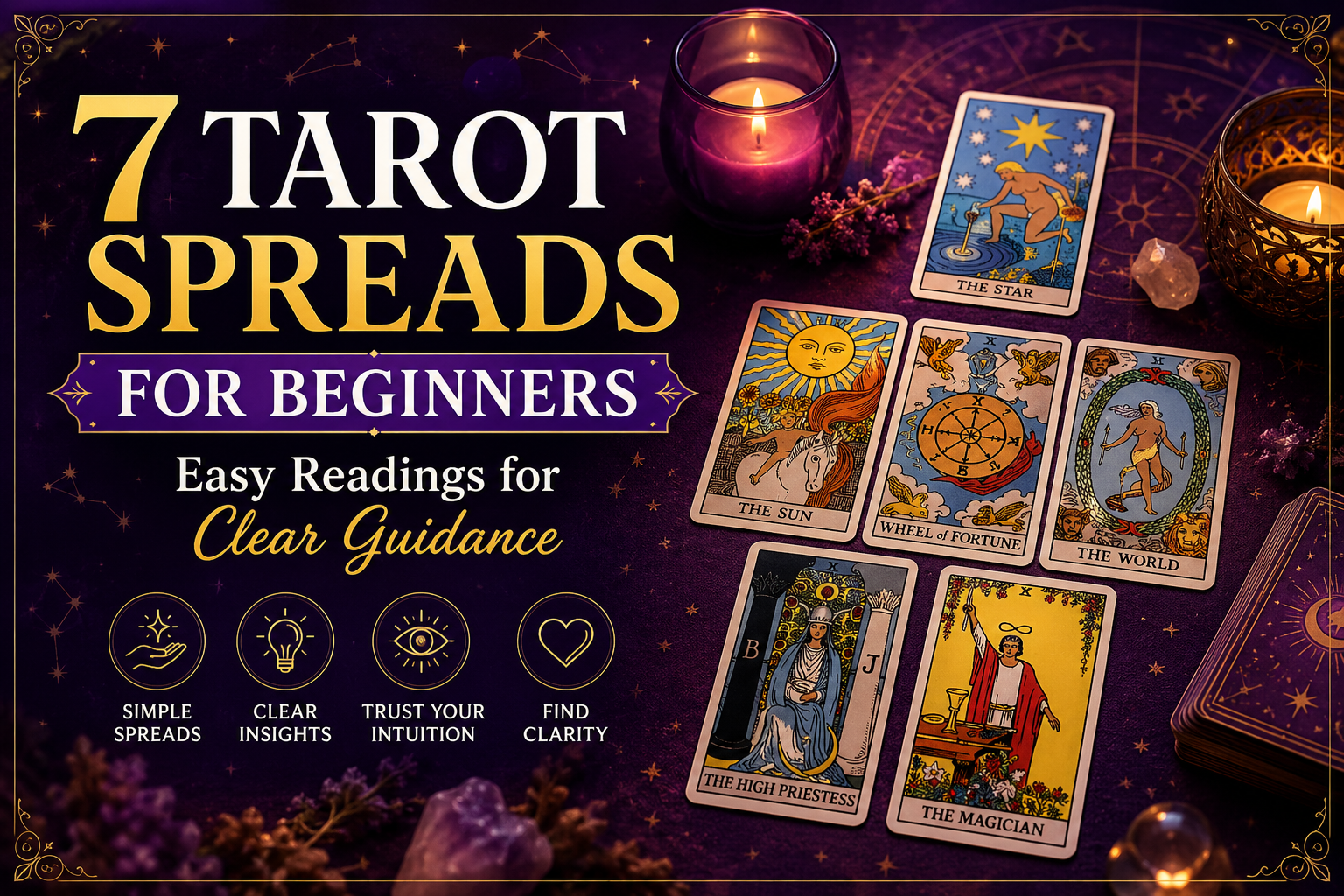
In this guide, we’ll explore 7 Tarot spreads for beginners, including simple one-card and three-card readings you can use for daily guidance, decisions, self-reflection, career questions, relationships, and personal growth.
What Is a Tarot Spread?
A Tarot spread is simply a specific arrangement of Tarot cards where each position has a particular purpose or question.
For example, a three-card spread might ask:
- What is happening?
- What do I need to understand?
- What should I do next?
Each card gives you one piece of the larger picture.
The value of a spread isn’t necessarily in the number of cards you use. In fact, beginner-friendly Tarot resources often recommend starting with simple one-to-three-card readings because they can provide useful insight without becoming overwhelming.
Think of a Tarot spread as a conversation framework. The cards aren’t there to make every decision for you. Instead, they can help you slow down, notice patterns, explore possibilities, and look at a situation from a different perspective. When you’re learning to interpret the cards, it’s also important to understand the difference between intuition and anxiety, because not every thought or feeling that appears during a reading carries the same meaning.
If you’re new to Tarot, starting with simple one-card and three-card layouts can make learning much less overwhelming. Biddy Tarot also recommends beginner-friendly spreads such as the Card-A-Day and Past–Present–Future layouts.
1. The One-Card Tarot Spread
Best for: Daily guidance and quick questions
If you’re completely new to Tarot, start here.
You don’t need a complicated layout. Simply shuffle your cards and draw one.
Before drawing, ask:
“What do I need to know today?”
or:
“What energy should I focus on today?”
Then look at the card.
Don’t immediately reach for a guidebookFirst, observe:
- What is the first thing you notice?
- What emotion does the image create?
- What symbols stand out?
- Does the card remind you of something happening in your life?
- What word comes to mind?
After that, look at the traditional meaning of the card and compare it with your first impression.
Example
Imagine you draw The Hermit.
Instead of automatically thinking, “This means loneliness,” consider the wider message.
Perhaps you have been surrounded by too many opinions lately.
The card might encourage you to:
pause → step back → reflect → listen to yourself.
That’s much more useful than simply memorizing one keyword.
Try this daily
For seven days, pull one card every morning and write down:
Card:
First impression:
Possible message:
What happened during the day:
At the end of the week, look back.
You may start noticing patterns in the way you personally connect with the cards.
2. Past – Present – Future Tarot Spread
Best for: Understanding a situation and its direction
This is one of the most familiar three-card Tarot spreads.
Place three cards from left to right:
Card 1 → Past
Card 2 → Present
Card 3 → Future
But don’t interpret the Future card as a fixed prediction.
A more useful approach is to view it as:
“Where is the current energy heading if nothing significantly changes?”
This leaves room for your choices and actions.
Card 1: Past
What previous experience, decision, event, or pattern has influenced the current situation?
Card 2: Present
What is happening right now?
What energy are you working with?
Card 3: Future
What direction could this situation move toward?
What should you become aware of?
Biddy Tarot similarly describes the Past–Present–Future spread as useful for understanding context and seeing how the present connects with possible future direction.
A better question to ask
Instead of:
“Exactly what will happen?”
try:
“What should I understand about where this situation is heading?”
That creates a more reflective and empowering reading.
3. Situation – Challenge – Advice
Best for: When you feel stuck
Sometimes the problem isn’t that you don’t have options.
It’s that you can’t clearly see what is actually blocking you.
This three-card spread can help.
Card 1 — Situation
What is really happening?
Card 2 — Challenge
What is making this situation difficult?
Card 3 — Advice
What approach could help you move forward?
For example, imagine you’re considering a major career change.
Your cards could represent:
Situation: You are ready for something different.
Challenge: Fear of financial uncertainty.
Advice: Build a practical transition plan instead of making an impulsive decision.
Notice how the reading doesn’t simply tell you:
“Quit your job.”
Instead, it encourages deeper thinking.
That’s one of the most useful ways to approach Tarot.
4. Decision-Making Tarot Spread
Best for: Choosing between two options
Having two choices can be exhausting.
You can use Tarot to explore the energy surrounding each option.
Try this five-card layout:
Card 1: What do I need to know about Option A?
Card 2: What could I learn from Option A?
Card 3: What do I need to know about Option B?
Card 4: What could I learn from Option B?
Card 5: What should I consider before deciding?
This isn’t about asking:
“Which option will definitely make me happy?”
Instead, ask:
“What am I not seeing about these choices?”
That question can reveal something more valuable.
Perhaps one option looks exciting but requires you to ignore an important practical issue.
Another may initially seem boring but offer stability and long-term growth.
The Tarot becomes a tool for reflection rather than a replacement for your own judgment.
5. Career & Purpose Tarot Spread
Best for: Work, career direction and personal growth
You can use this spread when you’re questioning your professional direction.
Try five cards:
Card 1 — Where am I now?
What is the current energy surrounding my career?
Card 2 — What is working?
What strength or opportunity should I recognize?
Card 3 — What is holding me back?
What pattern, fear, habit, or circumstance needs attention?
Card 4 — Where should I focus?
What deserves more energy right now?
Card 5 — My next step
What practical action can I take?
This is particularly useful when you feel like you’re working hard but aren’t sure whether you’re moving in the right direction.
Instead of searching for one dramatic answer, look for small actionable insights.
Sometimes the most powerful Tarot message isn’t:
“Change everything.”
It’s:
“Start with this one thing.”
6. Self-Discovery Tarot Spread
Best for: Understanding yourself
Not every Tarot reading needs to be about another person.
Some of the most meaningful readings are about you.
Try this four-card spread:
Card 1 — What am I feeling?
Card 2 — What am I avoiding?
Card 3 — What do I need to understand?
Card 4 — What can help me move forward?
This spread can be especially helpful when your thoughts feel scattered.
For example, you may believe you’re frustrated with your career.
But the cards may encourage you to look deeper and realize that the bigger issue is exhaustion, lack of recognition, or fear of starting something new.
The purpose isn’t to force an interpretation.
This kind of self-reflection can also help you recognize recurring emotional patterns, including the types of connections and people you may repeatedly attract. Understanding those patterns can be an important step toward creating healthier relationships.
It’s to create a moment where you can ask yourself:
“What is really going on inside me?”
7. Stop – Start – Continue Tarot Spread
Best for: Personal growth and fresh beginnings
This is one of the simplest spreads you can use when you want practical guidance.
Draw three cards.
Card 1 — STOP
What habit, mindset, behaviour, or pattern may no longer be serving me?
Card 2 — START
What should I begin doing?
Card 3 — CONTINUE
What is already working that I should keep nurturing?
This spread is excellent for:
- Personal growth
- Career planning
- Spiritual development
- New routines
- Goal setting
- Major life transitions
It also prevents the reading from becoming purely theoretical.
You finish with three practical directions.
How to Choose the Right Tarot Spread
You don’t need to memorize dozens of spreads.
Instead, match the spread to your question.
| Your Question | Recommended Spread |
|---|---|
| What do I need today? | One Card |
| What’s happening in this situation? | Past–Present–Future |
| Why do I feel stuck? | Situation–Challenge–Advice |
| Which option should I explore? | Decision Spread |
| What should I focus on professionally? | Career Spread |
| Why am I feeling this way? | Self-Discovery Spread |
| What should I change? | Stop–Start–Continue |
Start simple.
Once you become comfortable with three-card readings, you can gradually experiment with larger spreads.
Biddy Tarot also emphasizes that beginners can gain substantial insight from simple spreads rather than immediately jumping into complicated layouts.
How to Ask Better Tarot Questions
Your question can completely change your reading.
Compare:
❌ “Will I get the job?”
with:
✅ “What should I understand about my career opportunity right now?”
Instead of:
❌ “Will they come back?”
try:
✅ “What do I need to understand about this connection?”
Instead of:
❌ “Will I be successful?”
try:
✅ “What should I focus on to move toward my goal?”
Open-ended questions give the cards more room to provide meaningful reflection.
What Should You Do If a Tarot Card Confuses You?
Don’t panic.
A confusing card doesn’t automatically mean something negative.
Start with the image.
Ask yourself:
What do I notice first?
Then ask:
How does this card relate to my question?
Look at:
- Facial expressions
- Body language
- Colours
- Symbols
- Numbers
- Direction of movement
- Overall mood
Then check the traditional interpretation.
You can also write down your first impression before reading the guidebook.
Over time, you’ll build your own relationship with the cards instead of simply memorizing keywords.
Do You Need Clarifying Cards?
Not always.
One of the biggest beginner mistakes is pulling another card every time the first card doesn’t make sense.
Then another.
And another.
Sometimes, a confusing card makes us want to pull another card, and then another. Before you continue, ask yourself whether you genuinely need more information or whether you’re overthinking the situation and searching for certainty.
Suddenly, a three-card reading has become fifteen cards—and you’re more confused than when you started.
Before pulling another card, ask:
“Do I genuinely need more information, or am I trying to get the answer I want?”
Sometimes the first card is already giving you enough information.
Pause.
Reflect.
Then decide whether clarification is actually necessary.
Can Tarot Predict the Future?
Tarot can be used to explore possibilities, patterns and current energies, but it shouldn’t be treated as an unchangeable script for your life.
Your decisions matter.
Your circumstances can change.
Other people’s choices can change.
A Tarot reading can offer a perspective on the road you’re currently travelling—but you still hold the steering wheel.
This is why questions focused on awareness, choices and personal action can often be more useful than trying to predict an exact event.
A Simple Tarot Routine for Beginners
If you want to build confidence, don’t try to learn everything at once.
Try this seven-day routine:
Day 1
Pull one card.
Write your first impression.
Day 2
Pull one card and study its imagery.
Day 3
Try a Past–Present–Future reading.
Day 4
Try Situation–Challenge–Advice.
Day 5
Ask a career or personal-growth question.
Day 6
Try Stop–Start–Continue.
Day 7
Review your notes.
Look for repeated themes.
You may notice that the same symbols, suits, numbers or messages appear repeatedly.
That is where Tarot becomes more personal.
Final Thoughts
Learning Tarot doesn’t have to begin with complicated spreads or memorizing all 78 cards.
Start with one card.
Ask a clear question.
Observe the imagery.
Write down your first impression.
Then gradually move into three-card and five-card spreads as your confidence grows.
The goal isn’t to become someone who can recite every Tarot card meaning from memory.
The goal is to become more comfortable asking meaningful questions, recognizing patterns and listening to your own perspective.
And sometimes, the simplest Tarot reading can give you the clearest place to begin.
If you’re ready to explore Tarot more deeply, The Astro Palace offers personalized Tarot Card Readings designed to help you gain clarity around the questions and situations that matter most to you.
Your cards may offer the perspective. The next step is yours.
Frequently Asked Questions
A one-card or three-card spread is usually the easiest place to start. A one-card reading keeps the interpretation simple, while a three-card spread gives more context without becoming overwhelming.
Start with one to three cards. Once you become comfortable interpreting smaller spreads, you can experiment with larger layouts.
A one-card daily Tarot reading is an easy option. Ask what energy, lesson or theme you should be aware of that day.
Yes. Reading Tarot for yourself can be a useful way to practice interpreting cards and reflecting on your own questions. Keep your questions clear and avoid repeatedly pulling cards just to get a preferred answer.
Ask open-ended questions such as “What do I need to understand?”, “What should I focus on?”, or “What can I do to improve this situation?”
Not necessarily. Tarot can be approached as a reflective practice that explores patterns, possibilities and current circumstances rather than guaranteeing a fixed future.
2 thoughts on “Tarot Spreads for Beginners: 7 Easy Tarot Readings for Clear Guidance”