

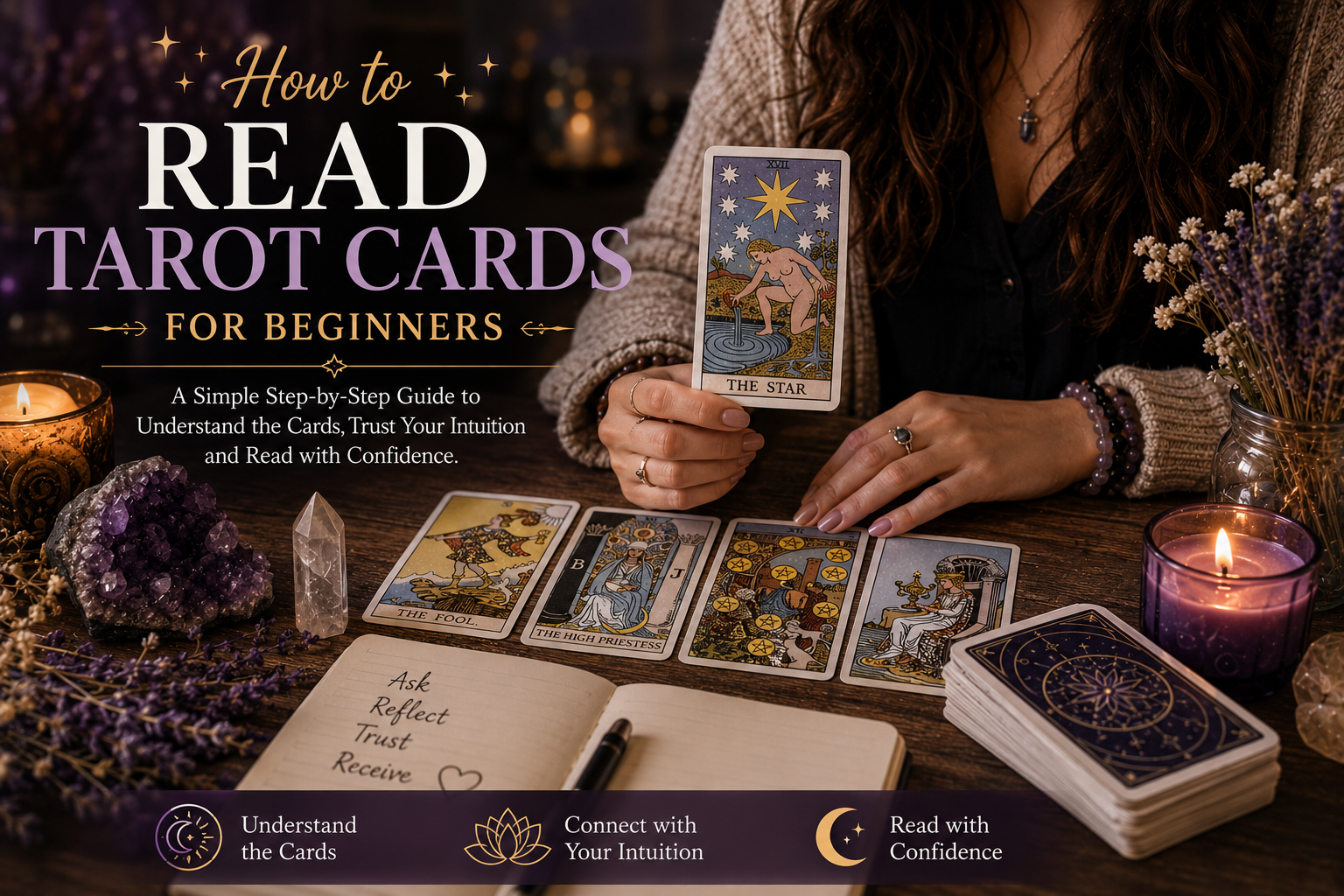
Have you ever looked at a Tarot deck and thought, “How do I actually read these cards?”
With 78 cards, different symbols, reversed meanings, Major Arcana, Minor Arcana and dozens of possible Tarot spreads, learning how to read Tarot cards can feel overwhelming at first.
The good news is that you don’t need to memorize all 78 cards before doing your first reading.
A better approach is to learn the basic structure of the deck, ask clear questions, observe the imagery, understand the card’s traditional meaning and gradually develop your own intuitive connection with the cards.
This guide will show you how to read Tarot cards for beginners, how to do your first reading, which spreads to start with, how to interpret difficult cards and the common mistakes beginners should avoid.
What Is a Tarot Reading?
A Tarot reading uses a deck of illustrated cards to explore a question, situation, feeling or possible direction.
A standard Tarot deck contains 78 cards, divided into:
- 22 Major Arcana cards
- 56 Minor Arcana cards
The Major Arcana generally deals with larger life themes, transitions and lessons, while the Minor Arcana explores more everyday experiences.
A reading isn’t simply about memorizing a dictionary definition for every card.
The meaning can change depending on:
- the question
- the card’s position
- surrounding cards
- imagery
- your intuition
- the situation being explored
That is why two readers can look at the same card and notice different aspects of its symbolism.
Do You Need to Be Psychic to Read Tarot?
No.
One of the biggest misconceptions about learning Tarot is that you need a special psychic ability before you can begin.
You don’t.
A beginner can develop Tarot skills through:
Knowledge + observation + intuition + practice.
You can start by learning the traditional themes associated with each card.
Then look at the image.
What immediately catches your attention?
What emotion does the card create?
How does that image relate to the question?
This combination gradually helps you become more comfortable interpreting Tarot.
How to Read Tarot Cards in 7 Simple Steps
Step 1: Choose a Tarot Deck
If you’re completely new, choose a deck with imagery that you can understand easily.
A deck based on the Rider-Waite-Smith tradition is often used in beginner resources because its imagery is widely discussed and makes it easier to find learning material. Current beginner guides similarly recommend starting with a familiar, symbol-rich deck rather than trying to learn through an overly complicated system.
But don’t get stuck thinking you need the “perfect” deck.
The most important thing is that you feel comfortable working with it.
Step 2: Understand the Tarot Deck
Before learning individual meanings, understand the basic structure.
Major Arcana
The 22 Major Arcana cards represent larger themes, turning points and archetypal experiences.
Examples include:
- The Fool
- The Magician
- The High Priestess
- The Empress
- The Lovers
- The Chariot
- Strength
- The Hermit
- Wheel of Fortune
- The Tower
- The Star
- The Moon
- The Sun
- The World
Step 3: Learn the Four Minor Arcana Suits
The Minor Arcana contains four suits.
| Suit | Common Themes |
|---|---|
| Wands | Passion, action, creativity |
| Cups | Emotions, relationships, feelings |
| Swords | Thoughts, communication, conflict |
| Pentacles | Work, money, stability, practical matters |
This doesn’t mean every Cups card is automatically about love or every Pentacles card is about money.
Context matters.
For example, a Cups card in a career reading could relate to emotional fulfillment at work rather than romance.
That’s why memorizing keywords alone isn’t enough.
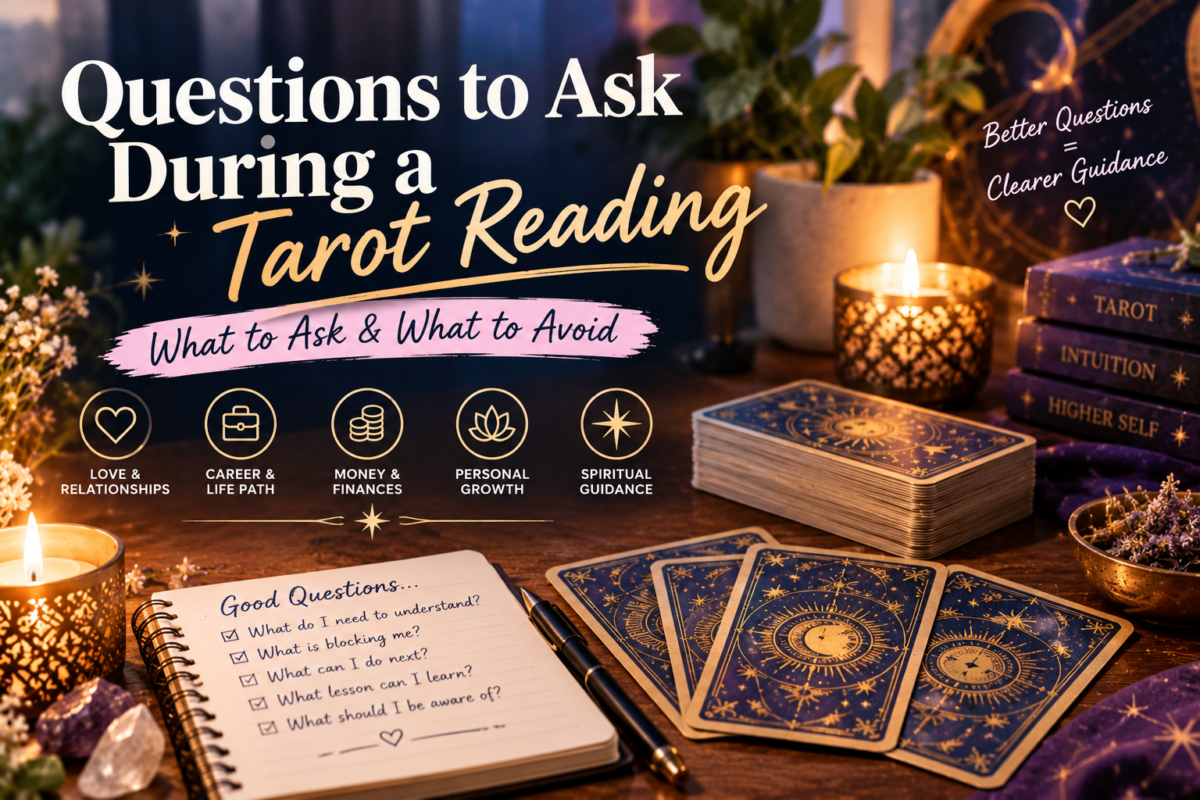
Step 4: Ask a Better Tarot Question
This is one of the most important skills when learning how to read Tarot cards.
A vague question often creates a vague reading.
Instead of:
“Will I be happy?”
try:
“What should I understand about my current emotional situation?”
Instead of:
“Will they come back?”
try:
“What do I need to understand about this connection?”
Instead of:
“Will I get the job?”
try:
“What should I focus on regarding this career opportunity?”
Open-ended questions give you more room for reflection and interpretation. Beginner Tarot resources commonly recommend questions that explore what you can understand or change rather than relying entirely on fixed yes/no predictions.
Step 5: Start With One Card
Don’t begin with a 10-card spread.
Start with one.
Shuffle your deck while thinking about your question.
Then draw one card.
Before immediately opening a guidebook, look at the card.
Ask:
What do I notice first?
What emotion does the card create?
What symbols stand out?
What story does the image suggest?
How could this relate to my question?
Then look at the traditional meaning.
This two-step process is useful because you learn to combine intuition with Tarot knowledge instead of depending entirely on memorized keywords.
A recent beginner guide published in July 2026 similarly recommends completing a simple one-card reading before trying to memorize the entire deck.
Step 6: Connect the Card to Your Question
This is where an actual Tarot reading begins.
Suppose you ask:
“Why am I feeling stuck in my relationship?”
You pull a card associated with uncertainty, withdrawal or emotional confusion.
Don’t immediately say:
“This card means my relationship is ending.”
Instead ask:
What aspect of this card actually answers my question?
Maybe the message relates to:
- avoiding an important conversation
- uncertainty about your own feelings
- fear of making a decision
- needing personal space
- ignoring something you already know
Tarot interpretation becomes much stronger when the card, question and context are connected.
Step 7: Write Down Your Reading
Keep a Tarot journal.
Write:
Date:
Question:
Card:
First impression:
Traditional meaning:
My interpretation:
Action I can take:
Then return to the reading later.
This is one of the easiest ways to improve.
You begin noticing which symbols repeatedly stand out to you and how cards actually relate to real situations.
The Best Tarot Spreads for Beginners
Once you’re comfortable with one-card readings, move to simple spreads.
1-Card Tarot Reading
The simplest spread.
Question:
“What do I need to understand today?”
Draw one card.
Use it as a reflection point for your day.
This is particularly useful for beginners because it teaches you how to interpret a card without becoming overwhelmed by multiple positions.
3-Card Tarot Reading
A simple three-card spread is the next step.
Option 1
Past → Present → Future
Option 2
Situation → Challenge → Advice
Option 3
What I know → What I’m missing → What I can do
For beginners, the second and third versions can be more useful because they encourage reflection rather than simply trying to predict what will happen.
5-Card Tarot Reading
Once you’re more comfortable, try:
| Position | Question |
|---|---|
| 1 | Current situation |
| 2 | What is influencing it? |
| 3 | Hidden factor |
| 4 | Advice |
| 5 | Possible direction |
Don’t add cards just because the answer isn’t what you hoped for.
That leads to one of the biggest beginner problems.
Don’t Keep Pulling Cards Until You Get the Answer You Want
Imagine you ask:
“Will this person contact me?”
You pull a card you don’t like.
So you pull another.
Then another.
Then another.
Eventually you get a card that feels positive.
You decide:
“That’s my real answer!”
This isn’t really creating clarity.
It’s creating confirmation.
If you’re emotionally invested in a question, pause.
Write down your first reading.
Give yourself time before asking again.
How to Use Intuition When Reading Tarot
Tarot knowledge is important.
But intuition can help you understand how that knowledge applies to a specific situation.
When you pull a card, notice your immediate response.
Do you feel:
- calm?
- uncomfortable?
- hopeful?
- confused?
- curious?
- resistant?
Don’t automatically assume every feeling is a spiritual message.
Sometimes your reaction is simply revealing your own expectations.
That’s useful information too.
Tarot and Intuition: Which One Should You Trust?
You don’t have to choose between traditional Tarot meanings and intuition.
Use both.
Start with the image.
What do you notice?
Consider the traditional meaning.
What does the card traditionally represent?
Return to your question.
How does that meaning fit the situation?
Check your intuition.
Is there something about the image or symbolism that feels particularly relevant?
Stay grounded.
Does the interpretation make sense in the actual situation?
This creates a more balanced reading.
How to Read Reversed Tarot Cards
Some readers use reversed cards.
Others don’t.
A reversed card is simply a card that appears upside down.
It doesn’t automatically mean:
“Bad outcome.”
Depending on your reading style, a reversal might suggest:
- blocked energy
- internal experience
- delay
- imbalance
- resistance
- an issue requiring attention
- a different expression of the card’s energy
If you’re a complete beginner, you don’t have to use reversals immediately.
Learn the upright cards first.
Then introduce reversals when you’re comfortable.
What If You Pull a “Bad” Tarot Card?
There are no cards that should automatically make you panic.
Cards such as:
Death
The Tower
Ten of Swords
can look frightening.
But Tarot symbolism is more nuanced than:
good card = good future
and
bad card = bad future.
For example, Death can represent endings, transition and transformation.
The Tower can represent disruption, revelation or the collapse of something unstable.
The Ten of Swords can relate to endings, exhaustion or reaching the end of a difficult chapter.
Always interpret the card within the question and surrounding context.
How to Read Tarot for Love
Love is one of the most common reasons people become interested in Tarot.
But instead of asking only:
“Will they come back?”
try:
- What do I need to understand about this relationship?
- What pattern keeps repeating?
- What am I not seeing clearly?
- What do I need to communicate?
- What should I prioritize in my love life?
- What can I learn from this connection?
How to Read Tarot for Career Questions
Tarot can also be used for career reflection.
Instead of:
“Will I get this job?”
try:
Card 1
What is my current career energy?
Card 2
What is my biggest challenge?
Card 3
What strength can I use?
Card 4
What should I avoid?
Card 5
What action should I take?
This creates a reading that gives you something practical to think about.
How to Read Tarot for Yes or No Questions
Yes/no Tarot readings are popular, especially among beginners.
However, forcing every card into a simple yes or no can remove much of Tarot’s nuance.
Instead of:
“Is this person my soulmate?”
try:
“What should I understand about my connection with this person?”
Instead of:
“Will I get the job?”
try:
“What can I do to improve my chances with this opportunity?”
The second question gives you something you can actually work with.
7 Common Tarot Reading Mistakes Beginners Make
1. Trying to Memorize All 78 Cards
You don’t need to learn everything in one week.
Start slowly.
2. Asking the Same Question Repeatedly
Repeated readings can create confusion.
3. Ignoring the Question
A card’s meaning must be connected to the question.
4. Treating Every Reading as a Fixed Prediction
Tarot can provide reflection and guidance, but it shouldn’t replace your own judgment.
5. Reading While Highly Emotional
Strong emotions can influence interpretation.
Take a pause when necessary.
6. Using Only Keywords
“Three of Swords = heartbreak” isn’t enough.
Look at the context.
7. Ignoring Real-Life Evidence
A Tarot interpretation should never encourage you to ignore obvious behavior, boundaries or important facts.
A Simple 30-Day Tarot Practice
You don’t need to spend hours every day.
Try this:
Week 1 — One Card
Pull one card every day.
Write your first impression.
Week 2 — Card + Meaning
Add the traditional meaning to your journal.
Week 3 — Three Cards
Start practicing simple three-card spreads.
Week 4 — Questions
Begin working with real questions and compare your readings with what happens afterward.
This gradual approach is also consistent with current beginner Tarot guidance that recommends regular small practice instead of attempting to memorize the entire deck immediately.
How to Know You’re Improving at Tarot
You don’t need to predict someone’s future perfectly.
You’re improving when you can:
- explain why a card fits a question
- recognize recurring symbols
- connect multiple cards
- notice patterns
- distinguish intuition from assumption
- ask better questions
- interpret cards without depending completely on a guidebook
- give grounded advice
- accept an interpretation that isn’t what you expected
The goal isn’t to become someone who always gives the answer people want.
The goal is to become someone who can provide clear, thoughtful and responsible guidance.
Tarot Reading vs Tarot Card Meaning
These are not exactly the same thing.
| Tarot Card Meaning | Tarot Reading |
|---|---|
| General symbolism | Meaning in a specific situation |
| Usually learned | Developed through interpretation |
| Card-focused | Question-focused |
| Can be memorized | Requires context |
| One card | May involve multiple cards |
| Traditional keywords | Symbolism + intuition + context |
This distinction is especially important for beginners.
Knowing that a card traditionally represents a particular theme doesn’t automatically tell you what it means in your situation.
When Should You Get a Professional Tarot Reading?
Reading Tarot for yourself can be valuable.
But sometimes you’re too emotionally involved in a situation to see it clearly.
A professional reading can provide another perspective when:
- you’re emotionally overwhelmed
- you’re stuck between difficult choices
- you keep repeating the same question
- you want an outside perspective
- you want a structured reading
- you don’t yet feel confident interpreting the cards
A professional Tarot consultation should ideally help you gain clarity and perspective, rather than create fear or dependency.
If you’re interested in a personalized reading, this is a natural place to connect to your Tarot Card Reading service page.
Frequently Asked Questions
Can anyone learn how to read Tarot cards?
Yes. You don’t need to be psychic to begin. Tarot reading can be learned through studying symbolism, practicing interpretation and developing your intuition.
How many Tarot cards should a beginner pull?
Start with one card. Once you’re comfortable, move to a simple three-card spread. You don’t need a large spread to get useful insight.
Do I have to memorize all 78 Tarot cards?
No. Memorization can help, but it isn’t necessary before starting. Learn gradually and use a reliable guidebook while practicing.
Can I read Tarot for myself?
Yes. Self-readings are a common way to practice. However, strong emotions can influence interpretation, so journaling and taking time before interpreting can help.
Can Tarot predict the future?
Tarot is often used for guidance, reflection and exploring possible directions. It shouldn’t be treated as a guarantee of one fixed future.
What is the best Tarot spread for beginners?
A one-card or three-card spread is usually easier to understand than a large spread. Start simple and increase the number of cards as your confidence develops.
Should beginners use reversed Tarot cards?
They can, but they don’t have to. If you’re new, learning upright meanings first may make the process easier.
What if I don’t understand the card I pulled?
Look at the image first, read the traditional meaning and connect it back to your question. If you’re still unsure, write down your interpretation and revisit it later rather than immediately pulling more cards.
Can Tarot answer yes or no questions?
You can use Tarot for yes/no questions, but open-ended questions often provide more useful context and guidance.
What Tarot deck is best for beginners?
A deck with clear, familiar symbolism and plenty of available learning resources can make the learning process easier. Many beginner resources use Rider-Waite-Smith-based imagery as a starting point.
How long does it take to learn Tarot?
There is no fixed timeline. You can perform a simple one-card reading immediately, while becoming comfortable with the entire deck takes regular practice.
Final Thoughts
Learning how to read Tarot cards isn’t about becoming perfect at memorizing 78 definitions.
It’s about learning how to listen.
Listen to the question.
Look at the imagery.
Understand the traditional symbolism.
Notice your intuition.
Then connect everything back to reality.
Start with one card.
Ask one meaningful question.
Write down what you see.
Practice again tomorrow.
Over time, the cards that once seemed confusing will begin to feel familiar.
And eventually, you won’t simply be asking:
“What does this card mean?”
You’ll be asking:
“What is this card showing me about this situation?”
That’s when Tarot starts becoming a genuine practice of reflection, intuition and guidance.

2 thoughts on “How to Read Tarot Cards for Beginners: A Simple Step-by-Step Guide”