

Have you ever met someone who seemed incredibly interested in you from the very beginning?
They text constantly.
They compliment you endlessly.
They talk about the future before you’ve even had time to know each other.
At first, it can feel exciting.
You might think:
“I’ve finally found someone who really understands me.”
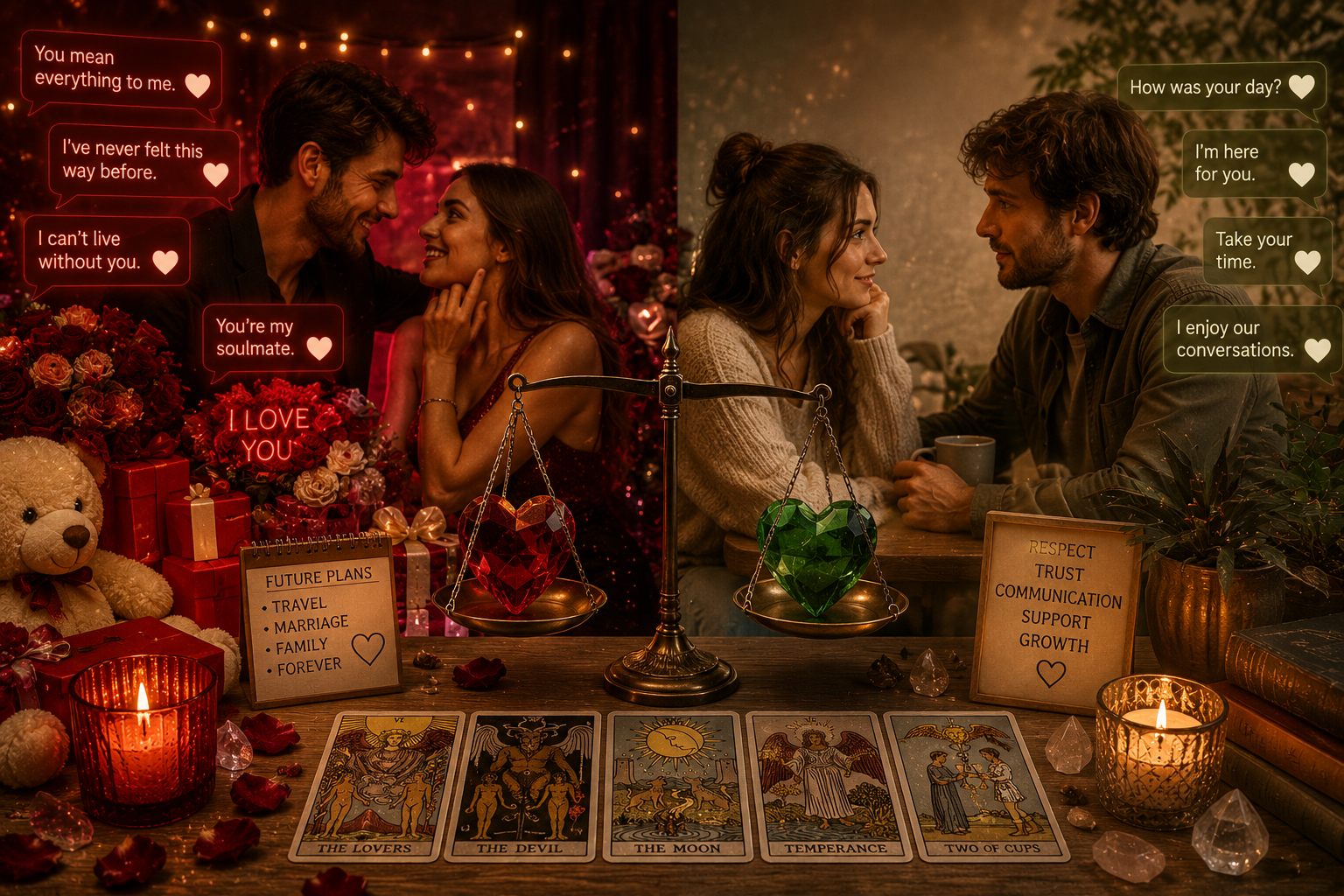
But after the initial excitement, you may start wondering whether what you’re experiencing is love bombing or genuine interest.
The difference isn’t always obvious.
Someone can genuinely be excited about you. They can be affectionate, expressive and eager to spend time together. At the same time, intense attention can sometimes create a connection that feels much deeper than it actually is.
Understanding love bombing vs genuine interest isn’t about labeling someone after a few romantic messages.
It’s about looking at the overall pattern.
Does their attention remain consistent?
Do they respect your boundaries?
Do their actions match their words?
And most importantly, do you feel emotionally safe rather than constantly pressured or confused?
Tarot can also become a useful reflection tool here-not to prove what another person secretly feels, but to help you examine your own emotions, expectations and relationship patterns.
What Is Love Bombing?
Love bombing generally refers to an intense pattern of attention, affection, praise or romantic gestures that can happen very quickly in a relationship.
It might look like:
- Excessive compliments
- Constant texting
- Very intense declarations of affection
- Talking about a future together extremely early
- Giving unusually large amounts of attention
- Wanting rapid emotional commitment
- Becoming upset when you establish boundaries
However, intense affection by itself doesn’t automatically mean love bombing.
Someone might simply be enthusiastic about a new relationship.
The important question is what happens after the initial intensity.
Does the person continue to respect you?
Can the relationship develop at a comfortable pace?
Are they interested in knowing the real you rather than an idealized version?
Those patterns provide much more useful information.
What Does Genuine Interest Look Like?
Genuine interest can also feel exciting.
Someone who genuinely likes you may want to talk frequently, spend time with you and learn about your life.
The difference is often found in consistency and respect.
Genuine interest usually allows space for:
- Individual boundaries
- Different opinions
- A gradual emotional connection
- Honest communication
- Mutual effort
- Realistic expectations
- Independent lives
- Getting to know each other over time
Healthy interest doesn’t require you to become emotionally committed immediately.
It gives the relationship room to develop naturally.
Love Bombing vs Genuine Interest: 9 Key Differences
The easiest way to understand the difference is to compare the patterns.
| Love Bombing | Genuine Interest |
|---|---|
| Intensity may develop extremely quickly | Connection develops over time |
| Can involve excessive praise | Compliments feel genuine and balanced |
| May create pressure for commitment | Respects your pace |
| Can idealize you | Wants to know the real you |
| May react badly to boundaries | Respects boundaries |
| Words may be much bigger than actions | Actions generally match words |
| Attention can become unpredictable | Interest tends to remain consistent |
| May create emotional pressure | Creates emotional safety |
| Focus can be on intensity | Focus is on building connection |
Remember: one behavior doesn’t prove anything by itself.
Look for patterns rather than trying to diagnose someone from a single interaction.
1. Intensity vs Consistency
One of the biggest differences between love bombing vs genuine interest is what happens over time.
A new relationship can naturally feel intense.
You may want to talk all night.
You may feel excited every time your phone lights up.
That’s normal.
The question is whether the person’s interest develops into consistent behavior.
Someone may initially send dozens of messages every day but then suddenly disappear.
Another person might communicate less intensely but remain reliable and respectful.
Consistency often tells you more than intensity.
Ask yourself:
“Is this person’s interest becoming more stable, or am I constantly experiencing emotional highs and lows?”
2. Constant Attention vs Respect for Space
Genuine interest doesn’t require constant access to another person.
Someone can care about you while still understanding that you have:
- Work
- Friends
- Family
- Personal goals
- Hobbies
- Private time
If someone becomes upset every time you don’t immediately reply, that’s worth noticing.
Healthy connection leaves room for individuality.
You shouldn’t have to prove your interest by being available every minute.
3. Big Promises vs Realistic Plans
Sometimes intense romantic attention comes with very big promises.
Someone you’ve known for a short time may start talking about:
“We’re going to be together forever.”
or:
“I’ve never felt this way about anyone.”
These statements can feel incredibly flattering.
But genuine connection doesn’t need to rush toward certainty.
Instead of focusing only on what someone promises, look at what they actually do.
Do they make plans?
Do they keep them?
Do they communicate honestly?
Do they show up when things aren’t exciting?
Actions create trust over time.
4. Fast Attachment vs Gradual Emotional Connection
Healthy relationships don’t have to follow a specific timeline.
Some people connect quickly.
Others take longer.
The important part is whether both people feel comfortable with the pace.
If someone constantly pushes the relationship forward even after you’ve said you want to slow down, pay attention.
You are allowed to say:
“I like you, but I want to take things slowly.”
The way someone responds to that boundary can tell you a lot.
5. Idealization vs Actually Knowing You
Another important difference is whether someone is interested in you or an idealized version of you.
Early attraction can involve projection.
Someone may assume you’re perfect before they’ve actually seen how you handle:
- Stress
- Disagreement
- Boundaries
- Different opinions
- Difficult situations
Genuine interest becomes deeper as someone learns who you really are.
They don’t need you to remain perfect.
They become interested in the complete person.
6. Pressure vs Healthy Boundaries
Boundaries are one of the clearest ways to observe relationship dynamics.
Try asking yourself:
Can I say no without being punished emotionally?
Can I ask for space?
Can I disagree?
Can I move at my own pace?
A healthy connection doesn’t require you to abandon your boundaries to keep someone’s attention.
If affection disappears whenever you establish a reasonable boundary, that’s something worth examining.
7. Words vs Actions
Romantic words can be beautiful.
But words aren’t the only evidence of genuine interest.
Consider this:
“They say they care about me.”
Now compare it with:
“Do their actions consistently demonstrate care?”
Look at the complete pattern.
If someone says they want to support you but repeatedly ignores your needs, the words and behavior aren’t aligned.
A healthy relationship doesn’t require perfection.
But consistent effort matters.
8. Emotional Highs vs Emotional Safety
Sometimes the strongest relationships aren’t the ones that create the biggest emotional highs.
They are the ones where you feel:
- Safe
- Respected
- Heard
- Comfortable
- Valued
- Free to communicate
If your connection constantly moves between intense closeness and painful uncertainty, pause before assuming that intensity means love.
Ask:
“Does this relationship give me emotional safety, or am I constantly waiting for the next reassurance?”
That question can reveal a lot.
9. What Happens When You Say “No”?
This may be one of the most useful things to observe.
Anyone can be charming when everything goes their way.
The more revealing moment can come when you say:
No.
Or:
Not yet.
Or:
I need some space.
Or:
I don’t agree.
A healthy connection should leave room for your autonomy.
Someone who genuinely respects you won’t need you to surrender your boundaries to prove that you care.
Why Can Love Bombing Feel Like True Love?
This is where psychology becomes particularly interesting.
When someone gives you intense attention, you may feel:
- Excited
- Desired
- Special
- Reassured
- Hopeful
- Emotionally connected
Those feelings are real.
But a real feeling doesn’t automatically prove a healthy relationship.
You can genuinely feel attracted to someone while still not knowing whether the relationship is sustainable.
That’s why it’s useful to separate:
How I feel right now
from
What I actually know about this person.
Try writing two lists.
What I Feel
- Excited
- Attached
- Hopeful
- Attracted
What I Know
- We’ve known each other for three weeks.
- They communicate consistently.
- They respect my boundaries.
- They follow through on plans.
- We haven’t experienced serious disagreement yet.
This simple exercise can help separate emotion from evidence.
Love Bombing vs Genuine Interest: What Should You Look At?
When you’re confused, consider these five areas.
1. Time
How long have you actually known each other?
2. Consistency
Does their behavior remain relatively stable?
3. Boundaries
Can you say no without feeling punished?
4. Actions
Do their actions support their words?
5. Emotional Safety
Do you feel secure enough to be yourself?
These questions can be more useful than asking:
“Do they really love me?”
Can Tarot Help You Understand Love Bombing?
Tarot can be useful as a reflection practice, but it shouldn’t be treated as a way to prove another person’s secret intentions.
Instead of asking:
“Is this person definitely love bombing me?”
try asking:
“What do I need to understand about this relationship dynamic?”
Other useful questions include:
- What am I feeling beneath the excitement?
- What am I potentially overlooking?
- Am I seeing this person realistically?
- What relationship pattern is being activated?
- What boundary deserves my attention?
- What should I take time to learn?
- What is within my control?
- What would a healthy next step look like?
This approach is consistent with the reflective way you’ve structured your existing Tarot content: Tarot is used to explore feelings, expectations, boundaries and choices rather than guarantee another person’s behavior.
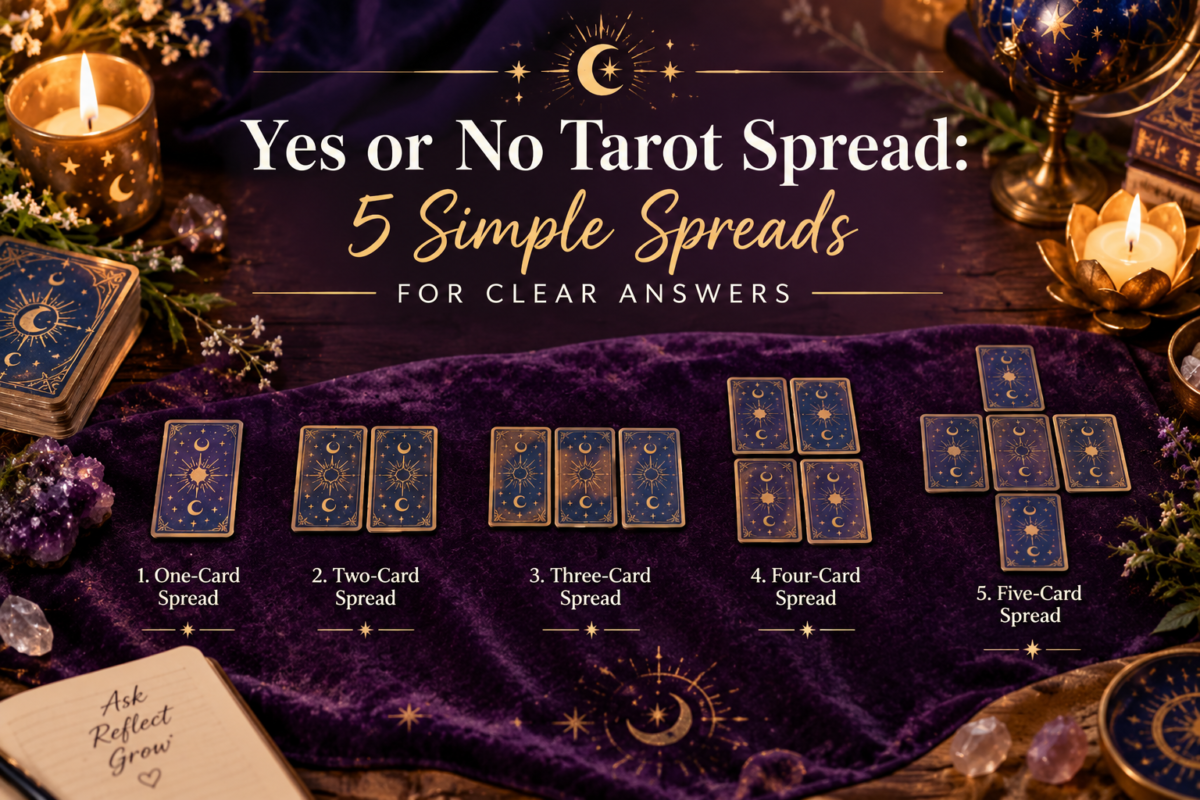
A 5-Card Tarot Spread for Love Bombing vs Genuine Interest
Try this spread when a new connection feels intense.
Card 1 – My Emotional State
What am I genuinely feeling right now?
Card 2 – My Expectations
What am I hoping this relationship will become?
Card 3 – What I’m Not Seeing
What deserves closer attention?
Card 4 – My Boundary
What boundary should I protect?
Card 5 – My Next Step
What would support a healthier approach to this connection?
Don’t keep pulling cards until you receive the answer you want.
The purpose is reflection-not reassurance.
Your existing relationship-clarity content makes the same important distinction: repeated Tarot questions can become part of anxiety rather than resolving it.
Love Bombing vs Genuine Interest: A Simple Reality Check
Before becoming deeply invested, ask yourself:
| Question | What to Notice |
|---|---|
| Do they respect my pace? | No pressure for instant commitment |
| Do their actions match their words? | Consistent behavior |
| Can I say no? | Boundaries are respected |
| Do they want to know the real me? | Not just an idealized version |
| Do I have space? | You can maintain your own life |
| Is communication consistent? | Not constant hot-and-cold behavior |
| Do I feel emotionally safe? | Less pressure, more trust |
| Can we disagree? | Conflict doesn’t destroy the connection |
| Am I attracted to them or their attention? | Distinguish person from emotional high |
What If You Think You’re Being Love Bombed?
Don’t feel pressured to make an immediate dramatic decision.
Instead:
Slow the pace.
Give yourself time to observe the relationship.
Maintain your boundaries.
Don’t abandon your normal life to accommodate someone new.
Watch behavior.
Pay attention to what happens after the initial excitement.
Avoid making major commitments too quickly.
Strong emotions don’t require immediate decisions.
Talk openly.
If something feels uncomfortable, communicate it.
Trust patterns, not isolated moments.
One amazing date doesn’t prove a healthy relationship.
One awkward conversation doesn’t automatically prove an unhealthy one.
Look at the bigger picture.
When Intense Interest Is Not Love Bombing
This distinction is important.
Someone being:
- affectionate
- enthusiastic
- romantic
- expressive
- excited
- generous with compliments
doesn’t automatically mean they’re love bombing.
Some people naturally communicate affection intensely.
The better question is:
“Does this intensity coexist with respect, consistency and healthy boundaries?”
If yes, you may simply be experiencing strong genuine interest.
Don’t turn every exciting new relationship into a psychological investigation.
Healthy skepticism should not become constant suspicion.
How Tarot and Intuition Can Work Together
You may sometimes have a strong feeling about a relationship.
Maybe something feels off.
Maybe everything feels right.
Either way, don’t automatically treat the feeling as unquestionable truth.
Instead ask:
What am I sensing?
Then ask:
What evidence supports it?
This creates a useful balance between intuition and reality.
Your existing article Intuition or Anxiety? 7 Ways to Tell the Difference is a natural next read here, especially for readers who struggle to distinguish an inner signal from fear or overthinking.
How to Know If a New Relationship Is Developing in a Healthy Way
Healthy relationships don’t need to be perfectly calm.
Disagreements happen.
People have bad days.
Communication isn’t always perfect.
What matters is how the relationship responds to those moments.
Look for:
Consistency over time.
Respect during disagreement.
Freedom to maintain your individuality.
Mutual effort.
Honest communication.
Respect for boundaries.
A willingness to let trust develop naturally.
Instead of asking:
“How intense is this?”
try asking:
“How healthy does this feel over time?”
That’s a much more useful question.
Relationship Patterns Worth Watching
Sometimes the issue isn’t only the other person’s behavior.
Your own history can influence what feels familiar.
For example, you may unconsciously associate:
Uncertainty → excitement
Distance → challenge
Attention → validation
Inconsistency → chemistry
If this feels familiar, don’t blame yourself.
Simply become curious about the pattern.
Your existing article Why Do I Keep Attracting the Same Type of Person? Tarot & Relationship Patterns can naturally take the reader deeper into this subject.
When to Step Back From a Tarot Reading
Sometimes the healthiest thing you can do is stop pulling cards.
Take a break if:
- You’re asking the same question repeatedly.
- You’re becoming more anxious after every reading.
- You’re checking cards instead of communicating.
- You’re making major decisions based only on a card.
- You’re searching for signs everywhere.
- You refuse to accept an answer unless it’s positive.
- You’re using Tarot to monitor another person’s thoughts.
A Tarot reading should support self-awareness-not replace your judgment.
Final Thoughts
Love bombing vs genuine interest isn’t always easy to distinguish, especially when you’re emotionally excited about someone.
You don’t need to decide everything immediately.
Give yourself time to observe.
Look beyond romantic words.
Notice consistency.
Protect your boundaries.
Pay attention to how the person responds when you slow down, disagree or say no.
And if you use Tarot, let it help you explore questions such as:
What am I genuinely feeling?
What am I assuming?
What am I not seeing?
What pattern is being activated?
What boundary do I need?
What would a healthy next step look like?
The goal isn’t to use Tarot to prove that someone is good or bad.
The goal is to become clearer about your own experience and choices.
Sometimes the most important question isn’t:
“Do they really like me?”
It’s:
“Does the way this relationship is developing support the kind of connection I actually want?”
That question puts your attention back where it belongs: on your needs, your boundaries and your choices.
Frequently Asked Questions
Love bombing generally involves unusually intense attention or affection that may create pressure or move a relationship forward very quickly. Genuine interest can also be enthusiastic, but it generally allows trust, boundaries and emotional connection to develop naturally.
Look at the overall pattern rather than one behavior. Consider whether the person respects your boundaries, allows you to maintain your own life, communicates consistently and whether their actions match their words.
No. Some people naturally express affection intensely, especially when they’re excited about someone new. Intensity alone doesn’t establish that a relationship is unhealthy. Context, consistency and respect for boundaries matter.
Strong affection isn’t automatically unhealthy. The concern is when excessive attention is combined with pressure, manipulation, boundary violations or major changes in behavior.
Intense attention can create strong feelings of excitement, validation and emotional connection. Those feelings can be genuine, but they don’t necessarily tell you how sustainable or healthy the relationship will be.
Slow the relationship down, maintain your boundaries and observe their behavior over time. You don’t have to make an immediate decision simply because the connection feels intense.
Tarot cannot objectively verify another person’s intentions or private thoughts. However, it can be used as a reflection tool to explore your feelings, expectations, boundaries and what you may need to pay attention to.
A useful question is:
“What do I need to understand about this relationship dynamic right now?”
Other helpful questions focus on your own feelings, boundaries, expectations and next steps.
Look for consistency over time, respect for boundaries, mutual effort, honest communication and behavior that matches their words. Genuine interest doesn’t require you to sacrifice your boundaries to keep someone’s attention.
Tarot can provide a structured way to reflect on your emotions and choices. However, it shouldn’t replace direct communication, real-world evidence or your own judgment. Your existing relationship-clairty article similarly emphasizes using Tarot as a reflection practice rather than a reassurance machine.