

Have you ever trusted your intuition about something, only to second-guess yourself moments later?
Maybe you had a strong feeling about a person.
Maybe you felt that a particular decision wasn’t right.
Or perhaps you suddenly knew you needed to take a different path, even though you couldn’t explain why.
Then your mind started asking:
“What if I’m wrong?”
“Am I imagining this?”
“What if I’m just being emotional?”
This is where intuition can become difficult to understand.
Your inner sense may arrive quietly, while fear often arrives with a long list of reasons, possibilities and worst-case scenarios.
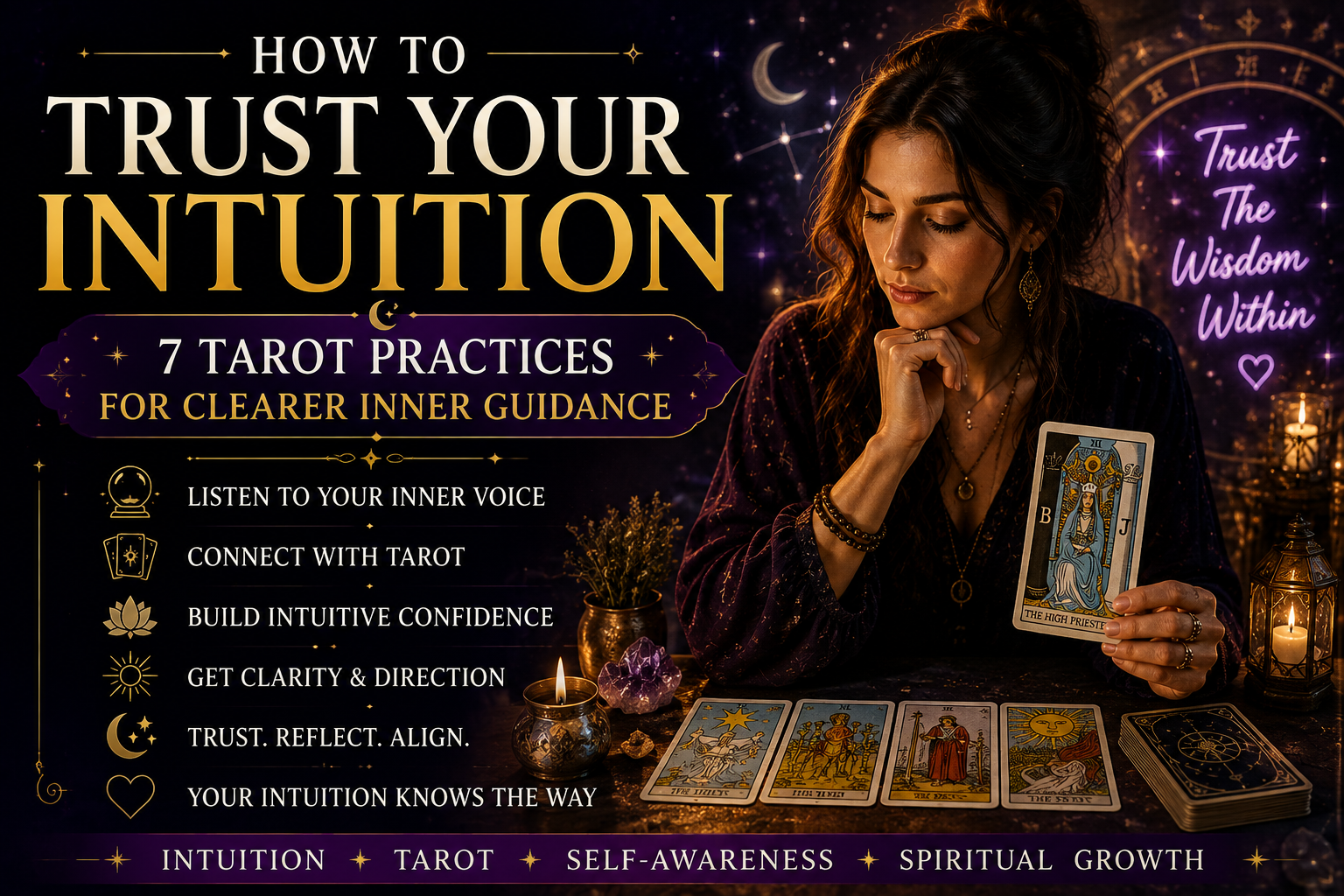
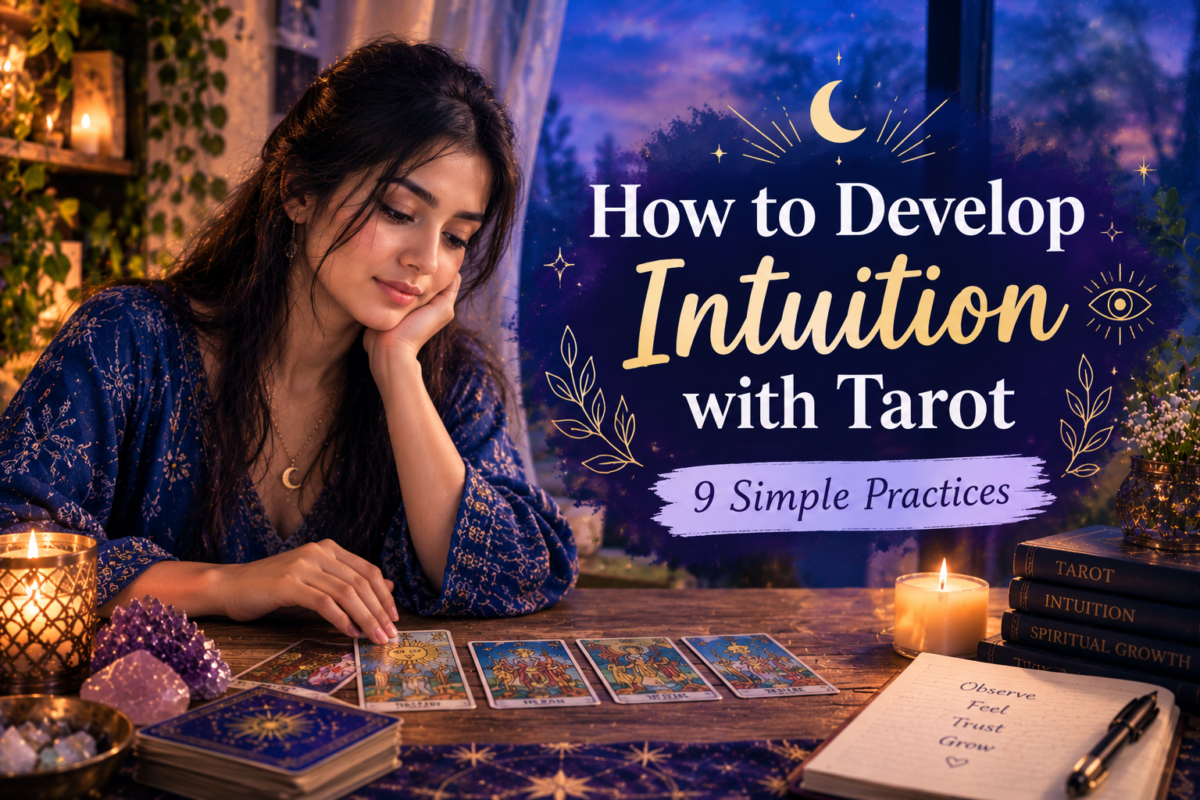
Tarot can provide a useful way to slow down and explore that inner voice. Instead of using Tarot to make every decision for you, you can use the cards as a reflective tool to trust your intuition, recognize your emotional patterns and develop greater self-awareness.
In this guide, you’ll discover seven Tarot practices that can help you strengthen your intuitive awareness without becoming dependent on the cards.
What Is Intuition?
Intuition is often described as an inner sense or immediate understanding that doesn’t seem to come from deliberate logical reasoning.
You might experience it as:
- A quiet feeling that something is right
- A sense that something doesn’t feel aligned
- A sudden insight
- A strong first impression
- An unexpected idea
- A feeling of calm certainty
- A subtle physical reaction
However, intuition isn’t the same as being automatically correct.
Your feelings can also be influenced by:
- Past experiences
- Fear
- Anxiety
- Expectations
- Memories
- Personal biases
- Previous relationship experiences
That’s why learning to trust your intuition doesn’t mean believing every feeling immediately.
Instead, it means learning to observe your inner signals and understand them.
Intuition vs. Immediate Emotion
One of the biggest mistakes people make is assuming:
“I feel it, therefore it must be intuition.”
Not necessarily.
For example, imagine someone you care about hasn’t replied to your message.
You immediately feel:
“Something is wrong.”
That feeling might come from intuition.
But it could also come from previous experiences, insecurity or fear of rejection.
The important question isn’t:
“Is this feeling real?”
The feeling is real.
The better question is:
“What is causing this feeling?”
This is why your previous guide on intuition and anxiety can be useful if you’re still learning to distinguish the two.
Tarot can then help you explore the situation rather than immediately deciding what the feeling means.
7 Tarot Practices to Help You Trust Your Intuition
1. Pull One Card Before Looking at the Meaning
This is one of the simplest ways to strengthen intuitive Tarot reading.
Instead of immediately opening a guidebook or searching Google, pull one card.
Look at the image.
Don’t interpret it yet.
Ask yourself:
- What do I notice first?
- Which symbol attracts my attention?
- What emotion does the card create?
- Does anything in the image remind me of my situation?
- What is the first word that comes to mind?
Write down your impressions.
Only afterward compare them with the traditional meaning.
Over time, you’ll begin to notice how your personal interpretations develop.
This is especially useful for beginners who want to become less dependent on memorizing Tarot definitions.
2. Ask Tarot Open-Ended Questions
If you want to strengthen your intuition, the question you ask matters.
Compare:
❌ “Will they text me tomorrow?”
with:
✅ “What do I need to understand about this communication?”
Or:
❌ “Is this person my soulmate?”
with:
✅ “What should I understand about this connection?”
Or:
❌ “Will I get the job?”
with:
✅ “What should I focus on regarding my career decision?”
Open-ended questions give you more space for reflection.
They also reduce the temptation to use Tarot as a simple yes-or-no prediction machine.
3. Keep an Intuitive Tarot Journal
One of the most effective ways to build trust in your intuition is to record it.
Every time you pull a card, write down:
Your question
What were you asking?
Your first impression
What did you notice before checking the meaning?
Traditional interpretation
What does the card traditionally represent?
Your intuitive interpretation
What did the card mean specifically to you?
What happened later?
Return to the reading after a few days or weeks.
Did your original impression make sense?
Did your situation change?
Did you interpret something differently later?
This creates a feedback loop.
Instead of simply saying:
“I think I’m intuitive.”
you’re actually observing how your intuition works.
4. Pay Attention to the First Impression
When you turn over a Tarot card, your mind may immediately notice something.
Maybe you notice:
the person’s expression.
Or:
a particular color.
Or:
a symbol in the background.
Or perhaps one card in the spread suddenly feels much more important than the others.
Don’t dismiss that first observation.
Write it down.
However, don’t automatically assume the first thought is a prediction.
Think of it as a starting point for exploration.
Your intuition can guide your attention without necessarily giving you a complete answer.
5. Practice Reading Without a Guidebook
Once you’re comfortable with basic Tarot meanings, try a simple exercise.
Pull three cards.
Don’t look up their meanings.
Instead, create a story from the images.
For example:
Card 1
What is happening?
Card 2
What is influencing the situation?
Card 3
What should I understand?
Look at the cards together.
Ask:
“What story do these three images tell me?”
Only after writing your interpretation should you check the traditional meanings.
This exercise can help you develop a personal relationship with the Tarot rather than relying entirely on external interpretations.
6. Use Tarot to Ask Yourself Better Questions
Sometimes intuition becomes clearer when you stop asking:
“What will happen?”
and start asking:
“What do I need to understand?”
Try these questions:
- What am I overlooking?
- What does my intuition want me to notice?
- What fear is influencing my decision?
- What am I already aware of but avoiding?
- What information do I still need?
- What boundary needs my attention?
- What choice aligns with my values?
- What lesson is this situation showing me?
These questions turn Tarot into a tool for self-awareness.
7. Learn When to Put the Cards Away
This might be the most important Tarot practice of all.
Sometimes the best way to strengthen your intuition is to stop pulling cards.
If you’re asking the same question repeatedly because you don’t like the answer, you’re no longer using Tarot for clarity.
You’re looking for reassurance.
For example:
“Will they come back?”
You pull a card.
You don’t like the answer.
You shuffle again.
Another card.
Still uncertain.
Another reading.
Eventually, you’re not listening to yourself anymore.
You’re asking the cards to remove uncertainty from a situation where uncertainty naturally exists.
That’s when taking a break can be more valuable than another reading.
Can Tarot Strengthen Your Intuition?
Tarot itself doesn’t have to be viewed as something that magically gives you answers.
Instead, the cards can function as visual prompts for reflection.
A card gives your mind an image.
That image can trigger memories, associations, emotions and questions.
The deeper value may come from what you discover while interpreting it.
For example, you pull:
The High Priestess.
Instead of immediately searching:
“High Priestess yes or no?”
pause.
Ask:
“What do I already know about this situation?”
Maybe you realize you’ve been ignoring an uncomfortable truth.
Maybe you recognize that you need more information.
Maybe you notice that you’re seeking certainty because you’re afraid to make the decision yourself.
That moment of recognition can be more valuable than a simple prediction.
5 Tarot Cards Associated With Intuition
Certain cards can make particularly interesting prompts when you’re working on intuitive development.
The High Priestess
The High Priestess is strongly associated with inner knowing, mystery, silence and looking beneath the surface.
When she appears, ask:
“What do I already know?”
The Moon
The Moon can encourage you to examine uncertainty, perception, fear and what may not yet be clear.
Ask:
“What might I be interpreting through fear?”
Queen of Cups
The Queen of Cups can encourage emotional awareness, empathy and sensitivity.
Ask:
“What is my emotional response trying to tell me?”
The Star
The Star can represent hope, renewal and a sense of direction.
Ask:
“What gives me a sense of alignment?”
The Hermit
The Hermit encourages stepping away from outside noise and looking inward.
Ask:
“What do I hear when I stop asking everyone else for answers?”
A 5-Card Tarot Spread for Trusting Your Intuition
Try this whenever you’re confused about a decision.
Card 1 — What I Already Know
What truth am I already aware of?
Card 2 — What Is Clouding My Judgment?
What fear, assumption or emotion is influencing me?
Card 3 — What Does My Intuition Want Me to Notice?
What deserves my attention right now?
Card 4 — What Information Am I Missing?
What should I learn before making a decision?
Card 5 — My Next Grounded Step
What practical action can I take now?
Notice that the final card asks for a grounded step.
That’s intentional.
Intuition becomes much more useful when reflection is followed by real-world action.
How to Know When You’re Overthinking a Tarot Reading
You may be overthinking when:
- You pull the same question repeatedly.
- You search for dozens of interpretations.
- You ignore every interpretation you don’t like.
- You ask multiple readers the same question.
- You’re checking Tarot whenever you feel anxious.
- You need the cards to make every decision.
- You’re more confused after the reading than before it.
If this happens, step away.
Take a walk.
Write down your thoughts.
Talk to someone you trust.
Gather practical information.
Then return to the question later if necessary.
Tarot should support your self-awareness, not replace it.
How to Trust Your Intuition Without Ignoring Logic
You don’t have to choose between intuition and logic.
In fact, the healthiest decisions often use both.
Think of it this way:
Intuition asks:
“How does this feel?”
Logic asks:
“What evidence do I have?”
Self-awareness asks:
“Why do I feel this way?”
Wisdom asks:
“What action makes sense?”
For example, you may have an uncomfortable feeling about a new job.
Don’t immediately reject the job because:
“My intuition says no.”
Instead, investigate.
Check:
- Salary
- Working hours
- Responsibilities
- Company reviews
- Growth opportunities
- Communication
- Contract terms
Your intuition can tell you:
“Something needs closer attention.”
Logic can help you discover what that something is.
A Simple Daily Tarot Exercise
You don’t need a complicated spread.
Every morning, pull one card.
Ask:
“What energy should I be aware of today?”
Before checking the meaning, write down:
My first impression:
What I notice:
What this reminds me of:
At night, return to the card.
Ask:
“Where did I notice this energy today?”
Do this for 30 days.
You may start noticing recurring symbols, emotional reactions and personal associations.
That’s far more useful for developing intuition than trying to memorize every Tarot card overnight.
What If Your Intuition Is Wrong?
This is important.
Developing intuition doesn’t mean becoming someone who is never wrong.
Everyone misreads situations sometimes.
Your memories, expectations and emotions can influence your perception.
The goal isn’t:
“I must always trust my first feeling.”
The goal is:
“I can listen to my first feeling, investigate it, and make a conscious decision.”
That’s a much healthier relationship with intuition.
Final Thoughts
Learning to trust your intuition isn’t about shutting out logic.
It isn’t about treating every feeling as a divine message.
And it certainly isn’t about asking Tarot to make every decision for you.
Instead, intuitive development is about becoming more aware of your internal signals while staying grounded in reality.
Tarot can help create that space.
A card gives you something to look at.
A question gives you something to explore.
And your own reflection can reveal what you may have been overlooking.
Sometimes the answer won’t come as a dramatic realization.
It may simply feel like:
“I already knew this.”
And perhaps that’s the most important part of learning to trust yourself.
Tarot can be used as a reflective practice to help you notice your first impressions, emotions, associations and recurring thoughts. It doesn’t guarantee intuitive accuracy, but regular journaling and reflection can help you become more aware of how your intuition works.
Start by recording your first impression before checking a guidebook. Over time, compare your intuitive interpretations with traditional meanings and real-life outcomes. This can help you recognize your personal intuitive patterns.
The High Priestess is one of the Tarot cards most commonly associated with intuition, inner knowledge and looking beneath the surface. The Moon, Queen of Cups and Hermit can also provide useful prompts for exploring intuition.
Your first impression can be valuable, but it doesn’t have to be treated as automatically correct. Write it down, explore the traditional meaning, consider the context and use your own judgment.
No. Ideally, Tarot should help you become more aware of your own thoughts and feelings rather than replace your judgment. The cards can provide a framework for reflection, but your decisions remain your responsibility.
Start with one-card readings, study the imagery before reading the guidebook, keep a Tarot journal and review your interpretations over time. Consistent practice is more useful than trying to memorize everything at once.
Repeatedly asking the same question, seeking reassurance, or reading too many interpretations can create more confusion. If a reading leaves you anxious, take a break and return to the situation with practical information and a clear mind.
There is no required frequency. A simple daily one-card reflection can be useful, but avoid repeatedly reading on the same question simply because you’re looking for a different answer.


One thought on “How to Trust Your Intuition: 7 Tarot Practices for Clearer Inner Guidance”