

Have you ever wanted something deeply but felt unsure about how to manifest it?
Maybe you’re trying to attract a healthier relationship, a new career opportunity, financial stability, personal confidence, or simply a greater sense of peace.
You may create a vision board, repeat affirmations, visualize your goals and try to stay positive. Yet after some time, you may still wonder:
“Am I doing this right?”
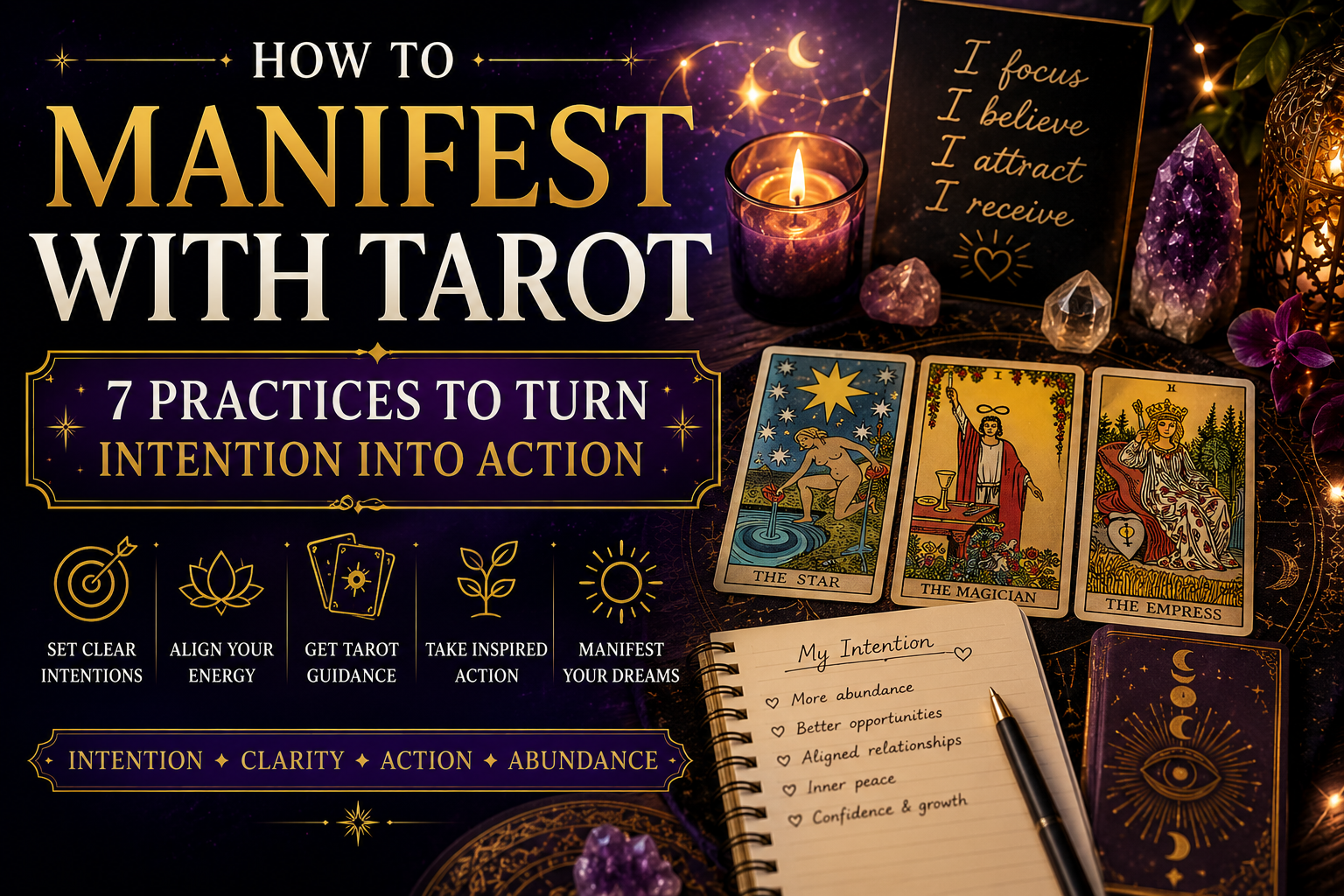
This is where manifestation with Tarot can offer a different perspective.
Tarot doesn’t need to be used as a magical shortcut to guarantee a particular outcome. Instead, the cards can help you clarify what you actually want, recognize emotional blocks, explore your beliefs and identify practical steps that support your intention.
The High Priestess Tarot is particularly useful as a reflection point when exploring inner knowledge, silence and intuition.
In other words, Tarot can help connect:
Intention → Awareness → Action → Reflection
In this guide, we’ll explore seven ways to use Tarot as a reflective tool for manifestation while staying grounded and realistic.
What Is Manifestation?
Manifestation is often described as the process of bringing a desired experience or goal into your life through focused intention, mindset and action.
On social media, manifestation is sometimes presented as:
“Think about something hard enough and it will automatically appear.”
Real life is more complicated.
You cannot control every external circumstance simply by thinking positively.
However, setting a clear intention can influence what you pay attention to, what choices you make and which opportunities you recognize.
For example, someone who decides:
“I want to build a career that actually fits my strengths.”
may begin researching opportunities, learning new skills, meeting people in their industry and becoming more intentional about the jobs they apply for.
The intention becomes useful because it influences behavior.
That is where Tarot can become a helpful reflection tool.
Can Tarot Help With Manifestation?
Tarot cannot guarantee that a specific person, job, amount of money or event will appear exactly as you imagine.
Instead, Tarot can help you examine the inner side of manifestation.
A Tarot reading can encourage questions such as:
- What do I really want?
- Why do I want it?
- What beliefs are influencing me?
- What fear is holding me back?
- What am I overlooking?
- What action can I take?
- What should I release?
- What should I focus on now?
This approach makes Tarot more useful than repeatedly asking:
“When will my manifestation happen?”
The better question may be:
“What can I understand or do differently to move toward my intention?”
7 Ways to Use Tarot for Manifestation
1. Start With a Clear Intention
Before pulling a single card, define what you’re trying to manifest.
Instead of:
“I want a better life.”
Try:
“I want to build a career that gives me financial stability while allowing me to use my creativity.”
Or:
“I want to develop healthier and more emotionally balanced relationships.”
A clear intention gives your Tarot reading a clear direction.
Write your intention in one sentence.
Then ask:
“What do I need to understand about this intention?”
Pull one card.
Don’t immediately search for the meaning.
Look at the image first.
Ask yourself:
What is the first thing I notice?
This creates a connection between your intention and your own intuitive interpretation.
2. Use Tarot to Identify Limiting Beliefs
Sometimes the biggest obstacle isn’t the goal itself.
It’s the belief underneath it.
You might consciously say:
“I want financial abundance.”
while unconsciously believing:
“Money is difficult to earn.”
Or:
“I want a healthy relationship.”
while believing:
“People always leave eventually.”
These conflicting beliefs can affect the decisions you make.
Try asking Tarot:
Card 1
What belief is limiting me?
Card 2
Where might this belief come from?
Card 3
What healthier perspective can I develop?
Card 4
What action can help me move beyond this belief?
The purpose isn’t to let the cards diagnose your psychology.
Instead, use the questions as prompts for self-reflection.
If the reading brings up an uncomfortable thought, write it down.
That thought may be worth exploring further.
3. Create a Tarot Manifestation Journal
A manifestation journal can become much more powerful when you combine intention with reflection.
Create four sections:
My Intention
What do I want?
My Current Reality
Where am I right now?
My Inner Block
What fear, belief or habit may be affecting me?
My Next Action
What can I actually do today?
Then pull one Tarot card for each section.
For example:
Intention: The Star
You may associate this with hope and renewal.
Current Reality: Eight of Pentacles
You may recognize that consistent effort is required.
Inner Block: Eight of Swords
You may reflect on self-doubt or feeling trapped.
Next Action: The Chariot
You may interpret this as taking focused action instead of waiting.
The reading becomes a conversation with yourself.
4. Use Tarot to Find the Action Behind the Intention
This is one of the most important manifestation practices.
Ask:
“What practical action supports my intention?”
Pull one card.
Then translate the symbolism into something practical.
For example:
The Magician
You may interpret the card as using the resources and skills already available to you.
Possible action: Start the project instead of waiting for perfect conditions.
Eight of Pentacles
You may associate it with practice and consistency.
Possible action: Spend 30 minutes developing a skill each day.
The Chariot
You may connect it with determination and direction.
Possible action: Choose one goal and create a specific plan.
Three of Wands
You may interpret it as looking toward expansion.
Possible action: Explore opportunities beyond your current environment.
The goal is to turn:
“I want this.”
into:
“Here is what I can do next.”
5. Use Tarot to Understand What You Need to Release
Manifestation isn’t always about adding something.
Sometimes it involves letting go of a pattern that no longer supports you.
Ask:
“What am I holding onto that is preventing me from moving forward?”
Then pull one card.
You may discover themes involving:
- Fear of failure
- Perfectionism
- Attachment to the past
- Need for control
- Self-doubt
- Comparison
- Fear of rejection
- Procrastination
Don’t interpret a card as proof that something negative is destined to happen.
Instead, treat it as a prompt.
Ask:
“Does this reflect something I recognize in myself?”
If it does, explore it.
If it doesn’t, don’t force the interpretation.
6. Create a 7-Day Manifestation Tarot Practice
If you want to experiment with Tarot and manifestation, try this simple seven-day practice.
Day 1 — Intention
What do I truly want?
Day 2 — Belief
What belief supports my intention?
Day 3 — Block
What belief or habit may be getting in my way?
Day 4 — Strength
What personal strength can I use?
Day 5 — Action
What practical step should I take?
Day 6 — Awareness
What opportunity or information should I notice?
Day 7 — Reflection
What have I learned about myself this week?
You don’t need seven separate decks or complicated rituals.
One deck and a notebook are enough.
The purpose is consistency.
7. Stop Asking Tarot When Your Manifestation Will Happen
This may be the most important practice.
It’s tempting to ask:
“When will it happen?”
Then again tomorrow:
“Has it changed?”
And again:
“Is it coming soon?”
Eventually, Tarot becomes a source of reassurance rather than reflection.
Instead, ask:
“What can I do today?”
This changes the energy of the reading.
You’re no longer waiting for the cards to give you permission to live your life.
You’re using them to understand yourself better while continuing to act.
Tarot Cards Often Associated With Manifestation
Certain cards can provide interesting symbolic prompts when you’re working with manifestation.
The Magician
The Magician is often associated with resourcefulness, skill and turning potential into action.
Ask:
“What resources do I already have?”
The Star
The Star can represent hope, renewal and inspiration.
Ask:
“What vision gives me genuine hope?”
The Empress
The Empress can be explored through themes of creativity, nurturing and growth.
Ask:
“What needs consistent care to grow?”
The Chariot
The Chariot can encourage focus, direction and determined movement.
Ask:
“Where do I need to take control of my direction?”
Ace of Wands
The Ace of Wands can be used as a prompt around inspiration, beginnings and creative energy.
Ask:
“What idea deserves my attention?”
Three of Wands
This card can encourage reflection on expansion, possibilities and looking toward what’s next.
Ask:
“Where could I think bigger?”
A 6-Card Tarot Manifestation Spread
Try this spread when you have a specific goal.
Card 1 — My Intention
What am I truly trying to create?
Card 2 — My Motivation
Why does this matter to me?
Card 3 — My Current Energy
What is influencing me right now?
Card 4 — My Block
What may be limiting my progress?
Card 5 — My Resource
What strength or resource can I use?
Card 6 — My Next Step
What practical action should I take?
This spread is intentionally focused on self-awareness and action, rather than predicting an exact outcome.
Manifestation and the Law of Attraction
The Law of Attraction is commonly discussed alongside manifestation, particularly the idea that thoughts and beliefs influence what a person attracts.
However, it is important to distinguish spiritual belief from scientifically established fact.
You don’t need to believe that your thoughts magically control every external event to benefit from manifestation practices.
Goal setting, visualization, journaling and reflection can still help you become more intentional about your behavior.
Tarot can fit into this process as a symbolic reflection tool.
For example:
Vision → Tarot reflection → Self-awareness → Action → Review
This approach keeps spirituality connected to everyday life.
What If Your Manifestation Isn’t Happening?
This is where manifestation content can sometimes become unhealthy.
If something hasn’t happened yet, don’t automatically conclude:
“I didn’t believe hard enough.”
Life contains factors outside your control.
Other people have their own choices.
Economic circumstances change.
Opportunities appear unexpectedly.
Timing can be unpredictable.
Sometimes your original goal may even stop being appropriate for you.
Instead of blaming yourself, ask:
- Is this goal still right for me?
- What have I learned?
- What can I control?
- What action can I take?
- What information am I missing?
- Is there another path toward what I actually want?
Growth doesn’t always look like getting the exact outcome you originally imagined.
Sometimes it looks like discovering that you want something different.
Tarot Manifestation vs. Tarot Prediction
These two approaches are very different.
Predictive approach
“Will I get the job?”
Reflective manifestation approach
“What can I understand about my career situation and what action can I take?”
Predictive approach
“Will my ex return?”
Reflective approach
“What do I need to understand about this connection and my own expectations?”
Predictive approach
“When will I become successful?”
Reflective approach
“What habits and strengths can help me move toward my definition of success?”
The second approach gives you something you can actually work with.
How to Manifest Without Becoming Obsessed
Manifestation should not become another form of overthinking.
If you constantly check:
- Tarot cards
- Angel numbers
- Signs
- Repeating numbers
- Social media posts
- “Synchronicities”
- Predictions
you may become more anxious rather than more grounded.
Create space between intention and obsession.
Set your goal.
Reflect.
Take action.
Then allow life to unfold.
You don’t need to ask Tarot every day whether your manifestation is “still coming.”
Sometimes the most powerful step is simply continuing to live.
A Simple Daily Manifestation Ritual
You can create a five-minute routine.
Step 1 — Set your intention
Write one sentence.
Step 2 — Pull one Tarot card
Ask:
“What should I be aware of today?”
Step 3 — Write your first impression
Don’t check the guidebook immediately.
Step 4 — Choose one action
Ask:
“What can I actually do today?”
Step 5 — Let go
Once you’ve reflected, continue with your day.
This final step matters.
Manifestation isn’t supposed to keep you trapped in constant checking.
Final Thoughts
Manifestation with Tarot doesn’t have to mean asking the cards to magically produce the future you want.
A more grounded approach is to use Tarot to explore your intentions, beliefs, fears, strengths and possible actions.
The cards can help you ask better questions.
Your reflection can help you recognize patterns.
And your actions are what allow intentions to become part of your real life.
You don’t need to know exactly when everything will happen.
Start with one clear intention.
If you’re learning to rely more on your inner guidance, you can also explore how to trust your intuition through simple Tarot practices.
Pull one card.
Listen to what comes up.
Then ask yourself the most important question:
“What can I do today?”
Sometimes manifestation begins not with receiving an answer, but with finally taking the next step.
FAQs
Tarot can be used as a reflective tool during manifestation practices. It can help you clarify intentions, explore limiting beliefs and identify practical actions, but it cannot guarantee a particular external outcome.
The Magician is often a useful symbolic card for manifestation because it can be interpreted through themes of resources, skill, initiative and turning potential into action. Other cards, such as The Star, Empress and Ace of Wands, can also provide useful reflection prompts.
Start with a specific intention. Pull cards asking what you need to understand, what may be blocking you, what strengths you can use and what practical action you can take. Keep a journal to track your reflections.
It is healthier to use Tarot to explore your own feelings, boundaries and choices rather than attempting to control another person’s decisions. Other people have their own autonomy and choices.
There is no fixed rule. A simple weekly or daily reflection can work well. Avoid repeatedly asking the same question because you’re seeking reassurance.
Useful questions include: “What is blocking me?”, “What strength can I use?”, “What should I focus on?”, “What action can I take?” and “What am I not seeing clearly?”
Manifestation is understood differently across spiritual traditions and personal belief systems. Rather than assuming thoughts alone control external events, a grounded approach combines intention with awareness, realistic planning and action.