


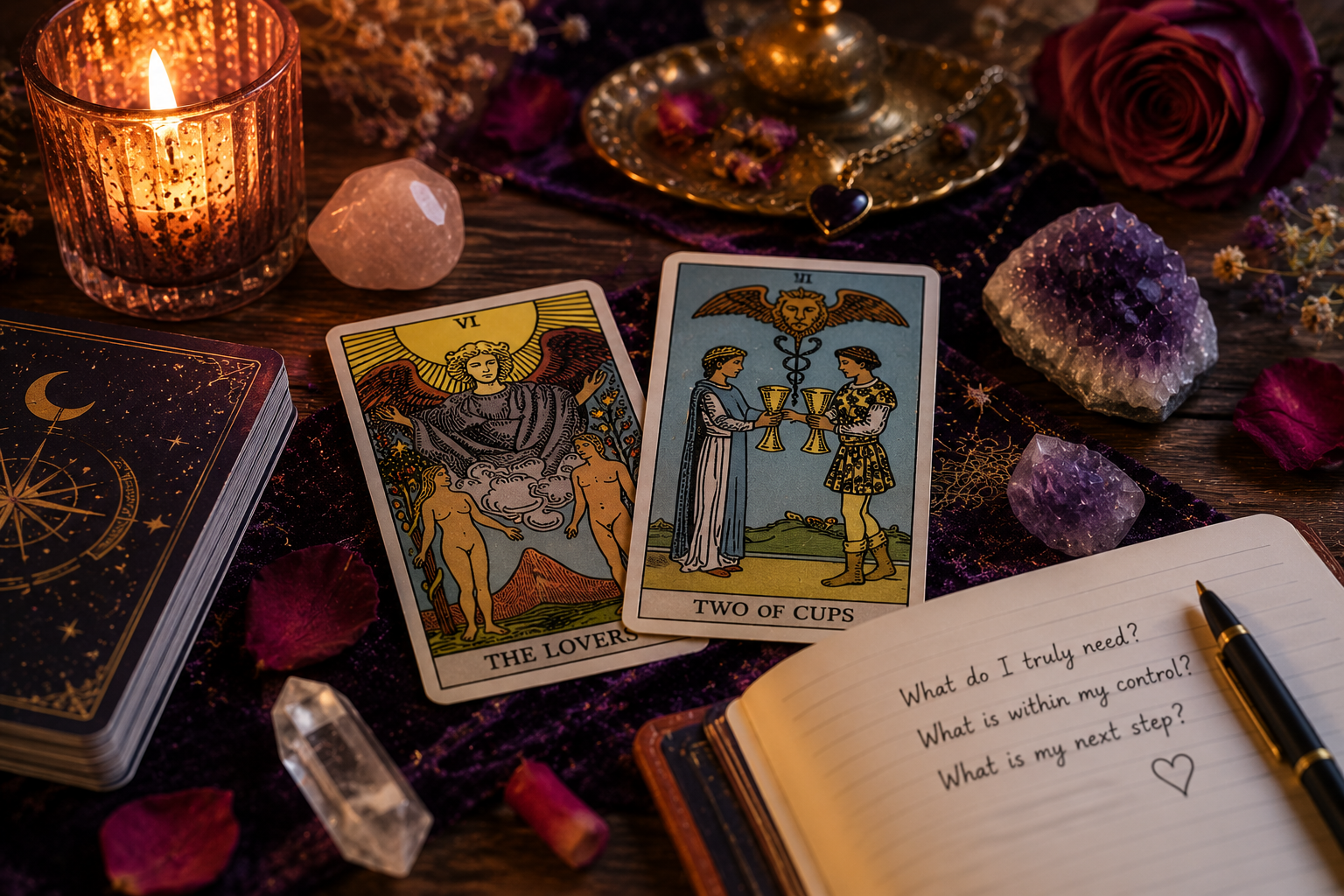
Have you ever felt completely confused about a relationship?
One day you feel hopeful. The next day you question everything.
You might find yourself wondering:
“Does this person actually care about me?”
“Am I overthinking this?”
“Should I wait or move on?”
“Why does this relationship feel so complicated?”
When emotions are intense, it can become difficult to separate what you genuinely feel from what you fear might happen.
This is where Tarot for relationship clarity can become a useful reflective practice.
Tarot cannot make another person love you, guarantee a particular relationship outcome, or replace honest communication. Instead, a thoughtful Tarot reading can help you slow down, examine your feelings, recognize patterns and ask better questions about what you actually need.
The goal isn’t simply to discover what will happen next.
The goal is to understand what is happening within you right now.
Why Relationships Can Feel So Confusing
Relationships rarely involve only one emotion.
You can love someone and still feel unhappy.
You can miss someone and still know the connection isn’t healthy.
You can feel attracted to someone while recognizing that your needs aren’t being met.
You can also experience genuine intuition alongside fear and overthinking.
When these emotions overlap, your mind naturally searches for certainty.
That’s why people often turn to Tarot repeatedly when they feel uncertain about love.
One reading may provide temporary reassurance.
Then another question appears.
And another.
Eventually, the reading itself can become part of the anxiety.
A healthier approach is to use Tarot as a reflection tool rather than a reassurance machine.
Can Tarot Really Help With Relationship Clarity?
Tarot can help you explore your own perspective on a relationship.
A card can act as a prompt that encourages you to think about:
- Your emotional needs
- Your expectations
- Your boundaries
- Communication
- Attachment patterns
- Fear
- Self-worth
- Repeating relationship patterns
- Choices available to you
For example, instead of asking:
“Will they text me tomorrow?”
you could ask:
“Why am I feeling so anxious about whether they contact me?”
The second question gives you something you can actually explore.
If you’re struggling to distinguish intuition from fear, your article Intuition or Anxiety? 7 Ways to Tell the Difference can help you explore that difference more deeply.
7 Tarot Questions for Relationship Clarity
1. What Am I Really Feeling About This Relationship?
This sounds simple, but it can be surprisingly difficult to answer.
Sometimes what we call love is a mixture of:
- Attachment
- Hope
- Attraction
- Loneliness
- Fear of losing someone
- Familiarity
- Emotional dependence
- Genuine affection
Pull one Tarot card and ask:
“What do I need to understand about my feelings?”
Before looking up the traditional meaning, study the card.
What emotion does the image create?
What part of the card catches your attention?
Does it remind you of something happening in your relationship?
Write down your first reaction.
Then compare it with the traditional interpretation.
This approach allows the reading to become a conversation with yourself rather than simply searching for a predetermined answer.
2. What Am I Not Seeing Clearly?
When you’re emotionally involved, you may focus heavily on one part of a situation.
For example, you might focus on:
“They said they care about me.”
while ignoring:
“Their actions have been inconsistent for months.”
Or you might focus on one difficult conversation while overlooking months of positive communication.
Ask your Tarot deck:
“What am I not seeing clearly in this situation?”
Pull one or three cards.
Then ask yourself:
Does this reveal something I have genuinely overlooked, or am I forcing the card to fit my fear?
That second question matters.
Tarot should encourage reflection, not confirmation of whatever you already believe.
3. What Relationship Pattern Am I Repeating?
Sometimes the most important relationship question isn’t:
“What are they going to do?”
It’s:
“Why do I keep ending up in situations that make me feel this way?”
You may notice patterns such as:
- Choosing emotionally unavailable people
- Becoming attached very quickly
- Ignoring red flags
- Overgiving
- Struggling to set boundaries
- Fear of abandonment
- Constantly seeking reassurance
- Confusing uncertainty with chemistry
Ask:
“What relationship pattern should I become more aware of?”
Then journal about the card.
If this question feels especially relevant, connect it with your existing article on Why You Keep Attracting Emotionally Unavailable Partners.
You can also explore same relationship patterns and how repeating emotional dynamics can influence the choices we make.
The important thing is not to blame yourself.
Recognizing a pattern is the first step toward changing it.
4. What Do I Actually Need From This Relationship?
Wanting someone isn’t the same as needing a healthy relationship with them.
Ask yourself:
What do I need to feel emotionally secure?
Maybe you need:
- Consistent communication
- Honesty
- Emotional availability
- Respect
- Commitment
- Space
- Affection
- Shared goals
- Clear boundaries
Pull a Tarot card and ask:
“What relationship need should I pay attention to?”
Then compare that need with your current reality.
This is where Tarot can become particularly useful.
Instead of asking whether another person will change, you begin asking whether the relationship you’re experiencing matches what you need.
5. What Boundary Needs My Attention?
Healthy relationships require boundaries.
A boundary isn’t a punishment.
It isn’t a threat.
And it isn’t an attempt to control someone.
A boundary communicates what you are and aren’t willing to accept.
For example:
“I need consistent communication.”
“I won’t continue a relationship where I’m repeatedly disrespected.”
“I need time to think before making this decision.”
Ask Tarot:
“What boundary do I need to understand or strengthen?”
Pull one card.
Then turn the reflection into a practical sentence.
For example:
Reflection: I may be giving too much while receiving very little.
Boundary: I need relationships where effort is mutual.
That is much more actionable than simply asking whether the relationship will survive.
6. What Is Within My Control?
This may be the most powerful question in a relationship Tarot reading.
You cannot control:
- Someone else’s feelings
- Someone else’s decisions
- Whether someone texts
- Whether someone commits
- Whether someone changes
- Whether someone chooses you
But you can influence:
- Your communication
- Your boundaries
- Your decisions
- Your behavior
- Your standards
- How you respond
- Whether you stay or leave
Ask:
“What is within my control right now?”
Pull one card.
Then write down three things you can realistically do.
This brings the reading back to your own agency.
7. What Is My Next Healthy Step?
Instead of asking Tarot to predict the entire future, narrow the question.
Ask:
“What is the healthiest next step I can take?”
That step might be:
- Having an honest conversation
- Taking some emotional space
- Setting a boundary
- Stopping constant checking
- Focusing on yourself
- Asking for clarity
- Giving the situation more time
- Accepting what someone’s actions are showing you
The card doesn’t have to give you a literal instruction.
Use it as a reflection prompt.
Then combine the reading with what you already know about the situation.
A 7-Card Tarot Spread for Relationship Clarity
If you’re dealing with a complicated relationship, try this spread.
Card 1 – My Feelings
What am I genuinely feeling?
Card 2 – Their Behavior
What should I objectively notice about the situation?
Card 3 – My Blind Spot
What am I struggling to see clearly?
Card 4 – My Pattern
What emotional or relationship pattern is being activated?
Card 5 – My Need
What do I need from a healthy relationship?
Card 6 – My Boundary
What boundary deserves attention?
Card 7 – My Next Step
What can I do to support my own emotional well-being?
Notice that this spread doesn’t ask:
“Will they come back?”
or:
“Are they secretly thinking about me?”
It focuses on questions that can actually help you make decisions.
Tarot Questions to Avoid When You’re Anxious
Tarot can become unhelpful when you use it repeatedly to obtain certainty.
Be careful with questions such as:
- “Will they text me tonight?”
- “Are they thinking about me right now?”
- “Did they see my message?”
- “Will they come back?”
- “Are they talking to someone else?”
- “Exactly when will they commit?”
- “Should I pull another card?”
If you keep asking the same question because the answer didn’t reassure you, the problem may no longer be the Tarot reading.
It may be anxiety seeking certainty.
Instead, pause.
Ask:
“What am I afraid will happen if I don’t know the answer?”
That question may reveal more than another card.
Tarot vs. Overthinking: Knowing When to Stop Pulling Cards
There’s a difference between reflection and repetition.
Healthy Tarot practice
You ask a question.
You reflect.
You journal.
You take action.
Then you give yourself space.
Anxiety-driven Tarot practice
You ask the same question repeatedly.
You search for a different answer.
You pull clarification after clarification.
You become more confused.
You check again.
If your reading leaves you more anxious every time, step away from the cards.
Your earlier article How to Stop Overthinking in a Relationship: 9 Ways to Find Clarity can naturally support readers who find themselves stuck in this cycle.
Sometimes clarity comes from not pulling another card.
How to Use Intuition Without Ignoring Reality
Intuition can be valuable, but intuition should not be confused with certainty.
You might have a strong feeling that something is wrong.
Instead of immediately deciding:
“My intuition says they’re lying.”
pause and ask:
What evidence do I actually have?
There may be a genuine concern.
There may also be fear from previous experiences.
The best approach is to consider both.
Your intuition can tell you:
“Something deserves my attention.”
Reality can help you determine:
“What exactly is happening?”
This is why combining Tarot with self-awareness can be more useful than treating every card as a prediction.
For readers interested in developing this skill, your How to Trust Your Intuition article can become the next step in the content journey.
When a Relationship Tarot Reading Feels Negative
Sometimes you pull a card that immediately scares you.
You see a difficult-looking card and think:
“Is this relationship doomed?”
Not necessarily.
A Tarot card doesn’t have to represent a fixed future.
A challenging card can instead encourage questions about:
- What needs attention?
- What needs to change?
- What am I avoiding?
- What am I learning?
- What choice is available to me?
For example, a difficult card might make you examine whether you’re holding onto something that no longer supports you.
Don’t automatically turn a challenging card into a prediction of heartbreak.
Look at the broader context.
How to Get More Accurate Relationship Tarot Readings
“Accurate” doesn’t necessarily mean predicting exactly what another person will do.
A more useful reading starts with a good question.
Be specific
Instead of:
“What will happen?”
ask:
“What should I understand about my current relationship dynamic?”
Avoid asking the same question repeatedly
Give yourself time to process a reading.
Write down your first impression
Your immediate response can reveal what the image brings up for you.
Separate facts from interpretations
Write:
Fact: They haven’t contacted me for three days.
Interpretation: They don’t care about me.
Those are not the same thing.
Consider the person’s actions
Words matter.
Actions matter too.
Keep your agency
A reading should help you understand your choices, not take your choices away.
How Tarot Can Help You Make Healthier Relationship Decisions
The most valuable relationship reading isn’t necessarily the one that predicts a happy ending.
It’s the one that helps you understand yourself more clearly.
You might realize:
“I’m staying because I’m afraid of being alone.”
Or:
“I keep waiting for potential instead of looking at reality.”
Or:
“I haven’t communicated what I actually need.”
Or:
“This relationship is triggering an old pattern.”
Those realizations can be powerful.
Tarot becomes useful when it helps you ask better questions and make more conscious decisions.
Tarot for New Relationships
You don’t have to wait until a relationship becomes complicated before using Tarot for reflection.
If you’ve recently met someone, try asking:
What am I genuinely attracted to?
What am I projecting onto this person?
What should I take time to learn about them?
What boundaries should I maintain?
Am I seeing this person as they are or as I hope they will become?
That last question can be particularly important.
Early attraction can sometimes encourage us to fill gaps in our knowledge with imagination.
Take your time.
Let someone’s behavior reveal who they are.
Tarot for Relationships After a Breakup
After a breakup, it can be tempting to ask:
“Will they come back?”
But consider asking:
“What am I learning from this relationship?”
Other helpful questions include:
- What am I still emotionally attached to?
- What do I need to release?
- What pattern should I avoid repeating?
- What did this relationship teach me?
- What do I need to rebuild within myself?
- What would a healthier relationship look like for me?
This shifts the focus from waiting for someone else to return toward understanding your own healing process.
A Simple 5-Minute Relationship Tarot Practice
You don’t need a complicated ritual.
Try this:
Step 1 – Take a pause
Put your phone away for five minutes.
Step 2 – Write the situation
Describe what is actually happening without adding assumptions.
Step 3 – Ask one question
For example:
“What do I need to understand right now?”
Step 4 – Pull one card
Study the image before checking the guidebook.
Step 5 – Write one action
Ask:
“What can I do with this insight?”
Then stop.
Don’t immediately pull five more cards.
Give yourself time to process.
When You Should Step Away From Tarot
There are moments when the best answer isn’t another reading.
Step away from Tarot if:
- You’re repeatedly checking the same question.
- You feel panicked after every reading.
- You’re using cards instead of communicating directly.
- You’re making major decisions solely because of a card.
- You’re constantly looking for signs.
- You’re unable to accept an answer unless it is positive.
- You’re using Tarot to monitor another person’s private thoughts.
Tarot should support your self-awareness-not replace it.
Final Thoughts
Tarot for relationship clarity isn’t about finding a magical card that tells you exactly who loves you, who will return or what will happen next.
It’s about asking questions that bring you closer to yourself.
When you’re confused about love, start with:
What am I feeling?
What am I not seeing?
What pattern am I repeating?
What do I need?
What boundary matters?
What is within my control?
What is my next healthy step?
These questions can transform a Tarot reading from a search for certainty into an opportunity for self-awareness.
You don’t need Tarot to decide your worth.
You don’t need a card to tell you that your needs matter.
And you don’t need to predict the entire future before taking your next step.
Sometimes, relationship clarity begins when you stop asking:
“What will they do?”
and start asking:
“What do I choose for myself?”
Frequently Asked Questions
Tarot can be used as a reflective tool to explore your feelings, expectations, patterns and choices. It shouldn’t be treated as a guaranteed prediction of another person’s behavior or feelings.
A useful question is: “What do I need to understand about this relationship right now?” Other helpful questions focus on your feelings, boundaries, needs, patterns and next steps.
Tarot can encourage you to reflect on a relationship, but it cannot verify another person’s private thoughts or feelings. Their communication and consistent behavior provide more reliable information.
There is no required number. Beginners can start with one card, while a three- or seven-card spread can provide more structure. More cards don’t automatically mean a more accurate reading.
You can explore your feelings about an ex through Tarot, but questions such as “What do I need to learn from this connection?” or “What should I focus on during my healing?” are generally more useful than repeatedly asking when someone will return.
Tarot may provide a structured way to reflect on emotions, but repeatedly pulling cards for reassurance can increase uncertainty. If you notice yourself asking the same question over and over, take a break and focus on grounded information and self-care.
Pay attention to whether you’re calmly noticing something or urgently searching for certainty. Tarot can be used as a prompt for reflection, while real-world evidence and direct communication can help you evaluate what is actually happening.
A Tarot reading shouldn’t be treated as a guaranteed prediction. Relationships involve the choices and actions of multiple people. Tarot is more useful when it helps you understand your own choices, needs and boundaries.





10 thoughts on “Tarot for Relationship Clarity: 7 Questions to Ask When You Feel Confused About Love”