

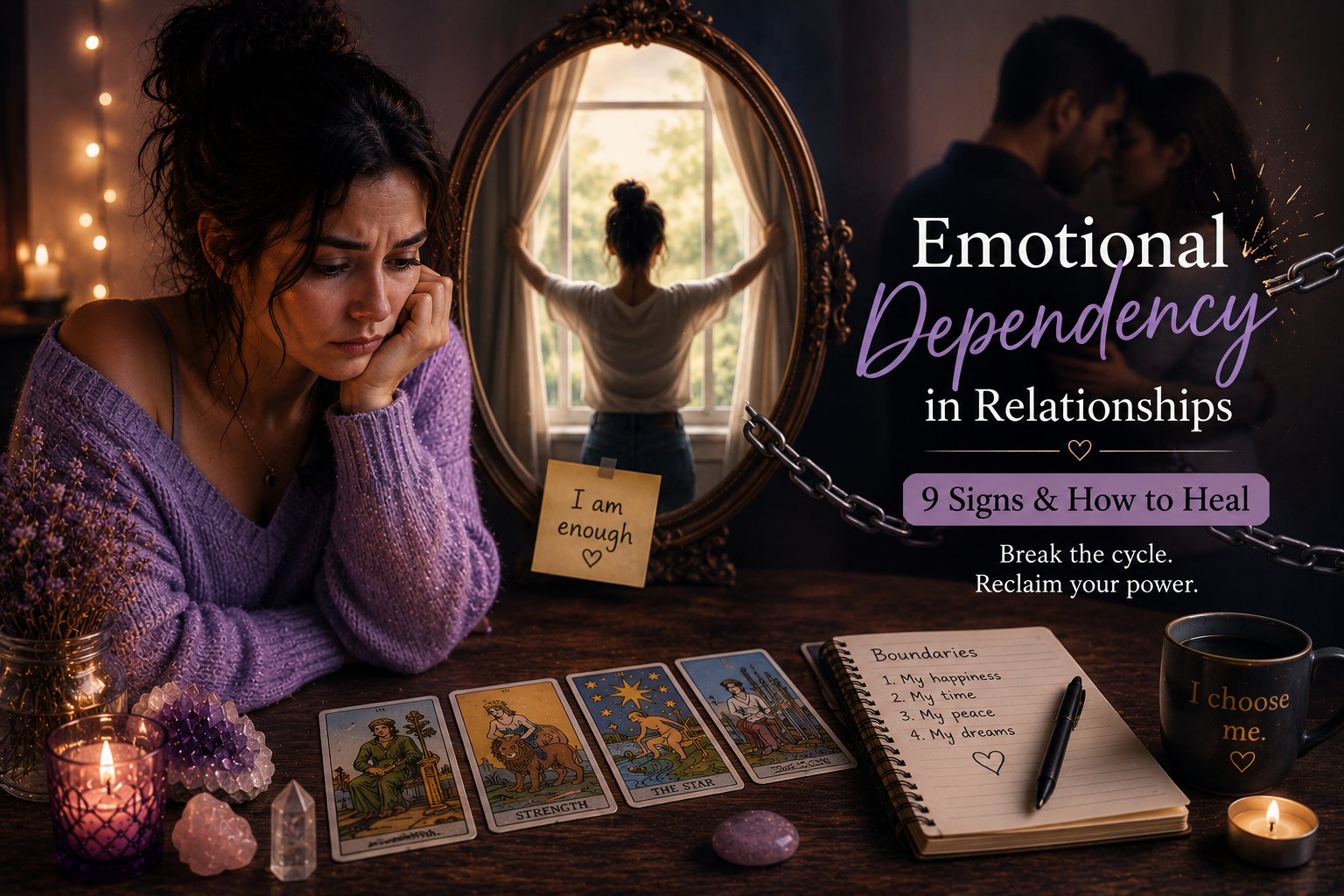
Have you ever felt like your entire mood depends on one person’s attention?
When they text, you feel happy.
When they become distant, you feel anxious.
When they reassure you, everything feels okay again.
But when they don’t respond, your mind starts creating stories.
“Are they losing interest?”
“Did I do something wrong?”
“What if they leave?”
“Why can’t I feel okay without them?”
This can be a sign of emotional dependency in relationships.
Emotional dependency doesn’t mean you love someone too much. Healthy relationships naturally involve emotional support. The concern begins when your sense of security, self-worth or emotional stability becomes heavily dependent on another person’s attention, approval or presence.
The goal isn’t to become cold or completely independent from your partner.
The goal is to learn how to love someone without losing yourself.
What Is Emotional Dependency in a Relationship?
Emotional dependency happens when you rely heavily on another person to regulate your emotions, reassure you, make you feel valuable or give your life a sense of meaning.
For example:
Your partner doesn’t reply.
You feel anxious.
You check your phone repeatedly.
You imagine something is wrong.
You finally receive a message.
Instant relief.
That relief can reinforce the cycle.
Over time, you may begin depending on your partner’s behavior to determine whether you feel:
- attractive
- loved
- safe
- important
- worthy
- secure
- happy
There’s an important difference between emotional support and emotional dependency.
Healthy emotional support
“I’m having a difficult day. I’d like to talk to my partner.”
Emotional dependency
“I cannot feel okay unless my partner makes me feel okay.”
That distinction matters.
Emotional Dependency vs Healthy Love
Being emotionally connected isn’t unhealthy.
In fact, relationships involve mutual support.
The difference is whether you still have a sense of yourself outside the relationship.
| Healthy Love | Emotional Dependency |
|---|---|
| You enjoy closeness | You fear distance |
| You trust your partner | You constantly need reassurance |
| You have your own interests | Your life revolves around the relationship |
| You can make decisions independently | You need their approval |
| You respect personal space | Distance feels like rejection |
| You can enjoy time alone | Being alone feels unbearable |
| You support each other | One person becomes responsible for your emotions |
| You maintain boundaries | You sacrifice boundaries to keep them |
Emotional dependence is generally understood as going beyond ordinary mutual support when a person relies on their partner for most or all emotional needs.
9 Signs of Emotional Dependency in Relationships
1. Your Mood Depends on Their Behavior
One of the clearest signs is emotional whiplash.
They text:
“Good morning ❤️”
You feel amazing.
They become quiet later.
Suddenly you feel unwanted.
Their behavior has become the remote control for your emotions.
A healthy relationship can influence your mood, but it shouldn’t completely control your sense of emotional stability.
2. You Constantly Need Reassurance
You might repeatedly ask:
- “Do you still love me?”
- “Are we okay?”
- “Are you sure?”
- “You’re not going to leave, right?”
- “Do you still want this relationship?”
The problem isn’t asking for reassurance occasionally.
Everyone needs reassurance sometimes.
The concern is when reassurance provides only temporary relief and you quickly need it again.
3. You Can’t Enjoy Your Time Alone
Ask yourself:
What happens when your partner isn’t available?
Do you:
- constantly check your phone?
- feel empty?
- become restless?
- cancel your own plans?
- wait for their message?
- struggle to focus?
Being comfortable alone is an important part of emotional independence.
You don’t have to love being alone every minute.
But you should know that you can still have a meaningful day without your partner being constantly available.
4. You Put Their Needs Above Your Own
You cancel plans.
You change your opinions.
You avoid difficult conversations.
You accept things that hurt you.
You keep saying:
“It’s okay.”
Even when it isn’t.
Why?
Because somewhere inside you may believe:
“If I make them unhappy, they might leave.”
This is where emotional dependency can overlap with fear of abandonment.
5. You Need Their Approval to Feel Good About Yourself
Maybe you feel attractive only when they compliment you.
You feel successful only when they approve of your decisions.
You question yourself whenever they disagree with you.
Your self-worth slowly becomes connected to their opinion.
But your partner’s approval should add to your confidence, not create it from nothing.
6. You Lose Interest in Your Own Life
Before the relationship, you had:
- friends
- hobbies
- goals
- routines
- interests
- personal ambitions
Then gradually everything became about the relationship.
Your world became smaller.
This is an important warning sign because emotional independence requires maintaining an identity outside your romantic connection. Current guidance on emotional dependency similarly emphasizes rebuilding individual interests, strengths and time alone.
7. You Overthink Every Change in Their Behavior
A short message becomes:
“They’re angry.”
A delayed reply becomes:
“They’re losing interest.”
A canceled plan becomes:
“They don’t care about me anymore.”
One small event becomes evidence for a much bigger story.
This is where emotional dependency can connect with relationship anxiety and overthinking.
8. You Are Afraid to Set Boundaries
You know something bothers you.
But you don’t say anything.
Why?
Because you’re scared that setting a boundary will make the other person leave.
This creates a dangerous equation:
“Keeping the relationship = keeping my needs silent.”
Healthy love doesn’t require you to disappear.
9. You Feel Like You Can’t Be Happy Without Them
This is perhaps the deepest sign.
You don’t simply want them.
You believe you need them to have a fulfilling life.
You may think:
“Nobody else will understand me.”
“I’ll never find someone like them.”
“My life has no meaning without this relationship.”
“I can’t imagine being alone.”
These thoughts can feel completely real during emotional distress.
But a relationship should become part of your life, not the entire foundation of your identity.
Why Does Emotional Dependency Happen?
There isn’t one single reason.
It can develop through different experiences and patterns, including:
Fear of abandonment
You may constantly worry that someone will leave.
Low self-worth
You may rely on another person’s approval to feel valuable.
Previous relationship experiences
Betrayal, rejection or inconsistent relationships can affect how safe closeness feels.
Difficulty being alone
If solitude feels like emptiness, you may seek another person to fill that emotional space.
Anxious attachment patterns
You may become particularly sensitive to changes in closeness and distance.
Losing yourself in relationships
When your identity becomes too closely connected to another person, separation can feel frightening.
None of these automatically mean something is “wrong” with you.
They’re patterns that can be understood and changed.
Emotional Dependency and Anxious Attachment
These concepts are related but shouldn’t be treated as identical.
Anxious attachment refers to a broader pattern around emotional closeness, security and relationships.
Emotional dependency focuses more specifically on relying heavily on another person for emotional stability, validation or fulfillment.
They can occur together.
For example:
“They haven’t replied.”
↓
“Maybe they’re losing interest.”
↓
“I need to know they still love me.”
↓
Reassurance.
↓
Temporary relief.
↓
The cycle begins again.
If this feels familiar, read:
anxious attachment in relationships
and your existing article can sit naturally here.
Emotional Dependency vs Fear of Abandonment
These are also different.
| Fear of Abandonment | Emotional Dependency |
|---|---|
| Fear that someone will leave | Reliance on someone for emotional stability |
| Focuses on possible loss | Focuses on emotional needs |
| Can trigger anxiety | Can lead to reassurance-seeking |
| May exist without dependency | Often involves strong emotional reliance |
| Can influence relationship behavior | Can influence identity and independence |
They can reinforce each other.
You may become emotionally dependent because you’re terrified of losing someone.
And the more dependent you become, the more frightening the possibility of losing them feels.
How to Stop Being Emotionally Dependent in a Relationship
The answer isn’t:
“Stop caring.”
It’s:
“Start caring for yourself too.”
1. Identify What You’re Getting From the Relationship
Ask:
What do I expect this person to give me emotionally?
Maybe it’s:
- validation
- security
- confidence
- companionship
- reassurance
- motivation
- self-worth
Now ask:
Which of these can I begin developing within myself?
2. Rebuild Your Own Routine
Create parts of your day that belong only to you.
For example:
Morning: exercise or meditation
Afternoon: work or study
Evening: hobby or friends
Night: journaling or reading
The goal isn’t to create distance from your partner.
It’s to create balance.
3. Spend Time Alone Without Escaping Into Your Phone
Try going for a walk.
Read.
Journal.
Cook.
Watch a movie.
Visit a café.
Practice meditation.
Do something simply because you enjoy it.
Learning that you can experience peace without constant external validation is a powerful step toward emotional independence.
4. Stop Checking for Reassurance
Before checking their:
- last seen
- online status
- social media
- likes
- followers
- activity
ask:
“What am I hoping to find?”
Usually, you’re looking for certainty.
But checking often creates more questions.
Instead, practice tolerating a little uncertainty.
5. Strengthen Your Self-Worth
Write down:
5 things you like about yourself
5 things you’re good at
5 things you’ve survived
5 goals unrelated to your relationship
This sounds simple.
But the purpose is important.
You’re reminding yourself:
“I am a whole person outside this relationship.”
6. Maintain Your Friendships
Your partner shouldn’t have to become your:
best friend + therapist + social circle + emotional regulator + entire world.
Healthy relationships allow space for other meaningful connections.
Call a friend.
Meet family.
Join a class.
Build community.
Your emotional world becomes stronger when it isn’t supported by only one person.
7. Learn to Communicate Instead of Testing
Don’t do:
“I’ll ignore them and see if they chase me.”
Don’t post something just to make them jealous.
Don’t intentionally create distance to test their love.
Instead say:
“I’ve been feeling insecure lately, and I’d like to talk about it.”
Direct communication creates clarity.
Tests create confusion.
8. Learn the Difference Between Need and Preference
This is a powerful exercise.
Need
“I need respect.”
Preference
“I prefer that you reply quickly.”
Those are not the same.
You can have preferences without making them proof of someone’s love.
9. Build Emotional Self-Trust
Instead of asking:
“What should I do?”
every time something happens, first ask:
“What do I think?”
Then:
“What do I feel?”
Then:
“What do I actually know?”
And finally:
“What choice respects me?”
This creates emotional independence without emotional isolation.
Can Tarot Help With Emotional Dependency?
Tarot shouldn’t replace psychological care or be used to diagnose emotional dependency.
But it can be a useful self-reflection practice.
Instead of asking:
❌ “Does my partner secretly love me?”
try asking:
✅ “Why am I seeking reassurance right now?”
Instead of:
❌ “Will they leave me?”
ask:
✅ “What fear is being triggered?”
Instead of:
❌ “Are they my soulmate?”
ask:
✅ “What does this relationship teach me about myself?”
That changes Tarot from a tool for constant reassurance into a tool for self-awareness.
7-Card Tarot Spread for Emotional Independence
| Card | Question |
|---|---|
| 1 | What am I emotionally dependent on? |
| 2 | What fear is underneath this dependency? |
| 3 | What am I seeking from my partner? |
| 4 | What can I give myself? |
| 5 | What boundary do I need? |
| 6 | What part of myself have I neglected? |
| 7 | What would emotional independence look like? |
This type of spread fits perfectly into The Astro Palace’s Tarot + Psychology + Emotional Healing content strategy.
Tarot Cards That Can Encourage Self-Reflection
The Devil
Can invite reflection on attachment, unhealthy patterns and feeling stuck.
The Lovers
Can raise questions about conscious choices, values and relationship decisions.
Strength
Can represent inner courage, emotional regulation and self-control.
Queen of Swords
Can encourage honesty, boundaries and clear thinking.
The Hermit
Can symbolize solitude, introspection and reconnecting with yourself.
The Star
Can represent hope, healing and rebuilding faith in yourself.
The Empress
Can encourage nurturing yourself rather than constantly seeking external validation.
These are reflective interpretations, not predictions or psychological diagnoses.
Emotional Dependency Can Make You Ignore Red Flags
One of the biggest problems is that dependency can make you focus on:
“How do I keep them?”
instead of:
“Is this relationship actually healthy for me?”
Ask yourself:
- Do I feel respected?
- Can I express disagreement?
- Are my boundaries accepted?
- Do I feel emotionally safe?
- Can I be myself?
- Is affection consistent?
- Do I feel free to have my own life?
Love shouldn’t require you to constantly prove your worth.
Emotional Independence Doesn’t Mean Becoming Cold
This is important.
You don’t need to become someone who says:
“I don’t need anyone.”
That’s not necessarily independence.
A healthier goal is:
“I can love you deeply, receive support from you and still know who I am without you.”
That’s closer to interdependence.
Two people can support each other without one person becoming responsible for the other’s entire emotional world.
A Simple 7-Day Emotional Independence Challenge
Day 1 – Notice
Write down when you seek reassurance.
Day 2 – Pause
Wait 20 minutes before reacting to an emotional trigger.
Day 3 – Alone Time
Spend 30 minutes doing something without your partner.
Day 4 – Self-Worth
Write five qualities you value about yourself.
Day 5 – Connection
Talk to a friend or family member.
Day 6 – Boundary
Identify one boundary you’ve been avoiding.
Day 7 – Reflect
Ask:
“What did I learn about myself this week?”
Small changes repeated consistently can become meaningful patterns.
Quick Self-Check
Answer honestly:
| Question | Yes / No |
|---|---|
| Does my mood depend heavily on my partner? | |
| Do I constantly need reassurance? | |
| Do I struggle to enjoy time alone? | |
| Have I stopped doing things I enjoy? | |
| Do I need their approval for important decisions? | |
| Am I afraid to set boundaries? | |
| Do I constantly check their activity? | |
| Do I fear being alone more than being unhappy? | |
| Do I feel incomplete without them? |
If many answers are yes, don’t immediately label yourself.
Instead ask:
“What emotional need am I trying to meet through this relationship?”
That’s the more useful question.
Frequently Asked Questions
1. Is emotional dependency the same as love?
No. Love involves emotional connection and mutual support. Emotional dependency becomes concerning when your emotional stability, self-worth or sense of fulfillment relies heavily on another person.
2. How do I know if I’m emotionally dependent on my partner?
Look at what happens when they aren’t available. If their absence consistently causes intense distress, reassurance-seeking or a feeling that you cannot function normally without them, it may be worth examining your level of emotional dependence.
3. Can you be emotionally dependent and still have a healthy relationship?
A relationship can contain some dependent behaviors without the entire relationship being unhealthy. What matters is whether the pattern consistently damages your independence, boundaries, self-worth or relationship functioning.
4. How do I stop being emotionally dependent?
Start by rebuilding your own routines, friendships, hobbies and self-worth. Learn to tolerate uncertainty, make independent decisions and communicate your needs directly.
5. Can emotional dependency be caused by fear of abandonment?
It can be connected. Fear of being left may increase reassurance-seeking and dependence on a partner for emotional security.
6. Is needing your partner normal?
Yes. Healthy relationships involve mutual emotional support. The issue isn’t needing support; it’s feeling unable to regulate your emotions, make decisions or feel valuable without the other person.
7. Can Tarot help with emotional dependency?
Tarot can be used as a reflective practice to explore emotions, relationship patterns, boundaries and self-awareness. It shouldn’t be treated as a substitute for professional mental-health support or as a way to prove another person’s thoughts or intentions.
8. When should I seek professional help?
If relationship anxiety or emotional dependency is causing significant distress, affecting daily functioning, or making it difficult to maintain healthy boundaries, speaking with a qualified mental-health professional can be a useful step.
Final Thoughts
The goal of emotional healing isn’t to stop needing people.
It’s to stop believing that one person is responsible for making you whole.
You can love someone and still have your own life.
You can miss someone without losing yourself.
You can want reassurance without needing it every hour.
You can enjoy closeness while still being comfortable with your own company.
And you can choose someone because you genuinely love them—not because you’re terrified of being without them.
The most powerful shift is from:
“I need you so I can feel okay.”
to:
“I am okay within myself, and I choose to share my life with you.”
That’s not less love.
That’s healthier love.
3 thoughts on “Emotional Dependency in Relationships: 9 Signs & How to Become Emotionally Independent”