


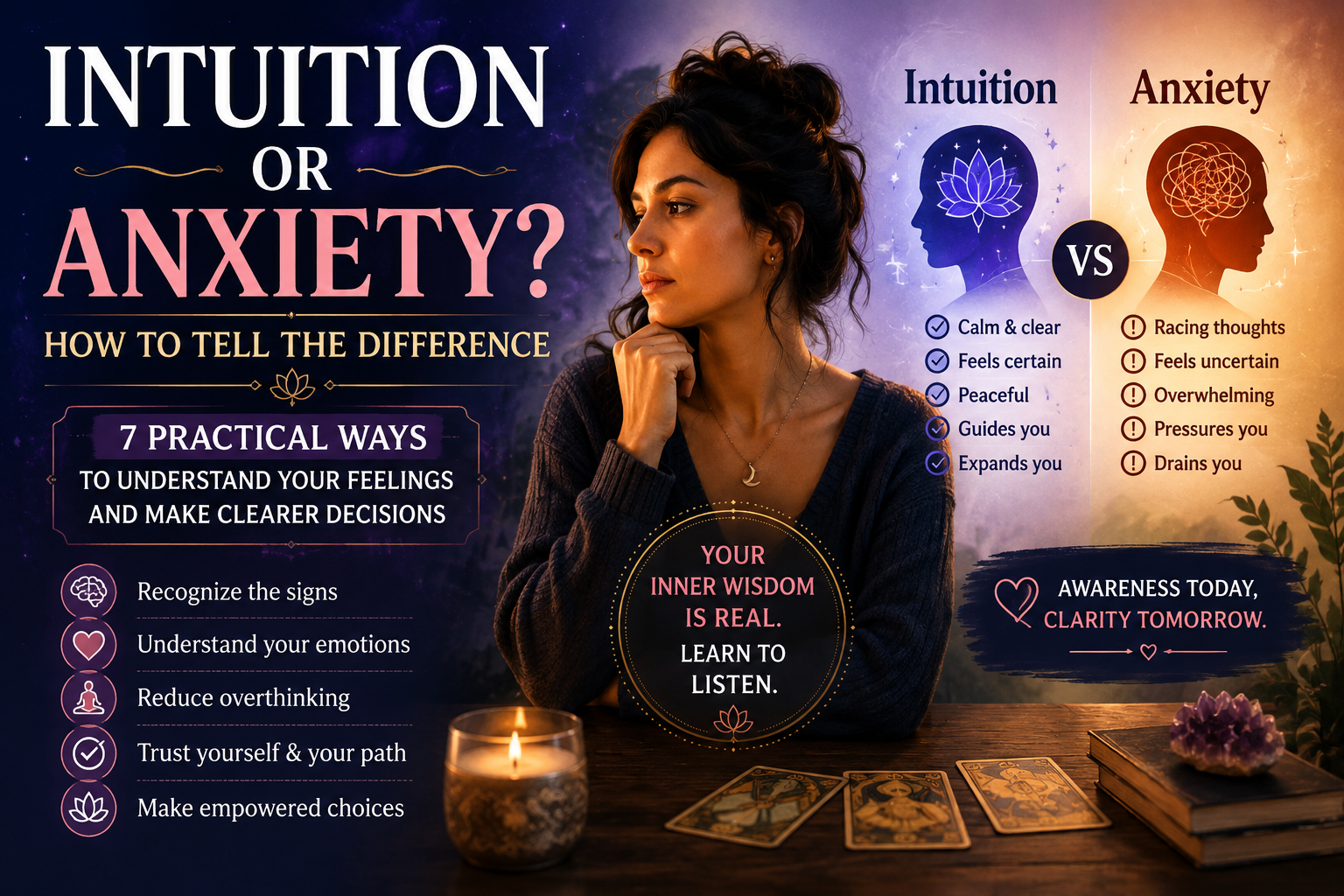
Have you ever had a strong feeling about a person or situation and wondered, “Is this intuition or anxiety?”
Maybe something feels wrong in a relationship.
Maybe you suddenly feel that you shouldn’t take a particular opportunity.
Perhaps you keep getting the feeling that something is going to happen, but you don’t know whether you’re picking up on something real or simply worrying about what could go wrong.
This can be incredibly confusing.
Intuition or anxiety can sometimes feel very similar, especially when you are emotionally invested in a situation. Both can affect your thoughts, emotions and body. Both can appear before you have fully understood what is happening.
However, there is an important difference.
You don’t have to blindly trust every feeling, but you also don’t have to dismiss every gut feeling as anxiety.
The goal is to learn how to pause, investigate and understand what your feeling may be responding to.
In this guide, we’ll explore seven practical ways to tell the difference between intuition and anxiety, how this confusion can affect relationships, and how Tarot can be used as a reflective tool without allowing a reading to replace your own judgment.
What Is Intuition?
Intuition is often described as a feeling of knowing something without consciously working through every piece of information.
Psychologically, it can sometimes be understood as your mind recognizing patterns from previous experiences and subtle information before you’re able to explain the conclusion logically.
For example, you may notice that someone’s words and behavior don’t quite match.
You might not immediately know why.
You simply think:
“Something doesn’t feel right.”
That doesn’t automatically mean your intuition is correct.
Instead, it may be a signal to pay closer attention and gather more information.
This distinction is important.
Intuition should not automatically become a prediction.
What Is Anxiety?
Anxiety tends to focus on possible threats and uncertainty.
It often asks:
- What if something goes wrong?
- What if they leave me?
- What if I make the wrong decision?
- What if I’m missing something?
- What if something bad happens?
- What if I regret this later?
The problem isn’t that these questions exist.
The problem is when your mind keeps generating more questions without reaching a useful conclusion.
Anxiety can push you toward repeated checking, reassurance-seeking, avoidance and overthinking. Current clinical guidance also notes that anxiety can create urgency and a strong desire for immediate relief, making it harder to distinguish worry from a useful internal signal.
Why Do Intuition and Anxiety Feel So Similar?
This is where things become confusing.
Both can appear as:
- A gut feeling
- A sudden thought
- Physical tension
- Hesitation
- A feeling that something is “off”
- A strong desire to move toward or away from something
- Uncertainty about what to do
For example, imagine your partner doesn’t reply for several hours.
You might suddenly think:
“Something is wrong.”
That thought could come from several places.
Perhaps you’ve noticed a genuine pattern of inconsistent communication.
Or perhaps previous heartbreak has made you highly alert to signs of rejection.
Or perhaps you’re simply having an anxious day.
The feeling itself doesn’t automatically tell you which explanation is correct.
That’s why context matters.
7 Ways to Tell the Difference Between Intuition and Anxiety
1. Ask: Is There Evidence Behind the Feeling?
Start with the facts.
Suppose someone you’re dating has become distant.
Instead of immediately deciding:
“They are losing interest.”
ask:
What have I actually observed?
Maybe:
- Their replies have become shorter.
- They have cancelled several plans.
- They stopped initiating conversations.
- You’ve already discussed the change with them.
That’s different from:
“They haven’t replied for three hours, so they must not love me anymore.”
The first situation contains observable patterns.
The second may contain a large assumption based on one event.
Therefore, before calling something intuition, look at the evidence around it.
2. Notice Whether Your Mind Is Creating Endless “What If” Questions
One of the clearest signs of anxiety is repetitive hypothetical thinking.
It might begin with:
“What if they don’t love me?”
Then:
“What if they’re talking to someone else?”
Then:
“What if they leave?”
Then:
“What if I never find anyone again?”
Soon, you’re dealing with an entire future that hasn’t happened.
Intuition doesn’t need to provide a complete explanation.
A feeling might simply tell you:
“Pay attention to this.”
Anxiety often demands:
“Figure everything out right now.”
That difference can be useful to notice.
3. Check Whether You Are Seeking Certainty
Ask yourself:
“Am I trying to understand this situation, or am I trying to become 100% certain?”
Complete certainty is rarely possible.
You cannot know exactly what another person is thinking.
You cannot guarantee that a relationship will last.
You cannot predict every future outcome.
If your mind keeps demanding another answer, another Tarot card, another conversation, another Google search or another reassurance message before you can feel okay, you may be caught in a certainty-seeking loop.
Instead, try asking:
“What is the next useful piece of information I need?”
That question is much easier to answer.
4. Give the Feeling Time
Not every decision needs an immediate answer.
If you feel overwhelmed, pause.
Take a walk.
Journal.
Sleep on it.
Talk to someone you trust.
Return to the situation when you’re calmer.
This doesn’t mean ignoring your intuition.
It means giving yourself enough space to distinguish a lasting concern from a temporary emotional reaction.
A useful question is:
“Does this concern still make sense when I feel calmer?”
If the answer is yes, investigate it.
If the thought disappears once the emotional intensity settles, you may have been responding primarily to a temporary fear.
5. Look for Patterns Instead of One Moment
This is particularly important in relationships.
One late message doesn’t tell you everything about a person.
One disagreement doesn’t define a relationship.
One awkward conversation doesn’t automatically mean something is wrong.
Patterns tell you more.
Ask:
- Does this happen repeatedly?
- Do their actions match their words?
- Have I noticed the same behavior before?
- Have I communicated my concern?
- Did anything change afterward?
For example, if someone consistently avoids important conversations despite repeated attempts to communicate, that pattern deserves attention.
Your intuition may be drawing your attention to something that your conscious mind hasn’t fully processed yet.
6. Notice What the Feeling Is Asking You to Do
This doesn’t mean that calm feelings are always intuition and anxious feelings are always wrong.
That’s too simple.
Instead, notice the behavioral urge behind the feeling.
Does it encourage you to:
Investigate?
or
React immediately?
Does it encourage you to:
Have a conversation?
or
Check someone’s phone/social media repeatedly?
Does it encourage you to:
Set a boundary?
or
Seek reassurance again and again?
Anxiety often pushes people toward actions that provide quick relief, such as checking, avoiding or repeatedly asking for reassurance.
That doesn’t mean the concern itself is imaginary.
It means the response may be driven by anxiety.
7. Ask What Your Past Experiences Might Be Adding
Sometimes the present situation is not the only thing you’re responding to.
Your past can influence your present.
For example, if someone previously betrayed your trust, you may become more alert to changes in behavior in future relationships.
That’s understandable.
However, your past experience can sometimes make your brain interpret a neutral situation as a warning.
Ask yourself:
“Is this feeling about what is happening now, or is something from my past being activated?”
This question doesn’t mean your feeling is wrong.
It simply gives you more information.
Intuition vs Anxiety: A Simple Comparison
| Intuition | Anxiety |
|---|---|
| May point your attention toward something | Often focuses on possible threats |
| Can coexist with uncertainty | Often wants certainty immediately |
| May encourage investigation | Often encourages repeated checking |
| Can be connected to patterns you’ve noticed | Can be driven by fear or past experiences |
| Doesn’t always require immediate action | Often creates urgency |
| Can become clearer with more information | May become louder through rumination |
Remember: this is a guide, not a diagnostic test.
Human emotions are more complicated than a simple “intuition = calm, anxiety = fear” formula.
What If Your Intuition Is Actually Warning You About a Relationship?
This is where you should avoid two extremes.
Extreme 1:
“My intuition says something is wrong, so I must leave immediately.”
Extreme 2:
“It’s probably anxiety, so I should ignore my feelings.”
Neither approach is necessarily helpful.
Instead:
Step 1 — Notice the feeling
What exactly feels wrong?
Step 2 — Identify the trigger
What happened immediately before you felt this way?
Step 3 — Check the evidence
What facts support your concern?
Step 4 — Look for patterns
Has this happened repeatedly?
Step 5 — Communicate
If appropriate, ask the person directly.
Step 6 — Observe their response
Do they listen?
Do they dismiss you?
Do they explain?
Do their actions change?
This process gives you something much more valuable than instant certainty:
clarity based on both feelings and reality.
How Overthinking Can Make Intuition Harder to Hear
If you already struggle with overthinking, you may find this especially difficult.
One thought becomes ten.
Ten become fifty.
Eventually, you can’t tell which thought started the entire process.
For example:
“Something feels different.”
becomes:
“They’re acting differently.”
then:
“Maybe they don’t love me.”
then:
“Maybe they’re interested in someone else.”
then:
“Maybe the relationship is over.”
then:
“What am I going to do?”
This is why your previous article, How to Stop Overthinking in a Relationship, can naturally be connected here.
The goal isn’t to stop thinking.
It’s to stop allowing one uncertain thought to create an entire story without evidence.
Can Tarot Help You Tell Intuition From Anxiety?
Tarot can be useful as a reflection tool, but it shouldn’t be treated as a machine that confirms whether your anxiety is correct.
For example, instead of asking:
“Is my partner cheating?”
a more reflective Tarot question might be:
“What am I not seeing clearly about this situation?”
Or:
“What fear is influencing my perception?”
Or:
“What boundary do I need to consider?”
Or:
“What should I focus on for my own emotional growth?”
This approach makes Tarot part of a larger process of self-reflection.
The cards don’t have to make the decision for you.
They can help you slow down, ask better questions and consider perspectives you may not have considered.
A 5-Minute Intuition vs Anxiety Exercise
The next time you’re confused, take a piece of paper and write:
1. What happened?
Write only the facts.
2. What am I feeling?
Name the emotion.
3. What am I afraid might happen?
Write the fear.
4. What evidence do I have?
Separate evidence from assumptions.
5. What information am I missing?
Think about what you don’t know yet.
6. What is one healthy action I can take?
Maybe it’s:
- Waiting
- Communicating
- Setting a boundary
- Gathering more information
- Taking care of yourself
- Asking for support
This simple process can help move you from reaction → reflection → action.
When You Should Seek Professional Support
Sometimes anxiety can become overwhelming and interfere with daily life.
If worry, intrusive thoughts, panic, compulsive checking or reassurance-seeking are significantly affecting your relationships, sleep, work or wellbeing, consider speaking with a qualified mental-health professional.
Tarot and spiritual practices can be used for personal reflection, but they should not replace appropriate professional care.



9 thoughts on “Intuition or Anxiety? 7 Ways to Tell the Difference”